
Executive communication · 9 min read · June 2, 2026
The executive presence trap and where the real leverage is

Every few weeks, an accomplished leader tells me some version of the same story:
“My boss says I need more executive presence before the next promotion. But when I ask what that means, nobody can tell me.”
They are right to be frustrated. They have been handed a destination with no map. So let me offer what the feedback-giver usually cannot: a clear-eyed look at what executive presence actually is, what it is not, and where the evidence says your development effort will actually pay off.
Executive presence is real, the way curb appeal is real
Here is the uncomfortable truth about executive presence: it is socially real and scientifically hollow at the same time.
Socially real, because promotion decisions genuinely turn on it. When Sylvia Ann Hewlett surveyed senior executives, they attributed 26% of what it takes to get promoted to executive presence, a finding she replicated a decade later in her updated research. Whether or not the construct holds up in a lab, the people deciding your career believe in it. Dismissing it entirely would be like a realtor dismissing curb appeal: the buyer’s impression may be superficial, but the sale still depends on it.
Scientifically hollow, because when researchers go looking for executive presence as a measurable quality inside the leader, it dissolves. The most rigorous study to date, Dagley and Gaskin’s 2014 article in Consulting Psychology Journal, interviewed professionals who had assessed thousands of executives and concluded that presence is located “in the perceptions of audience members rather than being something inherent in the executive.” There is no validated instrument to measure it, no controlled trial showing it can be trained, and the definition is partly circular: we say someone “has presence” because people pay attention to them, which is simply what presence means.
There is a sharper problem still. Research on charisma attribution shows that audiences bestow these judgments partly as a reward for embodying the group’s shared identity, being “one of us,” rather than for matching an abstract leader ideal. In elegant experiments, Platow and colleagues found that leaders described with in-group-typical traits were rated more charismatic than objectively more “leader-like” candidates, before doing anything at all. Tellingly, Dagley and Gaskin noted that the majority of executives described as having presence were men. Some of what gets labelled “presence,” in other words, is a measure of resemblance, not of capability. If you have ever received vague presence feedback you suspected had more to do with the mould than with you, the research is on your side.
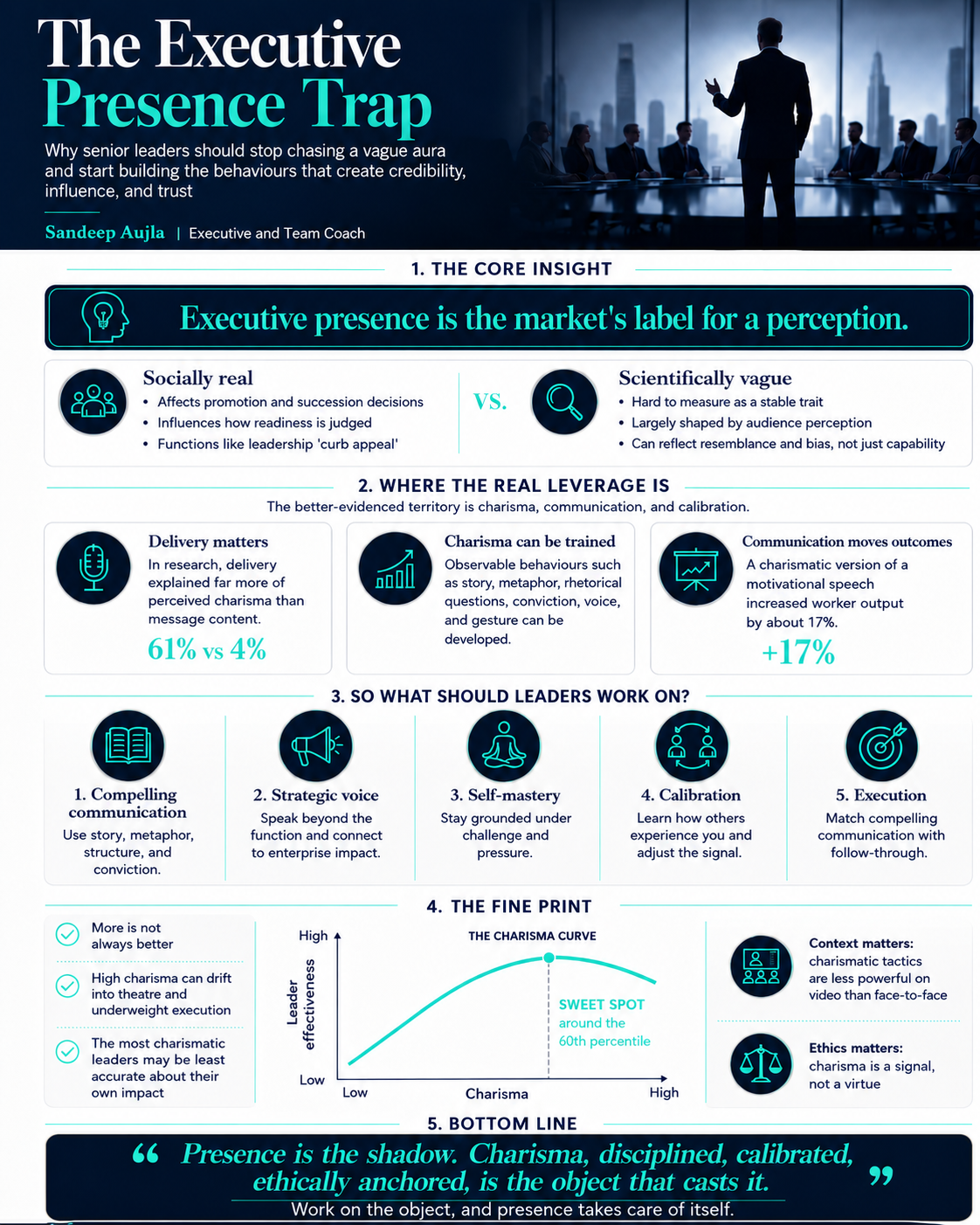
So when a prospect asks me for executive presence coaching, my first move is a reframe: executive presence is the market’s label for a perception. The science of charisma tells us what actually produces that perception, and that is where the leverage lives.
The construct hiding inside the buzzword
Strip away the mystique and charisma turns out to be one of the better-evidenced territories in leadership science. Three findings matter most.
First, the perception is manufactured by specific, observable behaviours. In a classic experiment, Holladay and Coombs had audiences watch a leader deliver either a visionary or a mundane message, with either strong or weak delivery. Delivery explained 61% of the variance in how charismatic the leader was judged to be. The visionary content? Four percent.
Second, those behaviours can be trained. John Antonakis and colleagues at the University of Lausanne identified a concrete toolkit: metaphors and stories, rhetorical questions, three-part lists, expressions of moral conviction, animated voice and gesture, and tested it experimentally. Managers randomly assigned to the training were subsequently rated significantly more charismatic and more leader-like by their own co-workers, with a meaningful effect size. Follow-up work found the training shifted how much observers saw women as prototypical leaders, a practical partial antidote to the resemblance bias above.
Third, and this is the finding that separates charisma from mere impression management, it moves real outcomes. In a field experiment published in Management Science, workers who heard a charismatic version of a motivational speech produced roughly 17% more output than those who heard a standard version, an effect comparable to offering financial incentives. Words, delivered well, competed with money.
So is charisma a skill?
Honest answer: it is a set of skills riding on a disposition.
Charisma has a stable trait component. Tskhay and colleagues showed it can be measured as an individual difference, visible to strangers within five minutes of interaction. Your baseline is partly given, like a singing voice. But nobody concludes from the existence of natural timbre that voice lessons are pointless. The signalling behaviours that generate charisma attributions are demonstrably learnable, and the experiments above measured gains in ordinary managers, not born performers.
When charisma becomes too much of a good thing
I practice evidence-informed coaching, which raises three caveats you should be aware of.
More is not better. Across roughly 800 leaders and 7,500 of their raters, Vergauwe and colleagues found that perceived effectiveness rises with charisma only up to about the 60th percentile, just above average, then declines. Highly charismatic leaders drift toward big-picture theatre and neglect operational follow-through. Activation without implementation, in other words: a decision made but not delivered is a dream deferred. Worse, their self-ratings keep climbing while everyone else’s ratings fall: the most charismatic leaders were the least accurate about their own impact.
Context moderates everything. A five-country meta-analysis found that charismatic tactics that worked powerfully face-to-face had near-zero effects on video calls. If much of your leadership happens on screens, delivery-heavy coaching alone will underdeliver. Substance, structure, and follow-through carry more of the weight there.
Charisma is ethically neutral. It is, as evolutionary researchers put it, a signal, and signals can be faked. The same toolkit that mobilizes a team can also mobilize a mob or the team that built Enron. That is precisely why serious development pairs the skills with self-awareness and an ethical anchor: charisma in service of the mission, not of the ego.
The choice in front of you
If you came looking for executive presence, here is the menu the evidence actually supports.
You can learn the signalling skills: story, metaphor, conviction, delivery, and structure, with well-documented effects on how leader-like you are perceived to be. In my Trusted Leadership Model, this is the work of Compelling Communication: messages that do not just inform, but ignite.
You can calibrate the signal, building the Self-Mastery to see yourself as others see you and engineering the feedback loops that keep you honest about where you sit on the curve.
You can add the Adaptive Discipline of execution if you are charisma-rich, or develop strategic voice if you are charisma-light.
Or you can invest primarily in substance and consciously let perception lag, a defensible choice in cynical or virtual environments where charisma’s returns are thinnest.
What you cannot usefully do is chase “presence” as a vague aura.
Work on the object, and presence takes care of itself: you become believed for your vision, trusted for your leadership, and sought after for your wisdom.
Impressions fade the moment you leave the room. Enduring trust is built using ethically anchored charisma.
References
- Antonakis, J., d’Adda, G., Weber, R. A., & Zehnder, C. (2022). “Just words? Just speeches?” On the economic value of charismatic leadership. Management Science, 68(9), 6355–6381. https://doi.org/10.1287/mnsc.2021.4219
- Antonakis, J., Fenley, M., & Liechti, S. (2011). Can charisma be taught? Tests of two interventions. Academy of Management Learning & Education, 10(3), 374–396. https://doi.org/10.5465/amle.2010.0012
- Dagley, G. R., & Gaskin, C. J. (2014). Understanding executive presence: Perspectives of business professionals. Consulting Psychology Journal: Practice and Research, 66(3), 197–211. https://doi.org/10.1037/cpb0000011
- Ernst, B. A., Banks, G. C., Loignon, A. C., Frear, K. A., Williams, C. E., Arciniega, L. M., Gupta, R. K., Kodydek, G., & Subramanian, D. (2022). Virtual charismatic leadership and signaling theory: A prospective meta-analysis in five countries. The Leadership Quarterly, 33(5), Article 101541. https://doi.org/10.1016/j.leaqua.2021.101541
- Grabo, A., Spisak, B. R., & van Vugt, M. (2017). Charisma as signal: An evolutionary perspective on charismatic leadership. The Leadership Quarterly, 28(4), 473–485. https://doi.org/10.1016/j.leaqua.2017.05.001
- Hewlett, S. A. (2014). Executive Presence: The Missing Link Between Merit and Success. HarperBusiness.
- Hewlett, S. A. (2024, January–February). The new rules of executive presence. Harvard Business Review, 102(1), 60–67. https://hbr.org/2024/01/the-new-rules-of-executive-presence
- Holladay, S. J., & Coombs, W. T. (1994). Speaking of visions and visions being spoken: An exploration of the effects of content and delivery on perceptions of leader charisma. Management Communication Quarterly, 8(2), 165–189. https://doi.org/10.1177/0893318994008002002
- Platow, M. J., van Knippenberg, D., Haslam, S. A., van Knippenberg, B., & Spears, R. (2006). A special gift we bestow on you for being representative of us: Considering leader charisma from a self-categorization perspective. British Journal of Social Psychology, 45(2), 303–320. https://doi.org/10.1348/014466605X41986
- Tskhay, K. O., Zhu, R., Zou, C., & Rule, N. O. (2018). Charisma in everyday life: Conceptualization and validation of the General Charisma Inventory. Journal of Personality and Social Psychology, 114(1), 131–152. https://doi.org/10.1037/pspp0000159
- Vergauwe, J., Wille, B., Hofmans, J., Kaiser, R. B., & De Fruyt, F. (2018). The double-edged sword of leader charisma: Understanding the curvilinear relationship between charismatic personality and leader effectiveness. Journal of Personality and Social Psychology, 114(1), 110–130. https://doi.org/10.1037/pspp0000147