Executive communication · 12 min read · June 20, 2026
The day you say it out loud

Every senior leader eventually reaches a moment where the hard part is no longer the decision.
It is saying it out loud. And for senior leaders, this is where executive communication becomes the real test.
You may be leaving a role people think you should be grateful to have. Stepping back from a mandate others expected you to carry. Naming a boundary after years of being endlessly available. Declining a next step that looks, from the outside, like the obvious move. Choosing a new chapter that others do not yet understand.
By the time you say the words, you may already be clear.
The room may not be.
A decade ago, I was the Director of Learning, Leadership and Change at a hospital in Toronto. I had been in the role just sixteen months. I loved the work, the team, and the organization. Nothing was broken. And the golden handcuffs were real.
That, it turned out, was exactly what made my leaving so hard for other people to understand.
The decision may have looked sudden from the outside. It was not.
Like many consequential decisions, it had been forming quietly before I had language for it. There were observations I had been collecting, signals I had been noticing, questions I had been carrying, and parts of myself I had been trying to hear more honestly.
What happened over that New Year’s reflection was not an impulsive turn. It was crystallization.
That quiet turn of the year gave me enough space to recognize what had already been taking shape. By the time I walked in to tell my VP, the decision had been made. Not because it was rushed, but because the deeper work had already happened.
My heart was still pounding.
When the news spread, the reactions taught me more about my listeners than about my choice.
“Why would you leave such a good job?”
“You’re lucky you can even do that.”
More than a few people heard it as a privileged decision, walking away when there was nothing obvious to walk away from. What almost none of them could see was the truth underneath: this was a deliberate, clear-eyed choice. I was exercising my agency, and the harder kind of courage, the courage to live with what will be.
The path ahead was far less certain than the one I was leaving. I just believed it was mine to take.
That was the first time I understood something I have now spent a decade coaching senior leaders through:
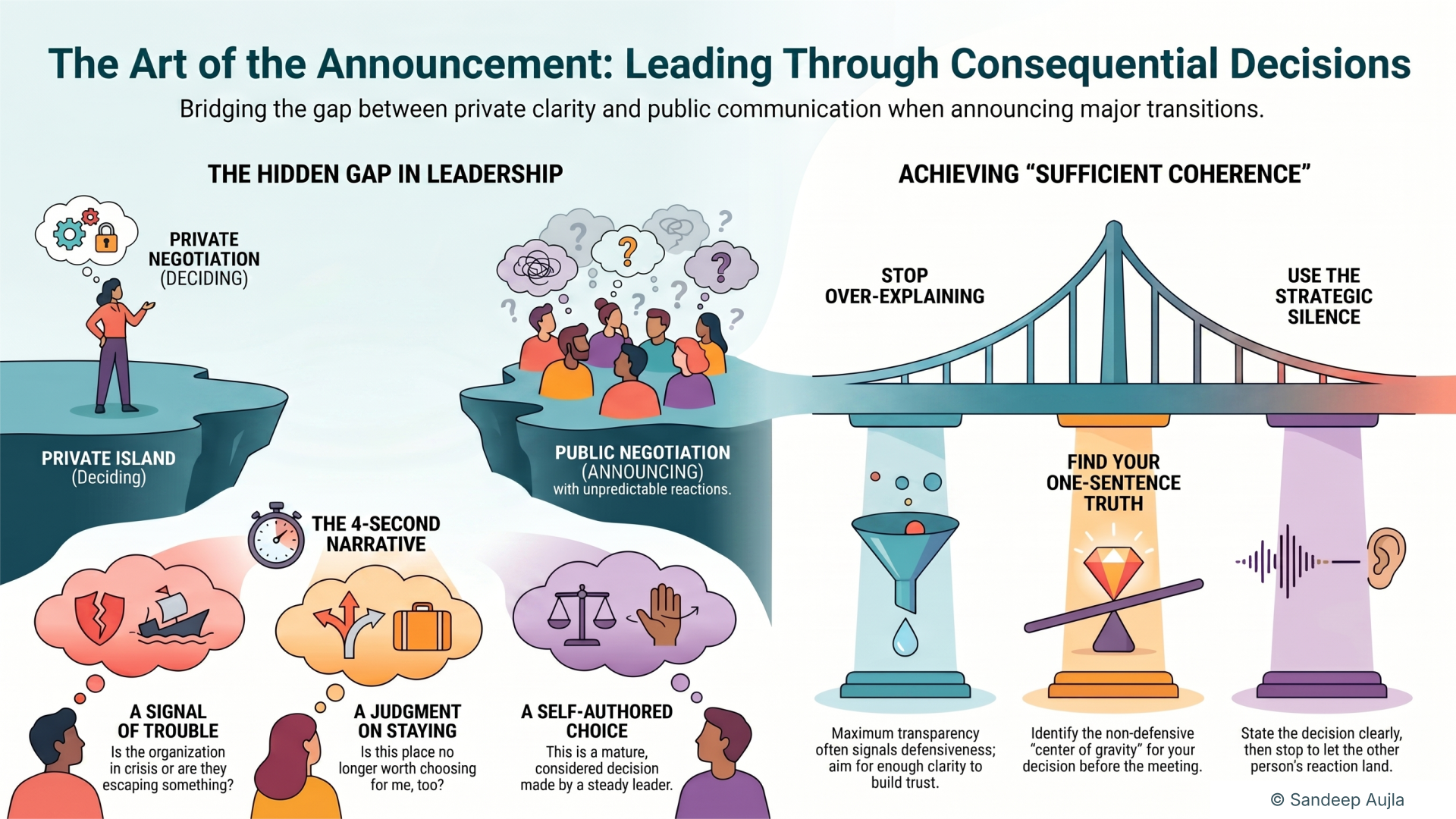
The first is a private negotiation with yourself.
The second is a public one, with people whose reactions you cannot script, whose own identities may be tangled up in the place, role, team, or system you are moving away from.
And in about four seconds, people begin deciding what kind of story your decision is.
Many leaders spend weeks, months, or even years discerning the “whether.” Then they underestimate the “how.”
And the how is where reputations, relationships, and legacies are quietly made, preserved, or bruised.
I have been thinking about this a lot lately. Across healthcare and other complex systems, more of the leaders I coach are reaching the same threshold I once did. They are making decisions that are clear to them, but not yet legible to others. And they are discovering that the announcement, not the decision, is often the real test of nerve.
Why communicating a decision is harder than making it
The more senior you are, the less your decisions are treated as purely personal. They become data.
People read them for signs of risk, politics, instability, ambition, burnout, betrayal, courage, or hidden conflict. A choice you understand from the inside may be interpreted very differently by people watching from the outside.
That is why the words matter. But the frame matters more.
The same five words, “I’ve decided to leave,” can be sorted almost instantly into three different stories.
The three ways people may read your announcement
1. As a signal that something is wrong
When a respected leader leaves and there is no visible crisis, people search for the hidden explanation.
- Is something happening behind the scenes?
- Is the organization in trouble?
- Was there a conflict?
- Are they being pushed out?
- Are they escaping something?
A senior departure, especially when “nothing is wrong,” breaks the expected script. The break itself is not the problem. The risk is when the break looks uncontrolled, impulsive, or unexplained.
People do not need your entire inner process. They do need enough steadiness to believe the decision has been considered.
2. As a judgment on what they are staying in
For many of your colleagues, the role, organization, profession, or system is not just where they work. It is part of who they are.
So when you leave, step back, or choose differently, your decision can land as a verdict on their choice to stay.
You may be saying, “This is the right next step for me.” They may hear, “This place is no longer worth choosing.”
That is why the warmest colleague can respond with a flash of coolness. You did not insult them. You made them recalculate.
3. As a deliberate, self-authored choice
This is the story you want to make easiest to hear.
A mature leader has made a considered decision. They are not fleeing. They are not performing dissatisfaction. They are not asking to be rescued, validated, or persuaded. They have reached clarity and are communicating it with care.
You do not fully control which story people choose. But you heavily influence which story is most available. Most leaders pour their energy into justifying the decision. That is usually the wrong lever.
Why over-explaining your decision backfires
There is a quiet instinct, when you announce something consequential, to over-explain. You want to lay out every reason, anticipate every objection, soften every possible disappointment, and leave no room for doubt.
It almost always weakens the message.
Not because the reasons are wrong. Because over-explaining often signals the very thing you are trying to disprove: that you are not quite sure, that you need the other person to agree, or that you are still negotiating with yourself in public.
Senior leaders often think people need:
- the full history
- the complete rationale
- the emotional backstory
- the reassurance package
- the proof that nobody should be upset
Most people actually need something much simpler:
- enough clarity to understand the decision
- enough steadiness to trust it
- enough respect to feel considered
- enough continuity to know what happens next
Say enough that the decision makes sense. Stop before it sounds like a defence.
Let me offer a contrarian challenge, because it matters: the popular advice to “be radically transparent about why you’re leaving” is often wrong for senior leaders. Not because honesty is unimportant. Because your audience is rarely asking for your full reasoning.
They are usually asking three quieter questions:
- Are you okay?
- Should I be worried?
- What does this mean for me?
Answer those, and you have done more for the relationship than a fifteen-minute explanation ever could.
Before you say it out loud
This is where I put on my coaching hat. Before the announcement, the real work is not wordsmithing. It is self-regulation, clarity, and intention. The racing heart is not evidence that you have made the wrong call. It is evidence that your body knows the moment matters.
Before you tell a soul, get clear on one thing: What is the cleanest one-sentence truth of this decision?
Not the spreadsheet of reasons. Not the polished narrative. Not the version designed to make everyone comfortable. The centre of gravity.
For example:
“I am ready to invest the next chapter of my work differently.”
“I know this mandate now needs a different kind of leadership.”
“I have reached clarity that staying would require me to override something I need to honour.”
“I am choosing a path that feels less certain, but more aligned.”
Your words may be different. They should be. The point is not to memorize a script. The point is to know the truth well enough that you can stay present while someone else reacts to it.
A question I often ask clients here is: What do you want to be true about this conversation a year from now, no matter how they react in the moment?
That question tends to slow the pulse. It moves the leader out of performance and back into stewardship.
During the conversation
The announcement is not a monologue. It is the opening of a dialogue you do not control.
That is where many leaders make the most common mistake: they talk through the other person’s reaction instead of letting it land.
Say the decision clearly. Then stop. Let the silence do some of the work. Let the surprise, disappointment, confusion, or questions arrive.
The first reaction is rarely the considered one. People often need a beat to move from shock to meaning-making. Your steadiness in that silence reassures more than another paragraph ever could.
This does not mean you become cold, detached, or overly polished. In fact, too much composure can create its own distance. The goal is not to perform certainty. The goal is to communicate from it.
Warmth matters. Respect matters. But so does not handing the other person responsibility for your clarity.
After the announcement
Once the news is out, your job changes. You move from informing to stewarding.
How you handle the weeks between telling and leaving, stepping back, or transitioning is what people often remember most.
- Did you remain generous?
- Did you stay accountable?
- Did you protect the dignity of the people and place involved?
- Did you avoid the subtle temptation to mentally leave before you had actually left?
- Did you make the next chapter easier for others, not just cleaner for yourself?
The announcement is a moment. The exit is a long goodbye. And for senior leaders, the long goodbye is part of the legacy.
What a strong message can sound like
Here is the architecture I often help leaders build. This is not a script to copy. It is a shape to make your own. Picture saying it to a board chair, CEO, senior colleague, or team you have led for years:
“I’ve decided to leave at the end of the quarter. This is a considered decision about where I want to invest the next chapter of my work, not a reaction to anything here. I’m committed to a clean handover, and I wanted to tell you directly because the relationship deserves that.”
Notice what the message does. It names the decision as owned. It frames the choice as considered. It reduces the likelihood that others will interpret it as a hidden critique. It signals continued reliability. It honours the relationship. It does not over-explain. That is sufficient coherence.
You will want your own words, not these. That is the point. Autonomy is the whole game here.
But test whatever you draft against four questions:
- Does it make the decision legible without justifying it?
- Does it signal that the choice is deliberate and owned?
- Does it tell this listener what they need to know next?
- Does it sound like the calm, self-assured version of you, not the defensive one?
If the answer is yes, you are probably close.
When a clean message is not enough
I do not want to oversell language as a cure-all. Some people will be hurt no matter how carefully you frame the decision. A clean message does not erase a real loss.
There are cultures, boards, bosses, and teams where any departure is read as betrayal. There are systems where choosing differently will be treated as disloyalty, no matter how respectfully you communicate it. Knowing which situation you are in is itself a strategic act.
There is also a quieter risk: that you craft the message so carefully you perform a composure you do not feel. That is not the goal. The goal is not a flawless announcement. It is a truthful one, delivered with enough steadiness that the truth can be heard.
A checklist before you say it out loud
Before you announce a consequential decision, ask yourself:
- What is the cleanest one-sentence truth of my decision?
- What might this sound like to someone who feels loyal to what I am leaving, changing, or declining?
- What do they need to know now, and what can wait?
- What do I want to preserve in this relationship?
- What will my behaviour after the announcement need to prove?
These questions will not eliminate the discomfort. They will help you lead inside it.
That is why the announcement deserves as much leadership discipline as the decision itself. Not because you can control every reaction. You cannot. But because you can enter the room with enough clarity, steadiness, and respect that people are more likely to understand the decision as what it is: an adult, self-authored choice made by someone who still intends to leave well.
For senior leaders, that is often the real work. Not just knowing when it is time. Knowing how to say it out loud.