
Decision-Making · 14 min read · October 20, 2026
When to Trust Intuition, and When to Slow Down
How leaders can strengthen decision-making without slowing down the people who need to act quickly.

A paramedic walks into a living room and, within seconds, senses that this call is different from the last forty chest-pain calls. She may not yet be able to explain exactly why. Her hands are already moving.
In long-term care, a personal support worker tells the charge nurse that a resident "isn't herself today." The vital signs are normal, but something about the resident's behaviour is different. By evening, the resident is being assessed for sepsis.
Neither observation begins with a formal comparison of options. Both reflect the kind of recognition that can develop through repeated experiences with patients and situations.
Leaders responsible for hospitals, paramedic services, long-term care homes, and other frontline organizations need people who can recognize a developing problem and act without unnecessary delay. They also need consistency, accountability, and assurance that decisions aren't based on intuition alone when the situation requires closer examination.
Those expectations can seem at odds, especially when the same team includes people with very different levels of experience.
The answer is unlikely to be asking everyone to slow down or follow the same decision-making process. Some situations demand immediate action, and experienced practitioners may recognize what matters long before they can fully articulate it.
The more useful leadership question is when that recognition can be trusted, and when people should deliberately slow down.
I would argue that organizations can improve decision-making consistency by helping people distinguish between those situations before the pressure arrives. That requires understanding how intuitive expertise develops and where its limits lie, and building practical safeguards around the decisions people make every day.
What this article explores
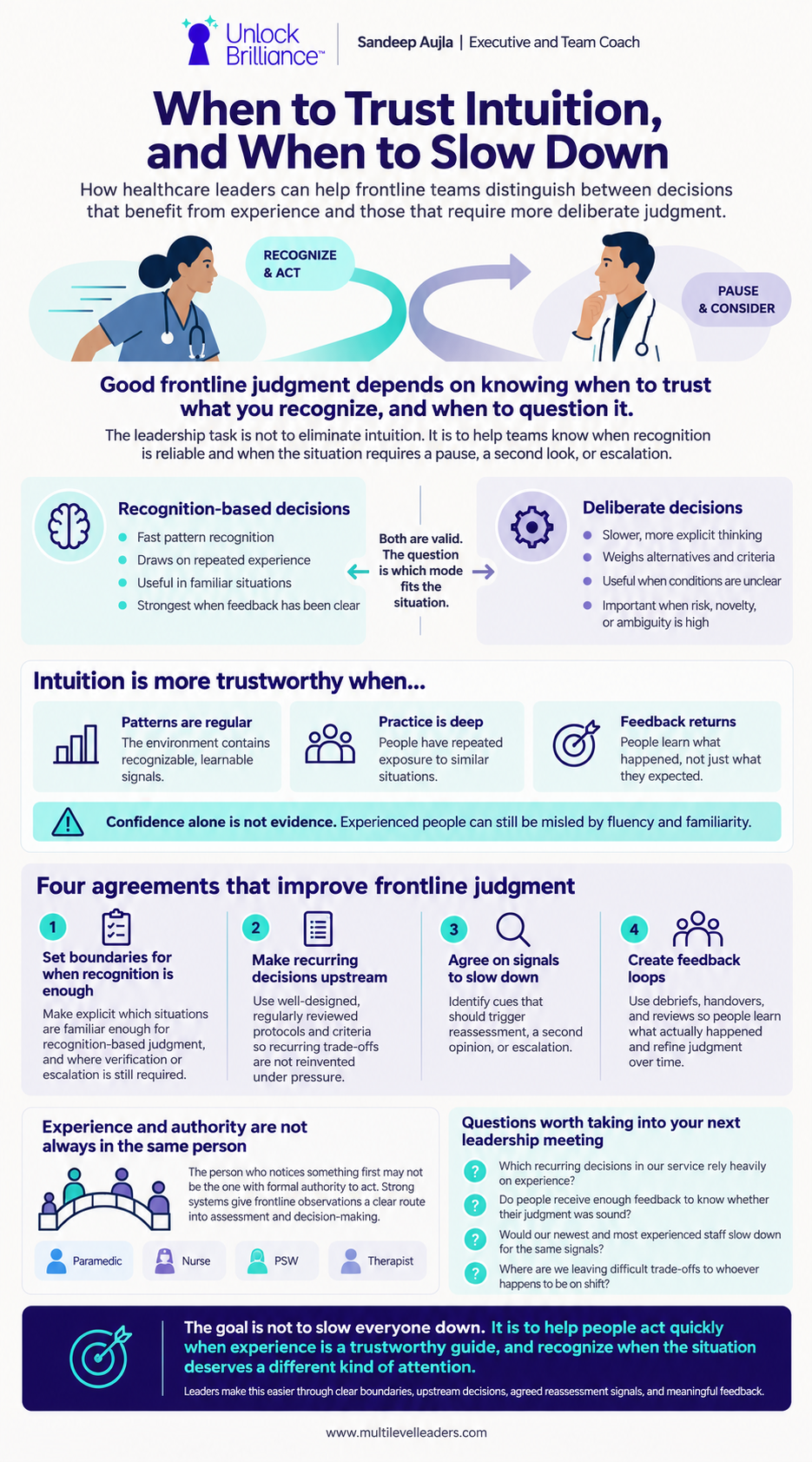
Frontline healthcare professionals often make decisions through rapid recognition built on experience. But when can intuition be trusted, and when is deliberate judgment needed? This essay examines the conditions for reliable intuition and four ways healthcare leaders can strengthen decision-making: establish shared boundaries, make recurring decisions upstream, agree on signals to slow down, and close feedback loops.
Two ways people make decisions
In everyday conversation, intuition and strategic thinking are sometimes treated as opposites. Intuition sounds instinctive, while strategy sounds deliberate and analytical.
For this discussion, I adopt a more precise distinction.
Recognition-based decisions occur when someone encounters a situation, recognizes a familiar pattern, and identifies a workable response from experience. Rather than comparing several alternatives, the person may mentally simulate the likely consequences of one course of action and adjust if something does not fit.
Deliberate decisions involve consciously defining the problem, considering alternatives, and weighing those alternatives against relevant criteria. The process is more explicit and usually requires greater time and attention.
Both have a legitimate place in frontline work.
Some of the clearest early evidence for recognition-based decision-making comes from research with experienced fireground commanders. In a study conducted for the U.S. Army Research Institute, researchers interviewed 26 experienced commanders about difficult incidents. Across 156 reported decision points, commanders compared two or more options in fewer than 12% of cases. In approximately 80% of cases, they recognized a familiar type of situation and acted on the first workable option.
These were experienced professionals making consequential decisions under pressure. Their accounts suggest they often drew on patterns built through years of exposure rather than explicitly comparing alternatives in the moment.
It’s worth noting that the study relied on recollections rather than direct observation of decisions as they occurred. An experienced practitioner may still reach a sound decision quickly because substantial learning has already occurred before the current situation.
The same study also showed where that expertise ends. In the one incident unlike anything the commanders had seen, a fire at a pumping station, they had no familiar pattern to draw on and deliberated much as novices would. They sought help from people with relevant experience.
Recognition is valuable. The challenge is knowing when the conditions support it.
When experience produces trustworthy intuition
Daniel Kahneman and Gary Klein approached intuition from different research traditions. Kahneman's work highlighted the biases and errors that can affect intuitive judgments, while Klein's research examined how experienced professionals make effective decisions in demanding environments.
In a joint paper published in 2009, they identified two conditions for developing trustworthy intuitive expertise.
First, the environment must contain sufficiently regular patterns that people can learn to recognize.
Second, individuals need adequate opportunities to practise and receive feedback that helps them distinguish accurate judgments from mistaken ones.
Consider a paramedic who has assessed thousands of patients with respiratory distress. Over time, changes in breathing, skin colour, posture, speech, and responsiveness may become familiar signals. When the environment provides recognizable patterns and meaningful feedback, experience can improve the ability to interpret those signals quickly.
Similarly, a nurse who regularly cares for post-operative patients may recognize a subtle change through routine observations before it becomes obvious.
But years of experience do not make all intuition equally reliable.
A leader may have spent twenty years making excellent operational decisions and still have limited experience with a particular strategic question. Decisions about staffing models, service redesign, or deployment planning often produce delayed outcomes shaped by many interacting factors. Feedback is slower and more ambiguous, making it harder to develop reliable recognition through experience alone.
The same problem occurs when consequences become visible somewhere else in the system. A unit may decide not to accept an admission because of current capacity. The people making that decision may never learn what happened to the patient who continued waiting elsewhere. Without that feedback, an important part of the learning process is missing.
Conditions can also change. A familiar patient presentation may behave differently under a new protocol, with different equipment, or in a population that does not match previous experience.
Kahneman and Klein also concluded that a person's confidence is not a reliable sign that their intuition is valid. A well-founded intuition and a poorly founded one can feel the same.
In an experimental study involving 64 Australian paramedics and 44 paramedicine students, researchers found that the fluency with which a diagnosis came to mind, and the confidence associated with that impression, influenced diagnostic intuition alongside the actual likelihood of the diagnosis. Experienced paramedics were also susceptible to these influences.
That finding does not diminish professional experience. It does show that the feeling of certainty is not, by itself, evidence that the underlying judgment is correct.
For leaders, this creates a practical distinction: the weight given to a judgment should depend on the nature of the situation and the evidence behind it, not on the confidence or seniority of the person making it.
The experience and authority problem
The person with the strongest recognition of a particular situation may not be the person with the greatest formal authority.
Consider the personal support worker who notices that a resident is behaving differently. Through daily contact, that worker may have developed a detailed understanding of what is normal for that individual. The observation may initially be difficult to translate into the language expected by someone with greater clinical authority.
That does not make the observation unreliable. It means the system needs an effective way to get relevant information to someone who can assess it and act appropriately.
The same principle applies across professional and organizational boundaries. A paramedic may recognize an emerging pattern that is not yet reflected in the available measurements. A nurse may see something that does not fit the current treatment plan.
Recognizing expertise across roles does not require abandoning professional accountability. It requires ensuring that valuable observations are heard, examined, and incorporated into decisions at the appropriate level.
That is one reason consistency in frontline decisions has to be designed rather than assumed.
Why consistency does not require everyone to decide the same way
Senior leaders are rightly concerned about variation in frontline decisions.
A patient should not receive substantially different care simply because a different person happens to be on shift. Operational decisions should be consistent with professional standards, established evidence, and organizational expectations.
Yet consistency cannot reasonably mean that every practitioner must use an identical mental process.
A paramedic in her first year and one in her twentieth year do not have the same patterns available to recognize. A personal support worker who knows a resident intimately may notice a change that a newly assigned professional does not. Equally, a highly experienced clinician may encounter an unfamiliar condition that requires consultation rather than relying on recognition.
I think four agreements help make that possible. They are an evidence-informed approach rather than a tested framework, and you can introduce each through existing huddles, handovers, debriefs, and quality reviews rather than as another initiative.
1. A shared test for when recognition can be relied upon
Teams need a shared understanding of which situations are sufficiently familiar, well understood, and supported by reliable feedback to permit rapid recognition-based decisions.
Two questions provide a starting point:
- Have we encountered this kind of situation often enough, with sufficiently clear feedback, to recognize a reliable pattern?
- If our initial judgment is wrong, how quickly would we know, and what would be the consequences?
These questions are prompts for professional judgment, not a clinical decision rule. A familiar situation can still carry significant risk, and quick feedback alone does not justify a rapid decision. Even when recognition is well founded, the potential consequences of an error may require independent verification, consultation, or other established safeguards. Interpret the answers within professional standards, escalation requirements, and patient-safety safeguards.
In huddles, handovers, and operational reviews, one prompt invites experienced practitioners to explain the basis of their judgment while giving others permission to surface differences: "What makes this situation similar to the ones we know, and what might make it different?" In urgent clinical situations, the discussion must remain proportionate to the available time and applicable protocols.
The same test will give different answers for different people. Newer practitioners may benefit from clearer default processes, accessible supervision, and named escalation contacts. Experienced practitioners may need greater discretion, accompanied by opportunities to examine the assumptions behind their recognition. Neither experience nor seniority should remove the expectation to seek help when conditions fall outside familiar patterns.
Capacity changes the answer too. Fatigue, sustained workload, interruptions, and competing demands may affect people's ability to notice, interpret, and respond to information, and expertise does not make anyone immune to those conditions. The same person may need different safeguards at the end of a long shift than at the start of one.
2. Deliberate decisions made before the pressure arrives
Some decisions in a frontline organization are best made before anyone faces an urgent situation.
Well-designed and regularly reviewed medical directives, escalation protocols, admission criteria, and other established processes can embody deliberate decisions made before the pressure arrives. They can give less experienced staff a reliable starting point and set boundaries within which experienced practitioners exercise discretion.
These arrangements matter most when the same difficult judgment arises repeatedly.
For example, if staff regularly confront uncertainty about accepting admissions when a unit is approaching unsafe capacity, leaving each shift to negotiate that decision independently places considerable responsibility on people working under pressure.
The organization may be better served by identifying the decisions frontline staff repeatedly make without sufficient authority, information, or time, then bringing together the relevant leaders and the people who carry the consequences to establish clear criteria, boundaries, and escalation pathways. Capacity, resource allocation, dependencies between departments, and competing safety considerations are common candidates.
3. Agreed signals that call for slowing down
Expertise includes recognizing when a familiar pattern no longer fits.
Researchers in Toronto developed a model of expert judgment in surgery that describes slowing down when circumstances depart from expectations. The model suggests that a central feature of expertise is knowing when to shift from relatively automatic performance to more deliberate attention.
The practical implication is that teams can identify some of these signals in advance and record them where they will be used.
A patient does not respond as expected. A situation falls outside a medical directive. Repeated interventions have not worked. The same concern has been escalated without resolution.
When those signals appear, the team should have an understood process for reassessment, consultation, or escalation, and the list can be revisited as experience accumulates. An agreed signal is easier to act on than a concern that must be negotiated from scratch each time.
Agreed signals also affect whether people feel able to speak up. A junior colleague should not have to overcome social barriers simply to suggest that a familiar situation may have changed. Equally, senior practitioners should be expected to reconsider their assessment when relevant new information emerges.
4. Feedback that allows judgment to improve
Recognition becomes more reliable through learning, and learning depends on knowing what happened.
That is harder than it sounds, because many frontline services are fragmented.
A paramedic transfers a patient to an emergency department and may never learn the eventual diagnosis. A long-term care worker raises an early concern but may not hear how the subsequent assessment unfolded. A unit makes a capacity decision without visibility into the consequences elsewhere.
These gaps matter because experience without meaningful feedback does not necessarily produce better judgment.
Debriefs and case reviews help most when they examine how a judgment was formed and what eventually happened. Four questions can structure those conversations:
- What did you notice first?
- What did you expect would happen?
- What actually happened?
- What would you pay attention to next time?
When outcomes occur in another unit or service, organizations can find practical ways to bring that learning back while respecting confidentiality and information-sharing requirements.
What the evidence can and cannot tell us
The fireground research relied on experienced commanders' recollections of past incidents rather than direct observation of decisions. Kahneman and Klein's paper drew together findings from different research traditions; it did not experimentally test their proposed conditions in hospitals or paramedic services. The surgical model describes expert judgment but does not establish the effectiveness of a particular training intervention. The paramedic experiment involved short written scenarios, which differ considerably from the demands of an actual emergency call.
The four agreements presented here synthesize that evidence and its practical implications. I am not aware of a study that has evaluated them together as one intervention in Canadian frontline healthcare settings.
There are also situations in which careful deliberation cannot precede action. When immediate intervention is required, established protocols and professional judgment remain essential. Deliberation may need to occur before the event, during a brief reassessment, or afterwards through structured learning.
I would treat the proposed approach as a practical working hypothesis worth examining within each service's context.
Helping people know when to trust what they know
Frontline expertise is built through repeated exposure to demanding situations, often over many years. That experience matters, particularly in settings where people must notice subtle changes and respond quickly.
But experience has boundaries. Some situations contain familiar patterns that people have learned to recognize reliably. Others are unfamiliar, changing, difficult to reverse, or shaped by consequences that are not visible to the person making the decision.
For leaders, the challenge is to respect the first without overlooking the second.
Before your next leadership meeting, consider four questions:
- Which recurring decisions in our service depend heavily on experience, and do people receive enough feedback to know whether their judgment was sound?
- Would our newest and most experienced staff recognize the same circumstances as reasons to slow down or escalate?
- Where are we leaving difficult, recurring trade-offs to whoever happens to be on shift?
- When did we last learn from a decision that felt right at the time but proved mistaken?
The aim is to help people act quickly when experience provides a trustworthy guide, and recognize when the situation deserves a different kind of attention. Leaders make that possible by creating the conditions in which people can trust their expertise, question it when necessary, and seek support without hesitation.
Frequently asked questions
What is the difference between intuitive and deliberate decision-making?
Intuitive decision-making often relies on recognizing familiar patterns developed through experience and quickly identifying a workable response. Deliberate decision-making involves consciously examining a problem, considering alternatives, and weighing relevant criteria. Both can be valuable, depending on the situation, available evidence, and consequences of error.
When can healthcare professionals trust their intuition?
Intuition is more likely to be reliable when an environment contains learnable patterns and practitioners have repeated experience with clear, meaningful feedback. These conditions were identified by Daniel Kahneman and Gary Klein in their research on intuitive expertise. Confidence alone is not evidence that intuition is accurate.
When should clinicians slow down their decision-making?
Clinicians may need more deliberate judgment when a situation is unfamiliar, expected patterns no longer fit, interventions produce unexpected results, or the consequences of error are significant. Established clinical protocols, verification requirements, and escalation procedures remain essential.
How can healthcare leaders improve frontline decision-making?
Healthcare leaders can establish shared criteria for relying on recognition, make recurring decisions upstream through well-designed protocols, identify signals that require reassessment, and create feedback loops that help professionals learn from outcomes.
Why is experience alone insufficient for reliable clinical intuition?
Experience develops useful recognition when people encounter recurring patterns and receive feedback on their judgments. When conditions change, outcomes are delayed, or feedback never reaches the decision-maker, years of experience may not produce equally reliable intuition.
References
Kahneman, D., & Klein, G. (2009). Conditions for intuitive expertise: A failure to disagree. American Psychologist, 64(6), 515–526. https://doi.org/10.1037/a0016755
Keene, T., Pammer, K., Lord, B., & Shipp, C. (2022). Fluency and confidence predict paramedic diagnostic intuition: An experimental study of applied dual-process theory. International Emergency Nursing. https://doi.org/10.1016/j.ienj.2021.101126
Klein, G. A., Calderwood, R., & Clinton-Cirocco, A. (1988). Rapid decision making on the fire ground (Technical Report 796). U.S. Army Research Institute for the Behavioral and Social Sciences. https://apps.dtic.mil/sti/pdfs/ADA199492.pdf
Moulton, C. A., Regehr, G., Mylopoulos, M., & MacRae, H. M. (2007). Slowing down when you should: A new model of expert judgment. Academic Medicine, 82(10 Suppl), S109–S116. https://pubmed.ncbi.nlm.nih.gov/17895673/