
Physician leadership · 14 min read · August 4, 2026
Establishing psychological safety in the first ten seconds

Every physician leader eventually faces a moment when the quality of the team’s silence becomes more important than the quality of the team’s words.
No one questions the plan. No one challenges the order. No one says, “Can we pause?” No one names the small doubt that sits in the room before the larger problem reaches the patient.
From the outside, that silence can look like alignment, efficiency, professionalism, or confidence.
Inside a clinical team, it may mean something very different. It may mean people have learned that speaking up is too expensive: too risky, too slow, too embarrassing, or too likely to be met with irritation, dismissal, defensiveness, or silence from the person with the most authority in the room.
That is why the deeper lesson of Toyota’s Andon Cord matters for medicine.
Yes, a hospital is not a factory. Patients are not products. Clinical judgment is not assembly-line work. Medicine carries uncertainty, acuity, emotion, ethics, family dynamics, scarcity, and irreversible stakes in ways manufacturing never fully can.
The misunderstood lesson of the Andon Cord
On a Toyota assembly line, stopping production is said to carry enormous cost, approximately $60,000 USD per minute. Everyone knows this. And yet, thousands of times a day, workers reach up and pull the now-famous Andon Cord, the mechanism any employee can use to signal a defect, a doubt, or a problem they cannot solve alone.
The popular story is irresistible: one brave worker stops an expensive production line to protect quality. It is a stirring image, but it is incomplete.
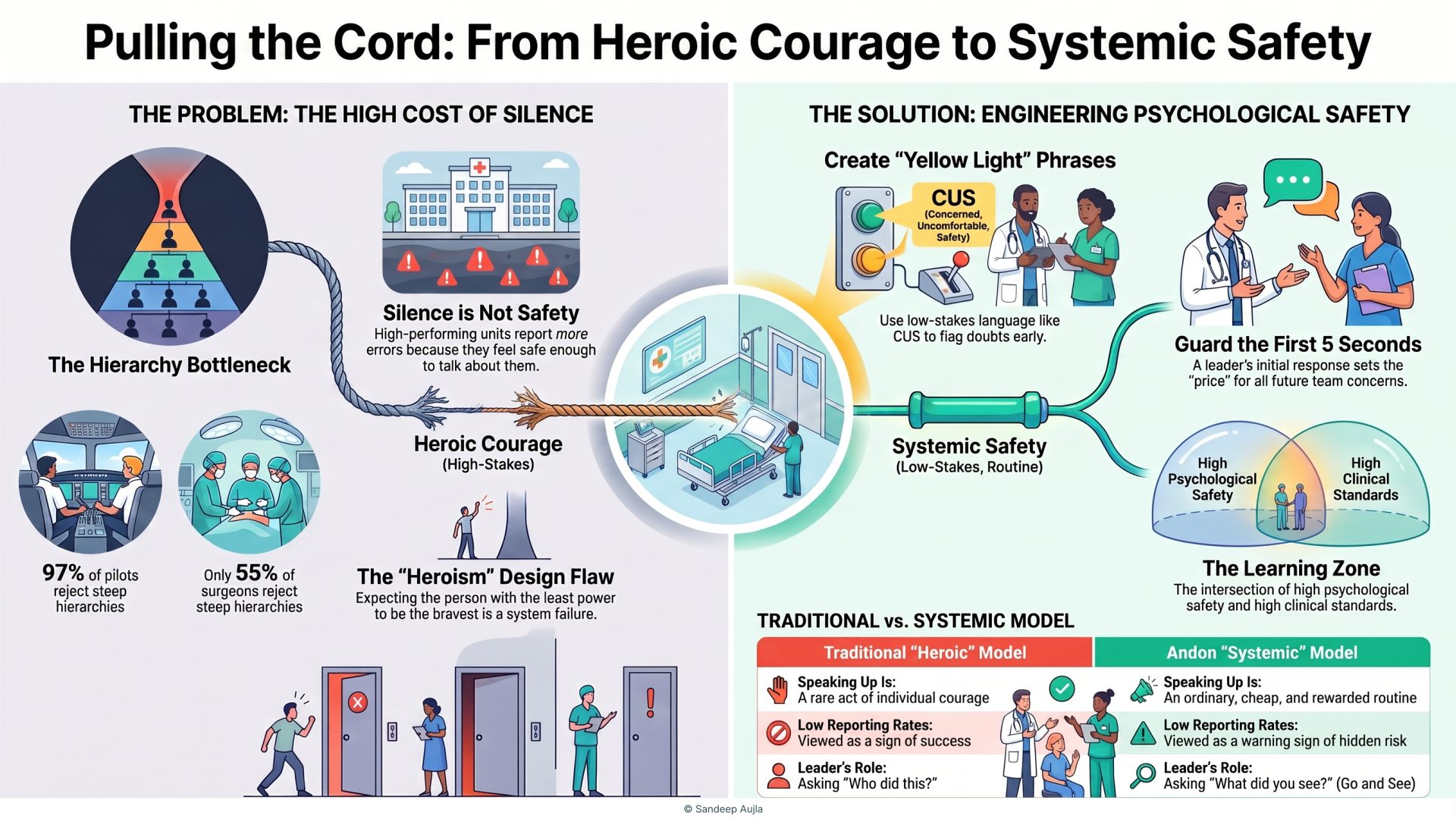
At Toyota, pulling the cord does not automatically stop the line. It triggers a two-stage system. The pull turns on a light and sounds a signal. The line continues moving toward a fixed-position stop at the end of the work zone. A team leader is expected to arrive quickly. If the issue is resolved before the vehicle reaches that fixed point, the line does not stop.
The cord, in other words, is not primarily a brake. It is a call for help.
That single correction offers the most valuable reframe in healthcare settings. The point is not the dramatic stop. The point is the ordinary, repeated, low-stakes act of raising a hand early enough for help to arrive before the problem moves downstream.
Toyota did not build a culture in which people were expected to be heroic every time they encountered a problem. It built a system where asking for help was normal, fast, visible, and supported.
That distinction matters deeply in medicine.
In clinical teams, we often ask people to do the hardest thing at the worst moment. We ask the most junior person, the newest nurse, the resident, the clerk, the respiratory therapist, the pharmacist, the medical assistant, or the front-desk staff member to challenge the most senior person in the room after risk has already escalated. Then we call it courage.
But if speaking up requires courage every time, the system is already too late.
The question physician leaders need to ask
Most organizations say they want people to speak up. Most senior leaders believe they are approachable. Most physicians would say they want to know if something is wrong. And still, concerns go unspoken.
That should make us cautious about the usual question: “How do we get people to speak up?”
Those ten seconds are cultural data. The glance, the interruption, the sigh, the defensiveness, the gratitude, the curiosity, the willingness to go and see, and the speed with which a leader moves toward the concern rather than away from it all teach the team what voice costs.
People learn very quickly whether voice is welcome in theory or safe in practice. A policy can authorize speaking up. A poster can encourage it. A huddle can invite it. But the leader’s response prices it. Once a team learns the price, they adjust their behaviour accordingly.
Silence is not the sound of safety
One of the most important lessons from Toyota is also one of the most counterintuitive: a low number of cord pulls is not necessarily a sign of success. It may be a warning sign.
A quiet line does not always mean a flawless line. It may mean problems are being hidden, absorbed, normalized, worked around, or passed downstream.
Sit with that as a physician leader. What does your team’s silence actually mean?
A unit with no reported near-misses, no questioned orders, no challenged assumptions, no “can I check something with you?” and no “something feels off” may not be a safe unit. It may be a unit that has learned not to speak.
Amy Edmondson found this counterintuitive pattern in hospitals: better-performing teams reported more errors, not fewer. The difference was not that good teams made more mistakes. They were more willing and able to talk about them.
That distinction is foundational. Low reporting can be good news. It can also be fear, fatigue, resignation, hierarchy, learned helplessness, or a belief that nothing useful will happen if people speak.
Physician leaders have to become much more curious about quiet. Not suspicious of people, but curious about the system. Who speaks easily here? Who never raises a concern? Whose questions get treated as valuable? Whose questions get treated as interruptions? What kinds of concerns are welcomed? Which ones disappear?
Why “speak up” efforts fail
Many organizations have tried to emulate Toyota’s visible aspects. They install tools, create escalation language, introduce safety huddles, laminate values, launch reporting systems, and teach CUS language: “I’m Concerned, I’m Uncomfortable, this is a Safety issue.”
These tools can help, but they do not create culture on their own. That is where many safety efforts quietly fail. The artifact crosses the threshold. The assumption underneath does not.
A hospital can give every team member permission to stop the line while still having a culture that punishes interruption, shames uncertainty, rewards perfection, tolerates incivility, and protects senior defensiveness. In that culture, the tool becomes theatre.
When the Andon Cord is pulled, a leader is expected to arrive quickly, go directly to the site of the problem, and help diagnose the issue.
The leadership discipline is practical and visible: go and see, ask what is happening, support the person, solve the problem as close to the work as possible, and learn from what surfaced.
For medicine, this is the crux.
That imbalance matters because the bottleneck is often not the courage of the person with less authority. It is the response of the person with more authority.
In steep hierarchies, the person with the least power is asked to carry the greatest interpersonal risk. The resident must challenge the attending. The nurse must interrupt the surgeon. The medical assistant must question the physician owner. The pharmacist must push back on the prescriber. The junior team member must decide whether the concern is worth the possible cost.
That is not a character problem. It is a design problem. And physician leaders are responsible for redesigning it.
How to ensure your “speak up” efforts work
The most important lesson of the Andon Cord is not that people should be brave enough to stop the line. The deeper lesson is that leaders should design work so that raising a concern rarely feels like stopping the line in the first place.
Voice should not be rare, dramatic, or dependent on personal courage. It should be ordinary, expected, fast, rewarded, and early enough that the problem is still small enough to solve.
That is where physician leadership begins.
What physician leaders can build instead
1. Create a low-stakes yellow light
Not every concern should have to sound like an alarm. Clinical teams need a way to raise early uncertainty before it becomes a crisis.
A low-stakes yellow light might be: “Can we pause for ten seconds?” “Something feels off.” “Can I check my understanding?” “I am concerned about this piece.” “Before we move on, can we look at one thing?” Or simply, “I may be wrong, but I want to flag something.”
The exact phrase matters less than the shared agreement behind it. The team needs to know that early concern is welcome, even when the concern is incomplete, uncertain, or ultimately wrong.
This is especially important in medicine, where many early signals are ambiguous: a subtle change in a patient’s status, a medication concern, a discrepancy in the chart, a family member’s observation, a resident’s unease, a nurse’s pattern recognition, or a front-desk staff member noticing that a patient who sounded “off” on the phone did not book the follow-up.
These are often not polished concerns. They are fragments. A strong safety culture knows how to receive fragments before they become events.
2. Guard your first response
When someone raises a concern, your first response teaches the team what voice costs. The first ten seconds matter.
A physician leader may think they are simply busy, focused, efficient, or under pressure. The team may experience the same moment as dismissal. That does not mean leaders need to become endlessly soft or performative. It means they need disciplined presence under pressure.
Useful first responses sound like: “Thank you for flagging that.” “What are you seeing?” “Show me where the concern is.” “Let’s pause and check.” “Say more.” “I would rather look at it now than miss it later.”
These responses do several things at once. They lower the interpersonal cost of speaking, move the team toward the data, avoid premature blame, protect standards without humiliating the person raising the concern, and teach everyone watching that voice is part of good clinical work.
In complex clinical work, you want people to raise concerns before they are certain. Thanking someone for a concern that turns out to be wrong is not indulgence. It is an investment in the next concern that proves right.
3. Go and see
Toyota’s principle of genchi genbutsu, often translated as “go and see,” is especially relevant to clinical leadership. Do not manage concern only from a distance. Go to the bedside. Look at the medication order. Review the handoff. Listen to the call. Walk to the front desk. Stand in the clinic flow. Ask the people closest to the work what they are noticing.
In healthcare, important knowledge is often local, practical, and distributed. It lives with the people doing the work, not only with the person holding the most formal authority.
Going to see is not micromanagement when it is done with curiosity and respect. It is a way of showing that concerns deserve attention, not abstraction.
4. Ask “what” before “who”
Under pressure, teams quickly learn whether leaders are trying to understand the problem or locate the person to blame. The sequence matters.
Start with: What happened? What did you notice? What made this harder to catch? What was unclear? What did the system make easy? What did the system make difficult? What do we need to change so this is easier to see next time?
There may still be accountability. There should be. Psychological safety does not mean the absence of standards. But if the first move is blame, the next concern will go underground.
The better sequence is learning first, accountability with fairness second, and system improvement always.
5. Treat silence as a signal
A quiet team deserves inquiry, not accusation. If no one raises concerns in your huddles, rounds, clinic meetings, surgical briefings, or debriefs, ask why.
The issue may be workflow. It may be time. It may be hierarchy. It may be prior punishment. It may be that people have raised issues before and nothing changed. It may be that the team has learned which concerns are “safe” to raise and which ones are career-limiting.
Physician leaders need to watch not only what gets said, but what never seems to surface. Useful questions include: “What are we not talking about that we should be?” “Where are people working around the system?” “What concern keeps showing up informally but not formally?” “Who sees the risk earliest?” “What makes it hard to raise that here?” “What did we learn from the last concern someone raised?”
These questions only work if the answers are met with action. A team will forgive imperfect solutions. It will not keep offering truth into a void.
6. Hold safety and standards together
Some physician leaders worry that psychological safety means lowered expectations. That concern deserves to be taken seriously. Medicine cannot afford sloppy thinking, vague accountability, or endless accommodation of poor performance.
High standards without voice produce anxious teams that hide problems. Voice without standards produces comfortable teams that may avoid hard truths. The learning zone is where both are high.
That is the relevance of the Andon Cord. It exists because the standard for quality is uncompromising. Problems are surfaced early because the work matters too much to let defects travel downstream.
The same is true in medicine. Inviting voice does not weaken rigour. Voice is how rigour survives contact with reality.
From artifact to culture
Edgar Schein’s culture model is useful here. Culture operates at several levels: visible artifacts, stated values, and the deeper assumptions that actually drive behaviour under pressure.
The artifact might be a stop-the-line policy, a CUS phrase, a huddle board, a safety dashboard, a near-miss reporting process, a daily team pause, a visible escalation pathway, or a shared “can we pause?” phrase. The stated value might be, “We speak up for safety.”
But the deeper assumption is revealed only under pressure. What does the team believe will actually happen if someone interrupts, challenges, questions, slows things down, or raises uncertainty?
That is the real culture.
Culture is embedded by what leaders consistently notice, measure, reward, tolerate, and react to when the stakes are high. The artifact is only the teaching tool. The leader’s repeated response guides what others learn and repeat.
What this looks like in a hospital
In a hospital, a physician leader might build the equivalent of an Andon system through formal stop-the-line authority in the OR, explicit escalation language, daily safety huddles, visible tracking of concerns, and rapid response to near misses. But the visible mechanism is only the start.
The culture changes when the attending, division head, medical director, surgeon, intensivist, hospitalist, anesthesiologist, or clinical chief repeatedly does three things in public.
First, they respond quickly and in person. They do not treat concern as an irritation to be processed later. They move toward it.
Second, they ask what the person saw before assigning meaning or blame. They make it clear that the concern is worth understanding.
Third, they close the loop. They tell the team what happened, what was learned, what changed, and why the concern mattered.
Consider the resident who escalates a concern that proves to be unfounded. A weak culture lets the resident feel embarrassed and quietly teaches everyone to be more certain next time. A stronger culture says, “Thank you for raising it. I would rather we check and learn than stay quiet and miss something.”
That sentence is not politeness. It is culture formation. Repeated over time, it rewires the assumption from “Escalating makes me look weak” to “Escalating is how good clinicians work here.”
What this looks like in a community clinic
The same principle applies in smaller settings, where the hierarchy can be even more intimate.
In a five-person practice, there may be no formal committee, no quality department, no safety infrastructure, and no spare capacity. The physician may also be the owner, employer, senior clinician, and final decision-maker. That makes the leader’s response even more visible.
The artifact can be simple: a ten-minute morning huddle, a whiteboard where anyone can post a concern, a shared phrase such as “Can we pause?”, a weekly review of near misses, a simple “what almost slipped?” question, or a same-day close-the-loop habit.
The lead physician can install the value by opening with their own uncertainty: “Here is what I might be missing this week.” They can act on a flagged concern the same day, thank the medical assistant who notices a medication discrepancy, listen when the front-desk staff member says a patient sounded worse than usual, and close the loop out loud so the person who raised the issue sees that it mattered.
In a small clinic, the payoff is immediate: a caught interaction, a follow-up that does not slip, a diagnostic doubt voiced before the patient leaves, a patient who is called back in time, or a staff member who stays because their judgment matters.
In a small team, one departure can destabilize the whole practice.
The tangible test
Here is the practical test for any physician leader.
Walk the floor, the clinic, the unit, the OR, the department, or the program and ask: “The last time someone raised a concern here, what happened in the next ten seconds?”
Then ask: “Did everyone see it?”
That answer will tell you more about the culture than the poster on the wall. If the person was thanked, helped, and taken seriously, the team learned something. If the person was ignored, corrected, shamed, mocked, delayed, or punished, the team learned something too.
Culture is always being taught. The only question is what lesson your team is learning.
When this is harder than it sounds
This work is simple to describe and difficult to sustain. There are real constraints: clinical volume is high, staffing is thin, physicians are interrupted constantly, emotions run hot, teams are tired, and some concerns are poorly timed, poorly framed, or incomplete.
Some people raise issues in ways that create confusion rather than clarity. Some environments carry years of mistrust. Some leaders inherited cultures they did not create. Some systems still reward speed, production, perfection, and personal control more visibly than learning. Some forms of speaking up require formal process, documentation, HR involvement, legal review, patient relations, or regulatory escalation.
A low-stakes yellow light does not replace those structures. But it does something those structures cannot do on their own. It shapes the everyday moments before formal escalation is needed. It teaches the team whether small concerns are welcome early or punished until they become large enough to force attention.
That is where physician leaders have enormous influence. Not total control, but real influence in the repeated, visible, ordinary moments where someone tests whether it is safe to say what they see.
What psychological safety unlocks
The Andon Cord endures as a metaphor because it makes visible something most organizations keep hidden: the moment a human being decides whether to speak or stay silent.
In manufacturing, silence costs money. In medicine, it can cost a life.
But this is not only about avoiding harm. A team that can speak early can learn faster, catch weak signals sooner, distribute intelligence more effectively, and correct course before reputational, operational, clinical, or relational damage accumulates. It can retain good people who are tired of carrying concerns alone. It can reduce the hidden tax of fear.
For physician leaders, this is the deeper invitation: do not merely tell people to pull the cord. Build the conditions that make reaching for it feel natural. Respond in ways that lower the cost of the next concern. Treat silence as data. Hold standards and safety together. Go and see. Ask what before who. Close the loop where everyone can see it.
That is the leadership work behind the metaphor.
The cord itself does not unlock the team’s brilliance. The culture behind the cord does. And that culture is built in the first ten seconds after someone is brave enough, or safe enough, to say: “Can we pause?”
References
Edmondson, A. C. (1996). Learning from mistakes is easier said than done: Group and organizational influences on the detection and correction of human error. Journal of Applied Behavioral Science, 32(1), 5–28. https://doi.org/10.1177/0021886396321001
Edmondson, A. C. (1999). Psychological safety and learning behavior in work teams. Administrative Science Quarterly, 44(2), 350–383. https://doi.org/10.2307/2666999
Edmondson, A. C. (2019). The fearless organization: Creating psychological safety in the workplace for learning, innovation, and growth. Wiley.
Graban, M. (2024). Demystifying Toyota’s Andon System: How it works and common misconceptions. Lean Blog.
Leonard, M., Graham, S., & Bonacum, D. (2004). The human factor: The critical importance of effective teamwork and communication in providing safe care. Quality & Safety in Health Care, 13(Suppl 1), i85–i90. https://doi.org/10.1136/qshc.2004.010033
O’Donovan, R., & McAuliffe, E. (2020). A systematic review of factors that enable psychological safety in healthcare teams. International Journal for Quality in Health Care, 32(4), 240–250. https://doi.org/10.1093/intqhc/mzaa025
Schein, E. H. (2010). Organizational culture and leadership (4th ed.). Jossey-Bass.
Sexton, J. B., Thomas, E. J., & Helmreich, R. L. (2000). Error, stress, and teamwork in medicine and aviation: Cross sectional surveys. BMJ, 320(7237), 745–749. https://doi.org/10.1136/bmj.320.7237.745