
Enterprise leadership · 12 min read · September 1, 2026
The bridge is the job, and it changes shape at the top

A Director is sitting in a promotion conversation, trying to explain why they are ready for VP.
They have the results. Their team is strong. Their function runs well. They are respected by peers. They can point to initiatives delivered, budgets managed, risks reduced, and staff developed.
Then the conversation shifts.
The question is no longer only, “Can you lead your area well?”
It becomes, “Can you move the enterprise?”
That is where many talented leaders feel the ground change beneath them. The work that made them credible as a Director is still valuable, but it is no longer enough. At VP level, the organization is watching for something larger: whether the leader can connect functions, priorities, professions, and power centres that do not naturally understand one another.
Can they translate between finance and operations? Can they help clinicians and administrators hear the same problem without retreating to their own language? Can they make strategy real enough for the front line and operational reality visible enough for the executive table? Can they work across departments, partners, boards, funders, and communities without needing formal authority over all of them?
That is the hidden work of moving from strong functional leader to enterprise leader. It is boundary spanning.
There is a quiet pattern in executive careers that rarely makes the competency models. The people who rise are seldom only the deepest experts in their function. They are the ones who can stand in the space between functions, professions, priorities, and power centres, then make those worlds legible to one another.
Clinicians and administrators. Finance and operations. Strategy and execution. The board and the front line. Hospital and community. Policy and practice.
Network researchers have a name for the empty space between groups that do not naturally connect. They call it a structural hole. The people who reach across that space are brokers. In ordinary leadership language, we call them translators, connectors, integrators, coalition-builders, enterprise thinkers, or simply the people who “know how to get things done.” Whatever the label, they create value because they can see across boundaries that others experience as walls.
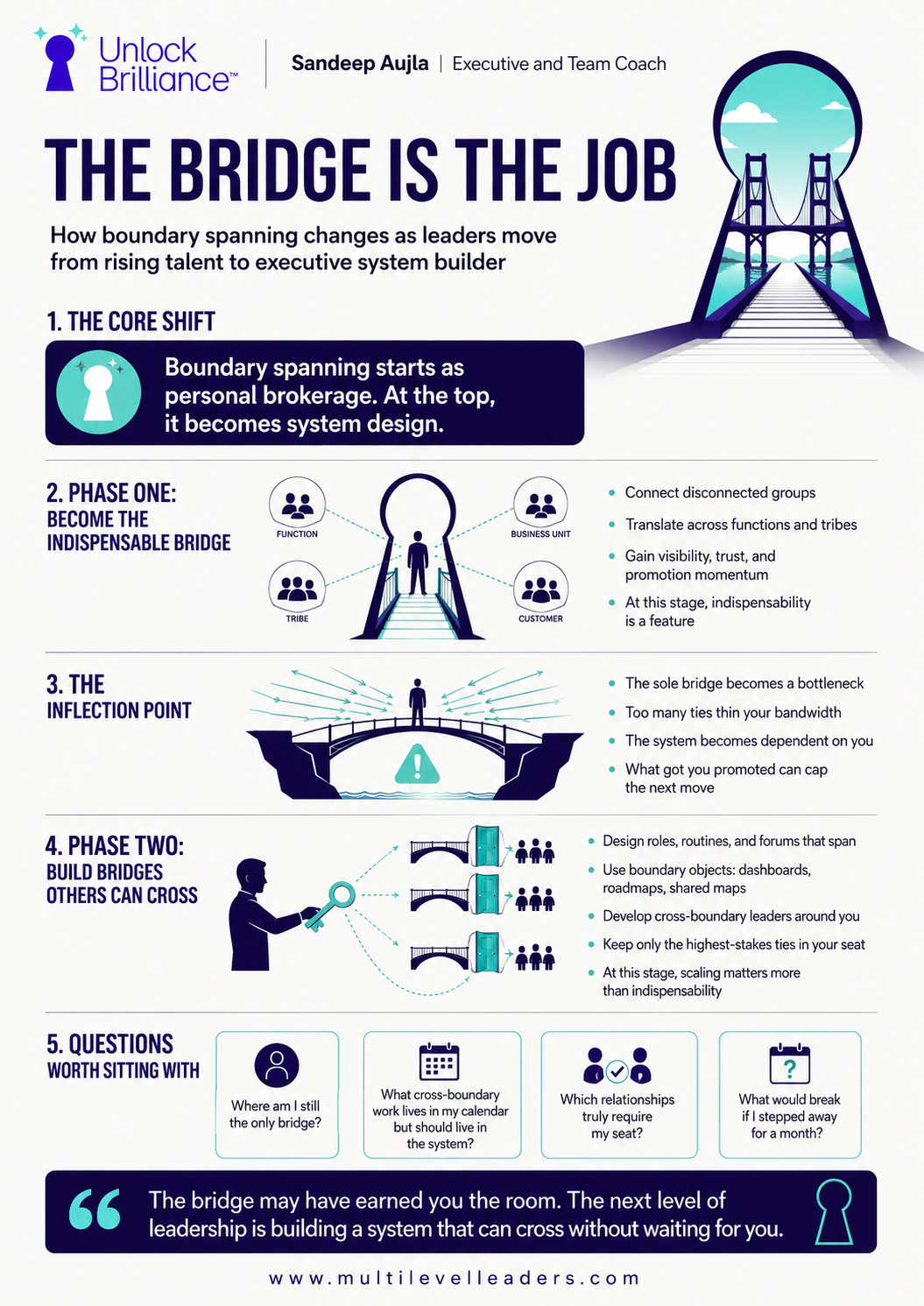
The version that opens the door to senior leadership can become the very version that limits you once you get there. Early in a career, being the indispensable bridge creates visibility, credibility, and opportunity. At the executive level, staying indispensable in the same way can turn you into a bottleneck.
The bridge is the job. Then the job becomes building bridges other people can cross without you standing in the middle.
Phase one: become the indispensable bridge
Early and mid-career, boundary spanning is a promotion engine. In one well-known study of managers in a large electronics firm, the people whose relationships connected otherwise separate groups were better paid, received stronger evaluations, and were more likely to be promoted. In practical terms, connecting people, ideas, and priorities that were previously disconnected became a visible career advantage.
The mechanism matters because it explains both the power and the trap. When you sit in the gap between two unconnected groups, you gain a vision advantage. You see ideas earlier. You notice patterns neither side can see alone. You can recombine perspectives in ways that feel obvious to you and surprising to everyone else. You become the person who can translate the operational issue into financial risk, the clinical concern into governance language, or the board’s question into something the front line can actually act on.
Boundary spanning also builds trust when it is done well. Network studies have found that people who bridge groups can be perceived as more trustworthy than those who do not, partly because a broker who misuses the role loses the bridge. Trust becomes part of the broker’s operating license.
This is why boundary spanning can be so powerful for someone moving from Manager to Director, or from Director to VP. You do not have to wait for formal authority. You can build the relational leverage that often leads to formal authority.
So the early advice is genuinely useful: make yourself the bridge. Volunteer for the cross-functional work nobody quite owns. Become fluent in more than one organizational language. Help the tribes understand one another. Bring the missing context into the room. Make yourself valuable by connecting what the system has separated. At this stage, indispensability is a feature.
The inflection point: when indispensability becomes the constraint
Then the same pattern starts to work against you. The very indispensability that earned the promotion can cap the next one. A leader who has become the sole bridge across functions, teams, or stakeholders may look valuable from a distance. Up close, the system has become dependent on a person rather than capable through design.
Bridging ties are expensive. They require maintenance, context switching, emotional labour, translation, trust repair, and constant attention. They also decay faster than internal ties because they cross differences. The leader who remains the single conduit becomes overloaded and starts carrying more information than any one person can responsibly process.
Research on network bandwidth reinforces the point. The wider your reach, the thinner the flow of information you can carry through each relationship. At some point, the leader who knows everyone, connects everything, and routes decisions through themselves begins to slow the system they are trying to help.
This is the executive threshold. The instinct that served you earlier, “route it through me and I will connect the dots,” starts to concentrate risk. It slows throughput. It creates dependence. It also prevents other leaders from developing the connective capacity the organization now needs at scale.
There is a political shadow here too. Brokerage can create personal advantage when one person benefits from keeping other groups dependent on them for access, information, or interpretation. Most capable leaders do not intend to play that game. Yet personal indispensability can drift into a more respectable version of the same pattern. The leader remains useful because the system has not learned to connect without them. That is the trap.
Phase two: build a system that spans without depending on you
The executive move is to stop treating personal brokerage as the main act. At the top, the work shifts from being the bridge to building the conditions that allow boundary spanning to happen repeatedly, reliably, and without constant executive mediation. This is the move from personal brokerage to distributed boundary-spanning capacity.
The research supports the shift. Studies of team-level boundary spanning show that when work is distributed across the team, the personal cost borne by any individual broker is reduced. The team becomes more capable, and the leader becomes less of a single point of failure.
A recent large-scale review of boundary spanning in teams adds two executive-grade insights. First, boundary spanning that extends beyond the organization has particular value because it brings in information, resources, and perspectives the organization does not already have. Second, when formal leaders carry out boundary-spanning work, it often carries more weight because the role itself legitimizes the crossing.
That does not mean executives stop brokering. Some relationships will always require the executive chair: a hostile regulator, a high-risk partnership, a board relationship, a ministry conversation, a funder, a union relationship, or a cross-sector coalition where the role itself carries meaning.
The shift is more precise than stepping away. The executive stops being the only broker and becomes deliberate about where personal brokering is truly required. Some ties belong with you because the stakes, authority, or symbolism require your seat. Many others should be built into the system so your people can span boundaries without waiting for you to convene, translate, bless, or rescue the work.
The resource underneath this is attention. Senior teams talk constantly about money, talent, and time. They manage attention less deliberately, even though attention is one of the scarcest executive resources in any complex organization. Distributed boundary spanning imports external insight while protecting the finite bandwidth leaders and teams have.
The executive levers: shared objects, roles, routines, and power to
The executive version of boundary spanning becomes practical through four levers: shared objects, roles, routines, and power to.
The first lever is a shared object. Researchers use the phrase “boundary object” for an artifact that different groups can use together while still reading it through their own local needs. In executive practice, this might be a shared roadmap, a prototype, a patient-flow dashboard, an enterprise risk map, a common operating picture, a service blueprint, a governance calendar, a strategy-on-a-page, or one set of metrics that clinical, operational, financial, and board audiences can all trust. The object does some of the translation work that would otherwise depend on the leader’s calendar.
The second lever is role design. If cross-boundary work matters, it cannot live only in informal goodwill. Someone has to own the relationship, the handoff, the shared measure, the escalation path, or the partnership rhythm. Strong executives make boundary work visible enough to be designed, staffed, and expected.
The third lever is routine. Boundary spanning cannot depend entirely on crisis meetings and heroic intervention. Leaders need routines in which functions make trade-offs together before the work breaks down: integrated planning forums, shared risk reviews, joint huddles, cross-functional retrospectives, partner check-ins, and decision meetings where the right people are present before the issue has hardened.
The fourth lever is power to. This is the leadership move from holding power over a system to increasing the system’s capacity to act. The executive’s work is to give people permission, context, relationships, and tools, then make it safe and worthwhile for them to use those tools.
This is where boundary spanning becomes design work. You build roles that require cross-boundary thinking. You create routines in which functions must make trade-offs together. You sponsor forums where the right people meet before the crisis. You reward leaders who connect the system rather than hoard control. You make the shared work visible enough that people learn to trust the bridge, not only the person who first stood on it.
The question changes from “How do I connect these groups?” to “What would allow these groups to stay connected without me as the permanent translator?” That is a very different leadership act.
The silo problem at two altitudes
Ask almost any Canadian healthcare leader to name their most stubborn organizational problem, and “silos” will come up quickly. Healthcare is fertile ground for boundary failures because it is full of specialized clusters: professional tribes, clinical and managerial divides, departments that share patients without always sharing information, organizations that share outcomes without sharing authority, and systems that require coordination without always funding or rewarding it.
Research on collaborative healthcare networks shows the value created by people who bridge invisible gaps. Pharmacists often act as medication-knowledge brokers. Facilities managers can hold operational brokerage power that goes unnoticed until someone maps how the work actually moves. Informal connectors often keep the system functioning long before the formal structure recognizes their contribution.
At phase one, you cross the walls and get noticed for it. At phase two, you redesign the crossing. The walls may still exist because specialization is real and often necessary. The leadership question is whether those walls have doors, shared maps, trusted interpreters, and routines that move information before risk accumulates.
The problem is the same. The altitude is different.
How to know which phase you are leading from
The practical question is whether you are using the right version of boundary spanning for the level you now occupy.
You may still be leading from phase one if most cross-functional issues require your personal intervention, people routinely say “only you can get this done,” stakeholders bring conflicts to you before trying to resolve them among themselves, or your calendar has become the informal operating system for the organization. You may also be leading from phase one if your absence causes decisions to stall, teams cannot translate priorities without you, or your strongest identity is still being the indispensable connector. Those patterns may feel flattering. They may also signal fragility.
You are likely moving into phase two when you create shared artifacts that reduce translation burden, build routines where cross-boundary work happens without your presence, develop leaders who can hold relationships across functions, reward system contribution rather than local optimization, and reserve your own brokering for the relationships where your seat truly matters.
Phase two does not make the executive less relational. It makes the relational work more architectural. You are still building trust. You are still helping groups see what they could not see on their own. You are still creating the conditions for better conversations across difference. The difference is that you are no longer making your personal availability the condition for the system’s integration.
Questions worth sitting with
For leaders in complex systems, especially healthcare and public-sector environments, these questions are worth returning to:
- Where am I still acting as the only bridge between groups that should now have their own bridge?
- Which relationships genuinely require my role, and which ones have I kept because they reinforce my usefulness?
- Where does the organization depend on informal translation because we have not built a shared object, routine, or forum?
- What cross-boundary work currently lives in my calendar that should live in the system?
- Who on my team is ready to become a boundary spanner, and what permission, context, or relationship do they need from me?
- Which silo has become so familiar that we have stopped treating it as a design problem?
- What would break if I stepped away for a month, and what does that reveal about the system I have built?
Used honestly, these questions help distinguish genuine executive stewardship from sophisticated bottlenecking.
The invitation
Boundary spanning is, at heart, a relational discipline. It requires leaders to help people see across their own boundaries without humiliating them for having boundaries in the first place.
Early on, it asks you to hold two vocabularies and become the keyhole through which locked value passes. Later, it asks something harder: to hand the key to others and trust that the doors will still open.
Wherever you sit on the climb, the useful question is this: which phase are you actually in, and which phase are you still leading from?
The rising leader who becomes the indispensable bridge and the executive who learns to build bridges are running different plays. Many stalled careers, and many strained organizations, carry the same hidden pattern: phase one’s playbook is still being used from a phase two chair.
The bridge may have earned you the room. The next level of leadership is building a system that can cross without waiting for you.
References
- Aral, S., & Van Alstyne, M. (2011). The diversity-bandwidth trade-off. American Journal of Sociology, 117(1), 90–171.
- Burt, R. S. (1992). Structural Holes: The Social Structure of Competition. Harvard University Press.
- Caccamo, M., Pittino, D., & Tell, F. (2022). Boundary objects, knowledge integration, and innovation management: A systematic review of the literature. Technovation, 113, 102424.
- Collien, I. (2021). Power in boundary spanning: A practice-theoretical perspective. Management Learning, 52(3), 283–301.
- Leicht-Deobald, U., de Jong, S. B., Peus, C., & Weisweiler, S. (2025). Boundary spanning in teams: A meta-analysis. Journal of Management.
- Long, J. C., Cunningham, F. C., & Braithwaite, J. (2013). Bridges, brokers and boundary spanners in collaborative networks: A systematic review. BMC Health Services Research, 13, 158.
- Luo, J. D. (2005). Particularistic trust and general trust: A network analysis in Chinese organizations. Management and Organization Review, 1(3), 437–458.
- Marrone, J. A., Tesluk, P. E., & Carson, J. B. (2007). A multilevel investigation of antecedents and consequences of team member boundary-spanning behavior. Academy of Management Journal, 50(6), 1423–1439.
- Star, S. L., & Griesemer, J. R. (1989). Institutional ecology, translations, and boundary objects. Social Studies of Science, 19(3), 387–420.