
Emotional intelligence · 22 min read · September 8, 2026
Does Emotional Intelligence Shape Strategic Foresight?

First published September 8, 2026. Revised September 16, 2026.
Ask a senior leader about the meeting they would handle differently, and most have one ready. You probably can think of a specific meeting in the recent past: the stakes were high, the room was tense, and afterwards you found the obvious question you never asked. Nothing about your knowledge changed between the meeting where you thought clearly and the Tuesday when you didn’t. Something else had.
Emotional intelligence is usually sold to executives as a relationship skill: how you show up, how you read the room, how you handle difficult people. Studies of leadership under stress point to a second function that may matter more at your level.
Before going further, the state of the evidence. I have not found a study that raises leaders’ emotional intelligence and then measures whether their strategic foresight improved. Nobody appears to have run that test. What follows is therefore a proposition rather than a finding: a mechanism that several separate lines of research make plausible, set out so you can judge it yourself, together with what has not been shown and what would change my mind.
Emotional regulation is one of the capabilities that can help bring that activation back into a range from which you can think.
In that state, leaders may make poorer decisions not because they lack knowledge, but because unregulated arousal can interfere with the brain functions that handle complex reasoning, future orientation, and foresight.
Why emotional arousal narrows strategic thinking
The usual assumption is that emotion interferes with judgment, and that keeping it in check leaves the judgment intact underneath. The evidence suggests the relationship may be more complicated.
That is the proposition, and the rest of this piece is about how far it holds.
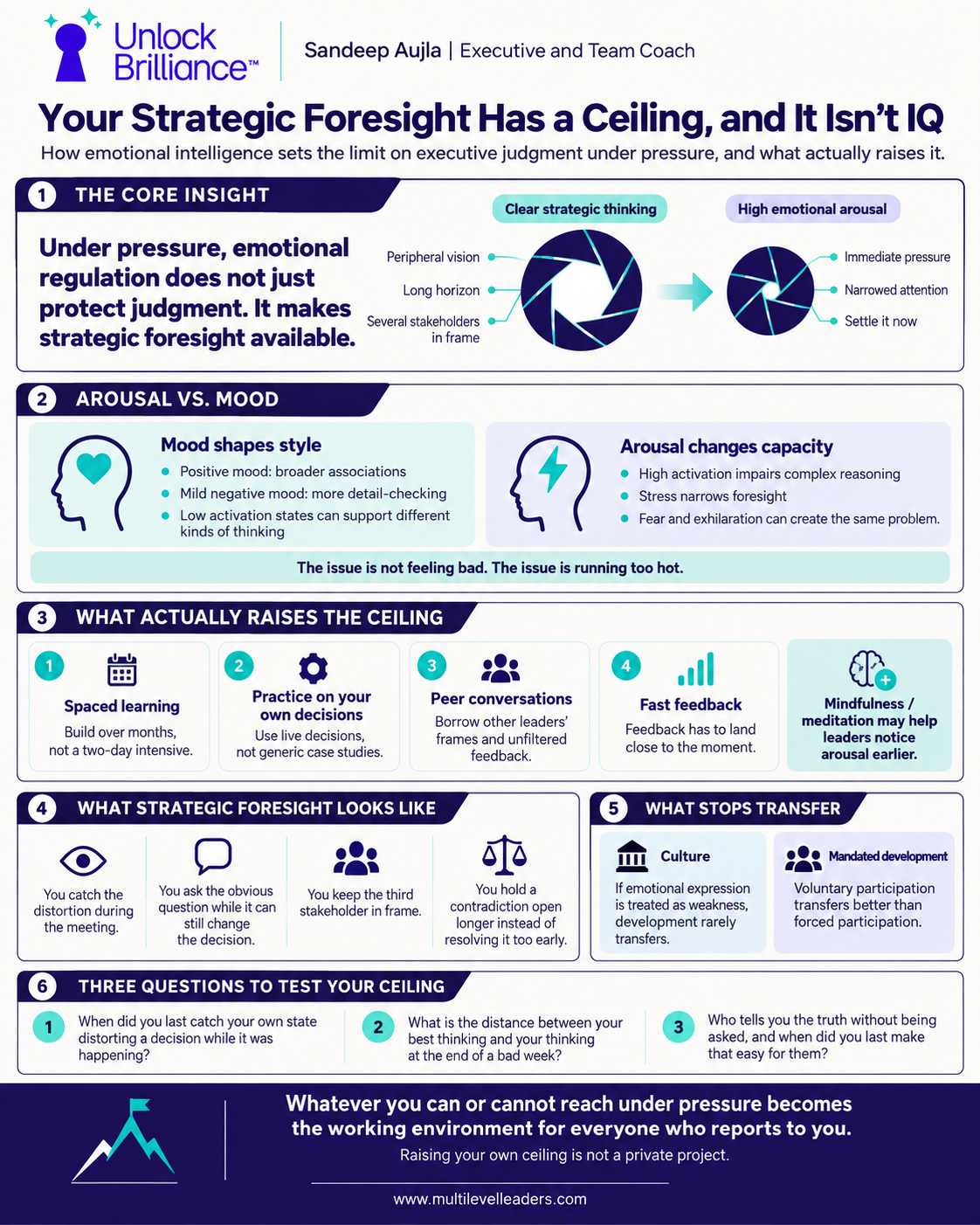
Think of it as an aperture.
That creates a possibility worth taking seriously at senior levels: emotional intelligence may have a cognitive consequence that receives less attention. It may affect how much of the strategic field remains available while you decide. Self-awareness can help you notice when your judgment is being distorted. Empathy can keep several stakeholder positions in the frame instead of collapsing them into one. On that account, these capabilities become inputs to the work you are paid for, alongside their better-known relational value.
That is a claim about one part of emotional intelligence, not all of it. Emotional intelligence covers more than managing your own state, so the next question is why this part carries particular weight in the argument.
Which part of emotional intelligence matters most for a senior leader
Emotional intelligence is usually described as four capabilities: noticing what you are feeling, managing it, reading what other people are feeling, and using both to handle relationships well. Models name them differently, but the four jobs are stable across them.
This article is mostly about the second one, which needs defending rather than assuming. Senior leaders need all four. Three things make emotional regulation particularly important to the proposition here.
It is the capability the condition loads. The other three operate on information: what you are feeling, what someone else is feeling, and what to do about it. Emotional regulation operates on the capacity that processes all of it. When emotional arousal narrows the aperture, everything the other three would have told you is still true and may become less available to you.
It is also difficult to outsource. A senior leader’s emotional intelligence is substantially scaffolded by other people. Someone in the room may read it better than you do. Someone may tell you afterwards what a stakeholder actually meant. But nobody else can directly regulate your own activation while the meeting is still happening.
And its failure can be unusually difficult to detect. Misreading a stakeholder eventually surfaces because the stakeholder acts on it. A narrowed aperture may not surface so clearly. From the inside, the narrowed frame can still look like the whole picture.
That is why I give regulation particular weight here: under pressure, it may constrain access to the other capabilities, it cannot be outsourced in the moment, and its failure can be difficult to detect.
However, not every unpleasant emotional state weakens judgment. Some can sharpen it, which is why you have to separate mood and arousal before the argument goes further.
Doesn’t a sombre mood improve critical thinking?
It can, and the answer turns on a distinction worth drawing carefully. In ordinary conversation, mood, emotion and arousal get used more or less interchangeably, which is reasonable. For this argument, two of them have to come apart.
Mood is emotional tone: positive or negative, pleasant or unpleasant. Emotional arousal is activation: how charged the body is, which shows up as pulse, breathing, and where attention goes. A sombre executive and an anxious executive are not in the same state, even though both may feel bad.
A mild mood can shape how you process information. A mildly positive mood tends to support broader association, possibility-scanning, and creative problem-solving. A mildly negative mood can support more careful analysis, closer attention to detail, and more systematic checking. That is why a sober second look can sometimes improve a plan, and why a constructive mood can help when the work calls for imagination.
Under acute stress, the body’s activation can impair the prefrontal systems that support complex reasoning and hand more control to habitual responses. That can happen whether the emotion is fear, anger, urgency, or even exhilaration. A leader who is furious and a leader who is elated are in different moods, but both may be dealing with the same narrowed capacity.
The instruction, then, is not “stay calm.” Different phases of strategic work are served by different states. Scanning for possibilities may benefit from mild positive affect. Stress-testing a plan may benefit from mild negative affect. Both are low-activation states. The concern is high activation, where the aperture may narrow and strategic options may become harder to hold in view. So the aim is not to feel calm before a hard meeting. It is to notice which state you are in, and to arrange the work so that the state you bring to a decision is one you can still think from.
There is another practical point: the effect of mood weakens when people correctly identify where the mood is coming from. “I am irritable because I slept badly, not because this proposal is weak” is a real intervention, and it costs nothing. That is another way self-awareness may protect judgment: by keeping an unrelated mood from attaching itself to a decision.
I would hold the mood findings more loosely than the arousal findings. Much of that research comes from laboratory settings, often with student samples, and the effects are modest. The pattern is useful enough to design around, but not precise enough to prescribe how an executive should feel before a decision.
That is why mood is a useful distinction, but not the main development target. The harder question is whether leaders can access emotional intelligence when pressure is intense and the stakes are high.
Can emotional intelligence assessments predict a leader’s ability to use EI during disruption?
A conceptual paper on why leaders falter in critical moments gives that gap a name: the interference that occurs when leaders know about emotional intelligence but cannot reach it under stress. Naming something is not evidence that it exists, and I am not yet aware of any instrument that tests EI under real pressure or disruption.
The description still matches an experience many executives will recognize after completing a 360, seeing themselves clearly in the report, and then finding that insight much harder to access when pressure rises. Knowing your EI profile and flexing it under pressure may be different capabilities. Much EI training concentrates more heavily on the first.
Can senior leaders develop emotional intelligence through training?
Yes, though narrowly. One controlled experiment speaks directly to this. Participants took an emotional intelligence course, a resilience course, or a placebo. Only the first two produced gains, and those who attended every session gained roughly twice the average. It was run with business school students rather than executives, so read it as evidence that the capability is trainable and that participation matters, not as a number to expect for yourself.
Across medical training programs, typical gains run four to eight percent on a self-report measure. Small, but real.
Small does not mean useless, and it does set the expectation. What a program of this kind can reasonably be asked to produce is a modest shift in a measured capability, not a different leader. A proposal promising more than that is promising more than the evidence carries.
Those are the gains that have been measured. The limits on them are larger, and they bear directly on whether the proposition in this piece can stand.
What the evidence on emotional intelligence and strategic foresight does not show
Three limits on the evidence, and one on me.
First, and largest: nobody has run the study. I have not found a research report that raises leaders’ emotional intelligence and then measures whether their strategic foresight improved. What exists instead is convergence, which is a weaker thing. Brain-imaging work on stress and prefrontal function, a study of emotional and social competencies in wildfire incident commanders, and global survey data on leaders under uncertainty all point in the same broad direction, and none of them tests that direction.
Convergence can be a sign that a mechanism is real. It can also be a sign that several fields share an assumption.
Second, the causal arrow may run backwards. Leaders who already think well under pressure may simply find emotional regulation easier, in which case it would mark good judgment rather than produce it. Nothing in the available evidence rules that out.
Third, averages hide programs. In the largest analysis of leadership training available, individual programs varied widely enough that the underlying effects ranged from negative to large. An average tells you little about the program in front of you. The evidence supports not leadership training in general, but particular design choices examined separately.
The fourth limit is mine. I coach and train senior leaders for a living, so I have a commercial stake in this area and a large body of observations from doing this work repeatedly. Those observations shape the questions I ask, the patterns I notice, and how I deliberate about competing interpretations of what the evidence may mean in practice, but they are not empirical evidence. That is why I explicitly distinguish between what the research shows and what I interpret from practice.
With those limits in view, what I would still stand behind is narrower than the original claim and more useful than it sounds. That high activation can impair complex reasoning is well established. The design choices below are supported by large analyses of leadership training in their own right, whatever they turn out to do for foresight. I would treat the connection between the two as credible and evidence-informed, while being careful not to claim that this particular executive application has been directly tested.
That is what the limits mean for use. Treat the design choices as the part with stronger empirical support, and the proposed mechanism as the reason for arranging them in this order rather than another. If the mechanism turns out to be wrong, you may still have built a better-designed development program.
What would change my mind?
One well-designed study would test the proposition much more directly.
Take senior leaders in a single sector, randomize them either to an emotional intelligence program or to an equally demanding program on something else, demonstrate that the EI intervention actually changed the targeted capability, then assess strategic foresight through observer-rated behaviour or decision quality rather than participant self-report. Measure again well after the program ends.
If well-powered studies repeatedly found no meaningful difference in foresight despite demonstrable improvements in EI, that would substantially weaken the proposition. I would want to know that.
What actually makes emotional intelligence usable under pressure
If the proposition is right, the development challenge is not simply to add more information about emotional intelligence. It is to make a useful response more available when physiology is working against access.
That distinction changes how development should be designed. Information alone may do little to change what becomes accessible in a pressured moment. That helps explain why a well-reviewed workshop can leave your judgment largely unchanged on a bad Tuesday.
Four design choices have comparatively strong support in the training-transfer literature and, if the access proposition is right, offer a plausible way to build for it: spacing, practice on live material, peers, and feedback close to the event.
Why spaced learning may work better than a two-day intensive
The development challenge may be understood partly as a retrieval problem rather than simply a knowledge problem. You may already know what good regulation or good judgment looks like. The harder task is making the response available when your own physiology is working against you.
Availability is more likely to develop through repeated retrieval across different situations than through a single vivid exposure.
A two-day intensive gives you one concentrated experience. Six sessions across six months give you repeated opportunities to return to the material under changing conditions. More importantly, the gaps are not empty. Between sessions, you return to the situations where access actually becomes difficult, which can turn each interval into a field test and each session into a debrief on real attempts rather than a rehearsal of ideas.
In an analysis of 335 leadership training samples covering more than 26,000 participants, the same content spread across weeks or months transferred to the job substantially better than when it was compressed into days, and produced close to three times the organizational results. A ten-month nursing leadership program was deliberately spaced at two-month intervals on the reasoning that compressed training gives behaviour less time to consolidate.
A third study is often cited here, and it will not carry the weight. Thirty-two aspiring school leaders showed nothing after one semester. Two years in, they rated themselves significantly higher on social awareness, organizational awareness, and several relationship competencies, while the colleagues who rated them saw no change at all. Read it as evidence about how long self-perception can take to shift, not as evidence that behaviour shifted.
One finding runs the other way. Spacing did not improve knowledge acquisition; compressed delivery was slightly better at that. Spacing appears to buy more in behaviour change and organizational results than in faster learning. If what you want is to understand emotional intelligence, a good two-day course may do that. If what you want is reliable access to the capability months later under pressure, the evidence suggests compressed learning alone is unlikely to be sufficient.
Why practising on your own decisions matters more than case studies
A case study is unlikely to reproduce the arousal of the situations in which senior leaders most need access to judgment. The board member who dismisses your reasoning in front of your peers might. So might the funding decision you cannot defend without conceding something you would rather not.
Working through someone else’s dilemma trains recognition in a relatively calm state. Practising on your own live situations is more likely to evoke at least part of the physiological and emotional signature attached to the real decision. It therefore better approximates the conditions under which the capability will later be needed.
That is why confidential coaching can be valuable: it lets senior leaders work with real decisions while the pressure is still recent, extract insight before the story hardens, and practise emotional regulation closer to the conditions that usually make them run hot.
As for capability-building workshops, across 117 studies of behavioural training, transfer to the job was greatest when practice used participants’ own scenarios rather than prepared cases. For a senior leader, that sets a practical test for any development you are offered: whose decisions are in the room?
Why peer conversations reach what a 360 cannot
Training programs that include peers and direct reports may be especially useful because they can restore two things seniority often reduces: unfiltered information about yourself, and exposure to other people’s frames.
Nobody who reports to you will easily say that you closed a question before you understood it, and nobody above you may be watching closely enough to notice. A group of people at your own altitude, with no stake in your approval, may be more willing to say it.
A 360 gathers that information once, anonymously, and delivers it as a document a few weeks later. A peer group can deliver it as a conversation about something that happened last week. That changes the immediacy and usefulness of the feedback.
The second benefit may matter even more for foresight. Organizational awareness, noticing patterns across a system rather than inside a function, is one way foresight becomes visible in organizational life, and pattern recognition improves through exposure to instances. One career supplies a limited number. Hearing four peers describe how they read the same kind of ambiguous situation adds theirs to yours.
You are, in a sense, borrowing aperture. Some of those additional frames may remain available afterwards.
Across 61 studies of what makes training survive contact with the job, peer support predicted whether skills were used at all and whether they were still in use three months later, at roughly the same strength as support from a supervisor. Together with organizational support, these account for about a third of the difference between training that transfers and training that evaporates.
One limit: I have not found a study comparing a cohort directly against individuals attending the same program. The case for cohorts is an inference from the peer-support finding, not a head-to-head result.
Why feedback has to land close to the moment
A narrowed aperture may be difficult to detect from inside it. Self-assessment alone may miss the narrowing precisely when activation is highest.
Someone else may therefore need to name what they saw, and soon enough that you can still recall the state you were in. Delay it by a quarter, and you may no longer be discussing the meeting itself. You are discussing a story you have since told yourself about the meeting, edited for coherence.
Feedback within days keeps the behavioural fact closer to the state in which it occurred, which may make the learning more usable the next time.
That is another reason confidential coaching suits this work: it offers reflection close enough to the event that the leader can still reach the state, the stakes, the defensive move, the missed question, and the narrowed frame. Coaching gives that moment a disciplined container, private enough for candour, structured enough to challenge the story, and close enough to convert experience into usable judgment before the lesson goes cold.
In that same analysis of 335 samples, adding feedback to a program raised transfer to the job from a modest effect to a large one, close to a tripling. It is among the cheaper design features to include and among the first to be cut.
One further approach aims at the interruption itself: noticing arousal early enough to act on it. In a randomized study of 64 London chief executives, twelve weeks of meditation improved measured emotional intelligence on several dimensions. Small, single-city, and self-reported, so I would hold it loosely. It is also one of the few methods here aimed directly at the moment where access may fail.
How these may compound over twelve to twenty-four months
None of these design choices necessarily work alone, and over a long enough engagement each may increase the value of the others.
Feedback close to the moment may help you notice narrowing earlier next time. Noticing earlier gives you more real instances to bring to a peer group. More instances may widen the pattern library you draw on when something genuinely novel arrives. A wider frame may also give you more options before pressure begins to close it.
I am not aware of a study that tests that loop end to end. It is the mechanism the design implies rather than a measured finding, and the one study with a two-year horizon cannot carry it because the change there appeared in how participants saw themselves and not in how anyone else saw them.
So the compounding account remains a testable design hypothesis rather than a demonstrated developmental trajectory. Treat the long timeline as a reason to create repeated opportunities for practice and transfer. Treat the claim that judgment itself changes as open.
What this would look like as strategic foresight
If the proposition holds, here is what a year or two of this kind of development might look like from the inside. It describes the target rather than a promised result.
You catch the distortion during the meeting instead of at eleven that night. You ask the obvious question while it can still change the decision. You keep the third stakeholder in frame when the first two are the loudest. You notice that a situation resembles one a peer described in March, and you adjust before the resemblance is obvious to everyone else. You hold a contradiction open for another week rather than resolving it early because the discomfort of holding it had become the real problem.
None of that appears neatly on an emotional intelligence assessment. These are the kinds of behaviours through which better strategic judgment and foresight may become visible.
What stops emotional intelligence training from working
In cultures where emotional expression reads as unprofessional or weakness-signalling, EI development may be constrained even when individual skill genuinely improves. The pattern is particularly relevant in fields such as medicine and the military.
If that describes your organization, your own capability may not be the binding constraint. The environment may be. Development inside such a climate can produce capability that is difficult to use openly.
How you got to training matters too. Across those 335 samples, transfer was several times higher when attendance was voluntary than when it was mandated, the single largest moderator in the study. It ran the other way on organization-level outcomes, so this is a real trade-off rather than a rule. But a senior leader required to attend training rather than choosing it should know the evidence on individual transfer is less favourable under that arrangement.
Three questions to test whether you can reach emotional intelligence under pressure
- When did you last catch your own state distorting a decision while it was happening, rather than afterwards?
- What is the distance between your best thinking and your thinking at the end of a bad week?
- Who tells you the truth without being asked, and when did you last make that easy for them?
If the answers are uncomfortable, the issue may not be what you know. It may be what remains available when pressure rises.
There are credible reasons to believe that capacity can be strengthened through executive coaching or development designed to unfold over several months rather than a single workshop, particularly when it involves practising on your own decisions with people who will tell you what they saw. The evidence is stronger for those design features than it is for the full causal proposition advanced in this essay.
Your emotional regulation becomes their working conditions
Employees who experience stronger leadership from their supervisors tend to show higher emotional intelligence themselves, learned partly by watching. That finding shows association, not proof of cause. Still, it points in the same direction as the rest of the evidence: the way leaders operate under pressure shapes the conditions around them.
Across those 117 studies, what people learned survived contact with the job best when their own superiors had been trained too. In other words, development transfers more reliably when the environment reinforces it.
That is the executive consequence.
Widening your own aperture under pressure is therefore more than a private development project. It may become part of the strategic environment you create.
None of this asks you to be less affected by hard things. It asks you to notice what pressure does to your field of view, and to build the conditions in which you can still see widely at the moments it matters most.
References
Arnsten, A. F. T. (2009). Stress signalling pathways that impair prefrontal cortex structure and function. Nature Reviews Neuroscience, 10(6), 410–422. https://doi.org/10.1038/nrn2648
Bless, H., Clore, G. L., Schwarz, N., Golisano, V., Rabe, C., & Wölk, M. (1996). Mood and the use of scripts: Does a happy mood really lead to mindlessness? Journal of Personality and Social Psychology, 71(4), 665–679. https://doi.org/10.1037/0022-3514.71.4.665
Boyatzis, R., Thiel, K., Rochford K., & Black, A. (2017). Emotional and social intelligence competencies of incident team commanders fighting wildfires. The Journal of Applied Behavioral Science. https://doi.org/10.1177/0021886317731575
Chanda, V., Buchireddy, S., Sawant, A., et al. (2025). Systematic review of healthcare curriculum for training in emotional intelligence within physicians, residents, and medical students. Journal of Medical Education and Curricular Development. https://doi.org/10.1177/23821205251380030
Chen, Y., & Lee, Y.-I. (2017). Developing emotional intelligence of employees: The role of leadership.
Forgas, J. P. (2013). Don’t worry, be sad? On the cognitive, motivational, and interpersonal benefits of negative mood. Current Directions in Psychological Science, 22(3), 225–232. https://doi.org/10.1177/0963721412474458
Fowler, K. R., Robbins, L. K., Field, A., & Avitia, G. (2025). Role of emotional intelligence in nursing leadership: Enhancing resilience and reducing turnover intent. Nursing Management. https://doi.org/10.1097/nmg.0000000000000251
Hughes, A. M., Zajac, S., Woods, A. L., & Salas, E. (2020). The role of work environment in training sustainment: A meta-analysis. Human Factors. https://doi.org/10.1177/0018720819845988
Isen, A. M., Daubman, K. A., & Nowicki, G. P. (1987). Positive affect facilitates creative problem solving. Journal of Personality and Social Psychology, 52(6), 1122–1131. https://doi.org/10.1037/0022-3514.52.6.1122
Krishnan, V. (2023). Why leadership falters in critical moments: Emotions and the impact on cognitive abilities. Future of Business Administration. https://doi.org/10.33422/fba.v2i2.505
Kumar, R., & Kumar, P. R. (2024). Emotions and leadership: The importance of emotional intelligence in military leadership. International Journal of Engineering Technology and Management Sciences. https://doi.org/10.46647/ijetms.2024.v08i06.006
Lacerenza, C. N., Reyes, D. L., Marlow, S. L., Joseph, D. L., & Salas, E. (2017). Leadership training design, delivery, and implementation: A meta-analysis. Journal of Applied Psychology, 102(12), 1686–1718. https://doi.org/10.1037/apl0000241
Reuben, E., Sapienza, P., & Zingales, L. (2009). Can we teach emotional intelligence? https://doi.org/10.2139/ssrn.1915471
Russell, J. A. (1980). A circumplex model of affect. Journal of Personality and Social Psychology, 39(6), 1161–1178. https://doi.org/10.1037/h0077714
Sánchez-Núñez, M. T., Patti, J., & Holzer, A. A. (2015). Effectiveness of a leadership development program that incorporates social and emotional intelligence for aspiring school leaders. Journal of Educational Issues, 1(1), 65–89. https://doi.org/10.5296/JEI.V11I1.7443
Schwarz, N., & Bless, H. (1991). Happy and mindless, but sad and smart? The impact of affective states on analytic reasoning. In J. P. Forgas (Ed.), Emotion and social judgments. Pergamon.
Schwarz, N., & Clore, G. L. (1983). Mood, misattribution, and judgments of well-being: Informative and directive functions of affective states. Journal of Personality and Social Psychology, 45(3), 513–523. https://doi.org/10.1037/0022-3514.45.3.513
Tamwatin, T., Hlupic, V., & Amar, A. (2013). Does meditation improve emotional intelligence of senior managers? Findings from a study in London. Academy of Management Proceedings. https://doi.org/10.5465/ambpp.2013.257
Taylor, P. J., Russ-Eft, D. F., & Chan, D. W. L. (2005). A meta-analytic review of behavior modeling training. Journal of Applied Psychology, 90(4), 692–709. https://doi.org/10.1037/0021-9010.90.4.692
Westover, J. H. (2026). Managing emotional uncertainty: Five leadership traits that drive decisive action. Human Capital Leadership Review. https://doi.org/10.70175/hclreview.2020.31.3.4
Wopat, J. A., & Needham, C. R. (2021). Leveraging emotional intelligence for organizational performance within the military. Open Journal of Business and Management. https://doi.org/10.4236/ojbm.2021.95143