
Emotional intelligence · 12 min read · September 16, 2026
Composure May Be the Most Expensive Way to Manage Your Emotions
By Sandeep Aujla, Founder and Lead Coach, Multilevel Leadership Consulting (MLC) Inc.

You held it together.
Your voice stayed level. You thanked the person for the challenge. You did not say the thing you were thinking. Walking back to your office afterwards, you noticed your jaw ached. You also realized you could not remember the last two items on the agenda.
That is composure working exactly as advertised.
It is worth asking what it cost.
What “emotionally activated” and “composure” actually mean
I am using three terms in this piece that can easily get blurred together. In ordinary conversation, they are often used interchangeably, which is understandable. For this argument, though, the distinctions matter, so it is worth clarifying what I mean by each one.
Activation is the body’s charge. Heart rate rises, breathing gets shallower, and attention narrows onto whatever feels most urgent. Activation is not the same as feeling bad. Good news activates you too, which is why excitement and anxiety can be hard to tell apart in the moment.
Composure is what other people can see: a steady voice, an unhurried pace, a face that gives away less than it might.
Emotional regulation is what is happening underneath. It is whether the activation has actually come down.
Why composure costs more than it looks
In one experiment, 120 people were randomly assigned one of three instructions before watching a distressing film: reinterpret what they were seeing, hide any reaction, or simply watch. Hiding the reaction worked in the narrow sense that observers saw less. It did not reduce what people actually felt. It also raised physiological arousal above the group who did nothing at all.
Reinterpreting the situation did reduce the feeling, and that skill is real and trainable. It is also modest. A meta-analysis of 35 randomized trials covering 5,638 people found that this kind of reappraisal had a small positive effect on performance. Once the researchers corrected for the tendency to publish results that worked, the effect became smaller.
Small does not mean useless, but it does mean we should account for the size of the effect when setting expectations for training that skill.
The second cost matters more for senior leaders because it affects the decision you are about to make. A meta-analysis of 51 studies and 2,486 healthy adults found that acute stress impairs working memory and cognitive flexibility. Those are the capacities you use to hold several things in view at once, weigh trade-offs, and change your mind when new information deserves it.
The effects were small, roughly a fifth to a third of a standard deviation, and they were strongest when the task was already demanding. That last point matters because executive work is rarely simple when it counts. The timing matters too: the impairment increased with the delay since the stressor rather than clearing quickly, which means that by the time you need composure, you may be asking for skilled work from the part of you the situation has already degraded.
The four emotional intelligence skills, and when they are available to you
In the ability model, emotional intelligence has four skills.
Perceiving and expressing emotion means reading accurately what you and other people are feeling, and saying it in a way that lands.
Using emotion means putting yourself in the state a particular task actually needs.
Understanding emotion means knowing what produced a feeling, and where it will likely go next if nothing changes.
Managing emotion means shifting your own state and helping another person regain theirs.
Each skill is real. Each is trainable. I teach all four. What they have in common is easy to miss: every one of them runs on working memory and flexible thinking, and those are the capacities that thin out first under load.
That is not an argument against developing them. It is an argument about sequencing. If emotional intelligence gets harder to access as activation rises, the higher-return move is often to arrive with less activation to manage.
This is where the conversation has to move upstream. If emotional intelligence skills become harder to access as activation rises, then the development question is not only how to strengthen those skills. It is also how to shape the situations that determine whether those skills will be available when you need them. That is why Angela Duckworth’s work on situation is so useful here.
What Angela Duckworth means by “situation”
I have long admired Angela Duckworth’s work because, as an Organizational Psychology Practitioner, I value researchers who take serious behavioural science and make it usable without making it simplistic. That is one reason I am genuinely excited about her latest book, Situated. It gives leaders a better way to think about behaviour change than simply trying harder in the moment.
Her definition of “situation” is wider than the word usually suggests:
“By ‘situation,’ I mean the objective physical and social circumstances you inhabit. Not just the actual spaces but also the company you keep, not just the objects within sight and reach but also cultural norms. Your situation is quite literally everything and everyone around you. All of it.”
For senior leaders, that matters immediately.
Much of what makes a meeting hard is situation. Who is in the room. What they read beforehand, and whether they read anything at all. Whether the question arrives as a surprise or as the fourth time you have heard it. What time of day it is. Whether the person raising the concern has an audience. Whether you have already had the harder version of the conversation in private.
Duckworth’s book includes a one-page worksheet called the Three-Boxes Blueprint. The boxes are Situation, Thoughts, and Response. You read it left to right to understand how a behaviour happened. You fill it in right to left to change one: name the behaviour you want, then the thought that would support it, then the change in situation that would help produce that thought.
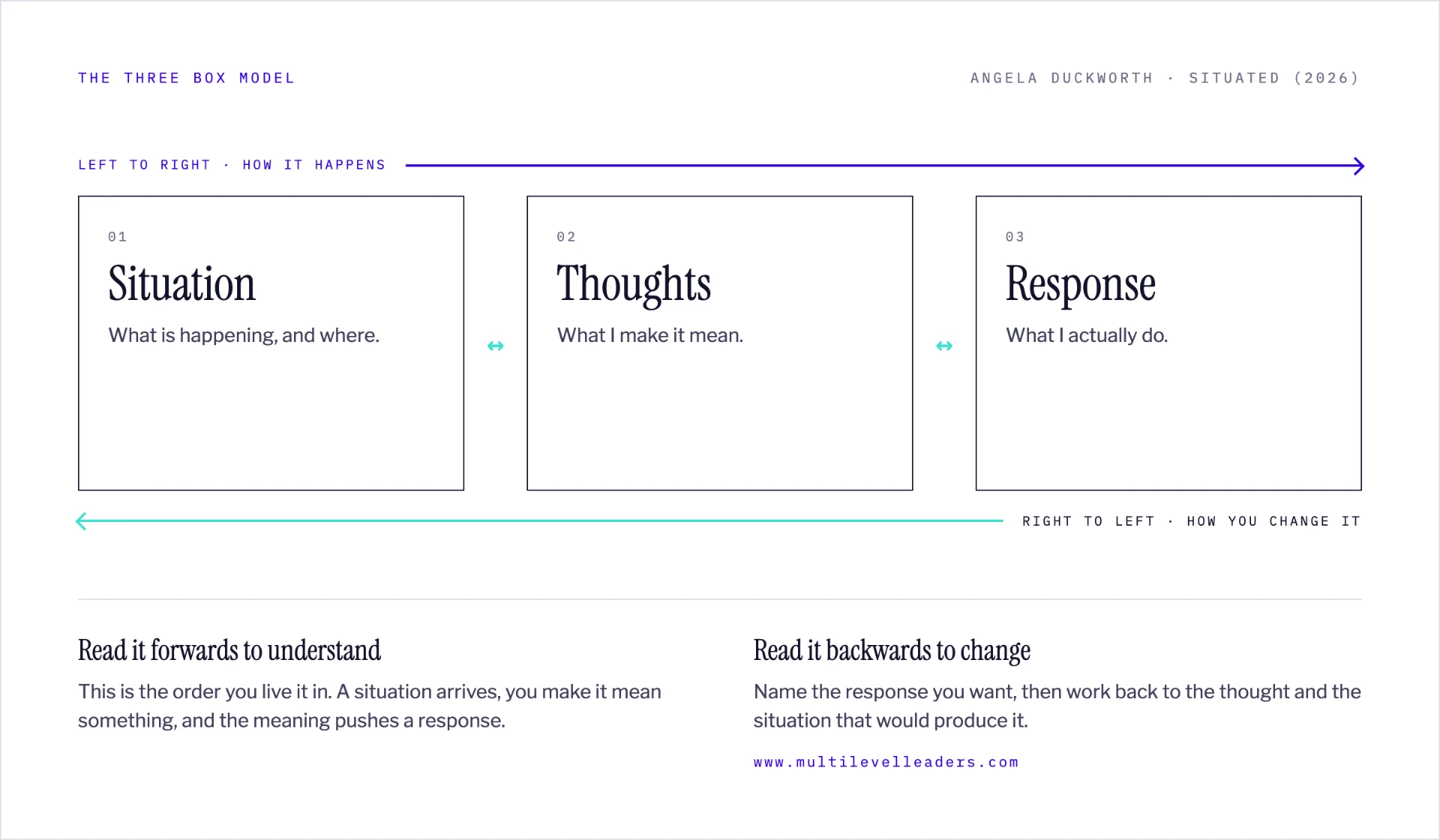
I like that move because it shifts attention away from heroic self-control in the moment and toward design before the moment arrives.
The fourth box, and why I add it
I use four boxes: Situation, Thought, Emotion, and Behaviour.
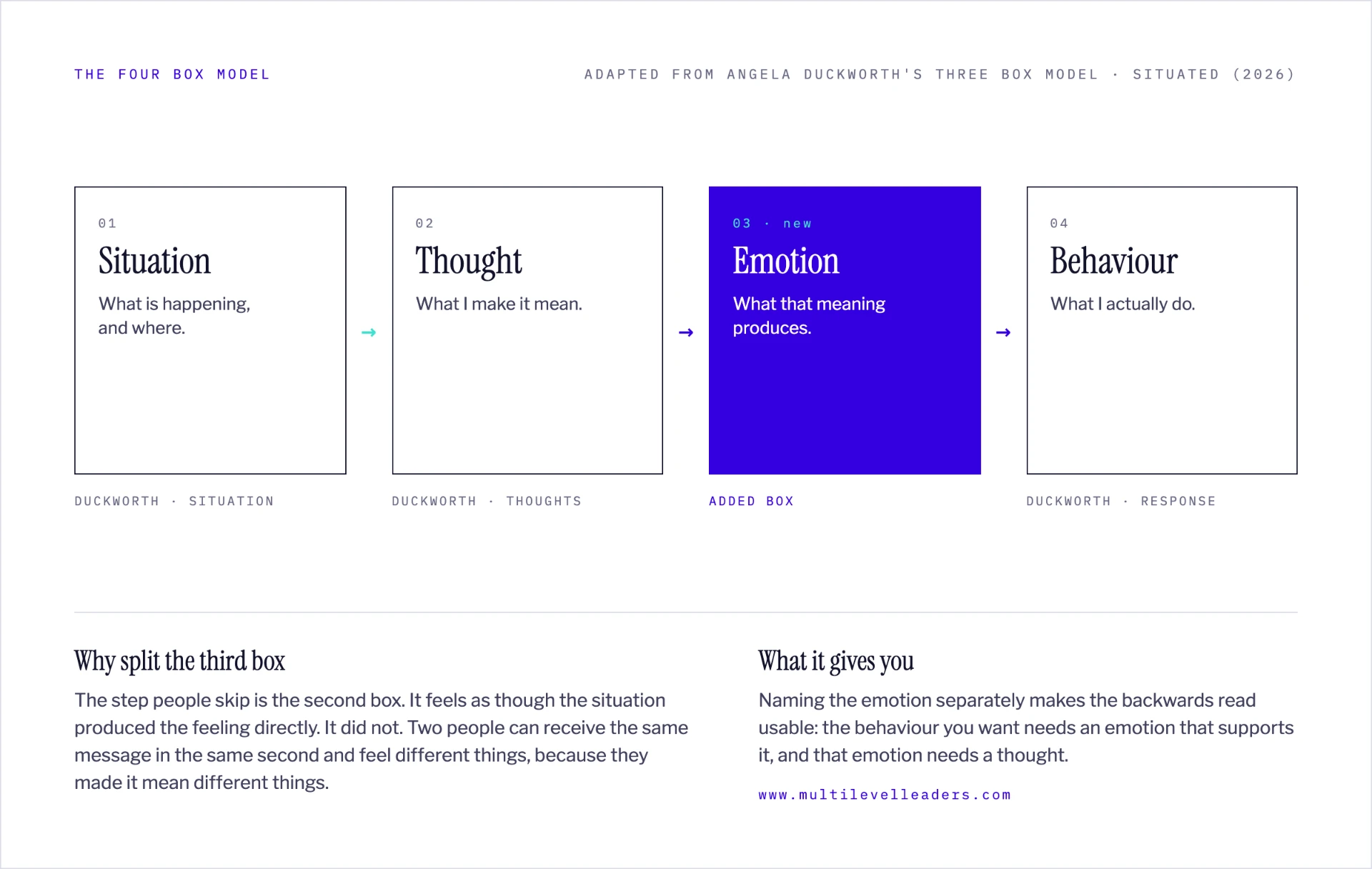
The fourth box is mine, and the reason is composure itself.
“Response” bundles what you feel and what you do. For many purposes, that is fine. For composure, it can hide the entire problem because composure is exactly the case where feeling and doing have come apart.
Two separations are doing the work, and each one costs something different when it collapses. An emotion is not the thought that produced it, and an emotion is not the behaviour that follows it.
An emotion is not the thought. A thought changes when you test it against evidence. An emotion does not. It changes when the conditions change, or when you choose what to do while it is still present. That difference is practical rather than philosophical, because it tells you which tool to reach for. If what you are carrying is a reading of the situation, checking it against what you actually know can move it. If what you are carrying is a feeling, checking it will not, and the useful questions become what would have to change, and what you will do while it is still there.
There is a cost to collapsing the two. The emotion is the signal that something mattered to you. Fold it into the thought and you lose the signal, which is how a leader ends up with a tidy analysis of a meeting and no idea why it is still sitting with them at nine that evening.
An emotion is not the behaviour. Senior leadership often rewards the visible behaviour while missing the internal cost. A leader can pause, nod, thank someone for the challenge, and still be losing access to curiosity, flexibility, and judgment underneath.
That distinction changes the development target. If we only look at behaviour, the goal becomes better performance under pressure. If we also look at emotion, the goal becomes earlier regulation, before the leader has to rely on performance to cover the cost.
Holding the two apart also lets you ask two questions instead of one:
- What state do I need to be in for this to go well?
- What do I actually want to do?
This is closer to a restoration than an invention. The framework Duckworth extended came from a model of emotion regulation, and in that model the third step was the emotional response itself. When the model was generalized from emotion to behaviour, that step was folded into a single word.
That is good news, because the point is not to feel perfectly calm before a difficult meeting. The point is to design the situation so the emotional state you are likely to enter with is one you can still lead from.
Four situation plays for senior leaders
Duckworth’s examples come mostly from personal life. They translate only partly to an executive’s work week. The four situation plays I use with senior leaders come from political acumen rather than habit change: the meeting before the meeting, socializing the idea, asking for a specific critique, and closing the loop on it.
The meeting before the meeting
You have the difficult part of the conversation one to one, before either of you has an audience.
The objection gets raised where it costs less to raise it, and where you can be curious about it instead of defending yourself in front of eleven people.
This is not avoidance. It is situation design.
Socializing the idea
The recommendation goes out in draft form at least a week in advance to the two people most likely to object, with one question attached: What am I missing?
That gives them time to review it properly, notice what concerns them, and raise the objection before the formal meeting. By the time the meeting happens, you are no longer introducing an idea cold. You are testing, refining, and confirming one.
Asking for a specific critique
Not “any thoughts?” That question often invites silence or a broadside.
A better question is: Where is this weakest?
A specific request gets you the objection in a form you can work with, at a time when working with it is still cheap.
Closing the loop
You go back and say which part of their input you used, what changed because of it, and what you decided against and why.
This is the one most often skipped. In my experience, it is also the one that does the most work. Someone who has seen their input taken seriously is more likely to bring you the next problem early.
None of these is an influence tactic in disguise. Each one removes a moment where you would otherwise have needed composure. A surprise objection in a room of your peers is an activating event. The same objection, raised over coffee on Tuesday by someone who knows you asked for it, is a conversation.
That is the shift.
The work is not to become someone who never gets activated. The work is to become more deliberate about the situations you keep walking into, especially the ones you can shape before they shape you.
Three limits worth naming
The third is mine.
First, the four-box version is a practitioner’s model. Nobody has tested it against a three-box version, and I have not found a study of situation design with senior leaders specifically.
Second, the evidence for designing the situation is thinner than the argument for it. The authors of a meta-analysis covering 306 experimental comparisons of emotion regulation strategies say directly that experiments have rarely tested how people regulate their own emotions by selecting or modifying situations. What has been tested most is what is easiest to run in a laboratory, which is not what a senior leader is best placed to use.
The case for intervening early rather than in the moment is set out in a 2016 review Duckworth co-wrote, and it is worth knowing what that paper is. It is a conceptual review rather than a study, and its own claim is hedged: situational strategies may be especially effective, on the reasoning that an impulse is easier to interrupt before it matures. That is a credible argument and it is not a tested result. So I would treat the four-box executive application as evidence-informed rather than proven, and I would say the same about any other version of it.
The practical case is also reinforced from outside the emotion regulation literature. Priya Parker makes a compelling argument in The Art of Gathering that gatherings, including meetings, are shaped by design: purpose, invitation, structure, room, sequence, and the way people are brought into conversation. Her language is different from Duckworth’s, but the leadership implication is similar. Meetings are not neutral containers. They are designed situations. Sometimes carefully. Often accidentally.
That is why the model should travel with humility.
You try something, watch what happens, and adjust.
Third, I coach and train senior leaders for a living, so I have a commercial stake in this area and a large body of observations from doing this work repeatedly. Those observations shape the questions I ask, the patterns I notice, and how I deliberate about what effective situation design and executive development may look like in practice, but they are not the same as empirical evidence. That is why I distinguish explicitly between what the research shows and what I am interpreting from practice.
That doesn't make the argument wrong but I want to be clear about the limits of the evidence and you should not mistake a useful model for a proven formula.
Three questions before your next hard conversation
- Who in that room will be hearing this for the first time, and could they have heard it from you earlier instead?
- What state do I need to be in for this to land, and what would help put me there before I walk in rather than during?
- The last time somebody gave me a difficult piece of feedback, did I go back and tell them what I did with it?
If the answer to the last question is no, start there.
It costs one conversation. It changes what people bring you and how early they bring it. It is also the one situation play that keeps improving the room long after the meeting ends.
The larger point is simple: composure is useful, but it is late. By the time you are holding it together in the room, the situation has already done much of its work on you.
References
Bosshard, M., & Gomez, P. (2024). Effectiveness of stress arousal reappraisal and stress-is-enhancing mindset interventions on task performance outcomes: A meta-analysis of randomized controlled trials. Scientific Reports, 14, 7923. https://doi.org/10.1038/s41598-024-58408-w
Duckworth, A. (2026). Situated: Find the people and places that bring out your best. Scribner.
Duckworth, A. (2026). Three-boxes blueprint [Worksheet]. https://www.angeladuckworth.com/s/3-Boxes-Blueprint-Handout.pdf
Duckworth, A. L., Gendler, T. S., & Gross, J. J. (2016). Situational strategies for self-control. Perspectives on Psychological Science, 11(1), 35–55. https://doi.org/10.1177/1745691615623247
Gross, J. J. (1998). Antecedent- and response-focused emotion regulation: Divergent consequences for experience, expression, and physiology. Journal of Personality and Social Psychology, 74(1), 224–237. https://doi.org/10.1037/0022-3514.74.1.224
Mayer, J. D., Salovey, P., & Caruso, D. R. (2008). Emotional intelligence: New ability or eclectic traits? American Psychologist, 63(6), 503–517. https://doi.org/10.1037/0003-066X.63.6.503
Parker, P. (2018). The Art of Gathering: How We Meet and Why It Matters. Riverhead Books.
Shields, G. S., Sazma, M. A., & Yonelinas, A. P. (2016). The effects of acute stress on core executive functions: A meta-analysis and comparison with cortisol. Neuroscience & Biobehavioral Reviews, 68, 651–668. https://doi.org/10.1016/j.neubiorev.2016.06.038
Webb, T. L., Miles, E., & Sheeran, P. (2012). Dealing with feeling: A meta-analysis of the effectiveness of strategies derived from the process model of emotion regulation. Psychological Bulletin, 138(4), 775–808. https://doi.org/10.1037/a0027600