
Leadership assessment · 15 min read · September 22, 2026
When capable healthcare leaders become less effective under prolonged change

How the Hogan Development Survey surfaces the tendencies that grow louder under sustained pressure, and what to do once you can name your own
Most senior leaders in Canadian healthcare have been working in unstable conditions for several years.
Funding models keep shifting. Workforce shortages have become structural. Care continues to move out of hospitals into homes, community settings, and virtual platforms. AI is arriving in documentation, triage, scheduling, diagnostics, and decision support faster than many governance structures can absorb.
That is the part many performance conversations miss.
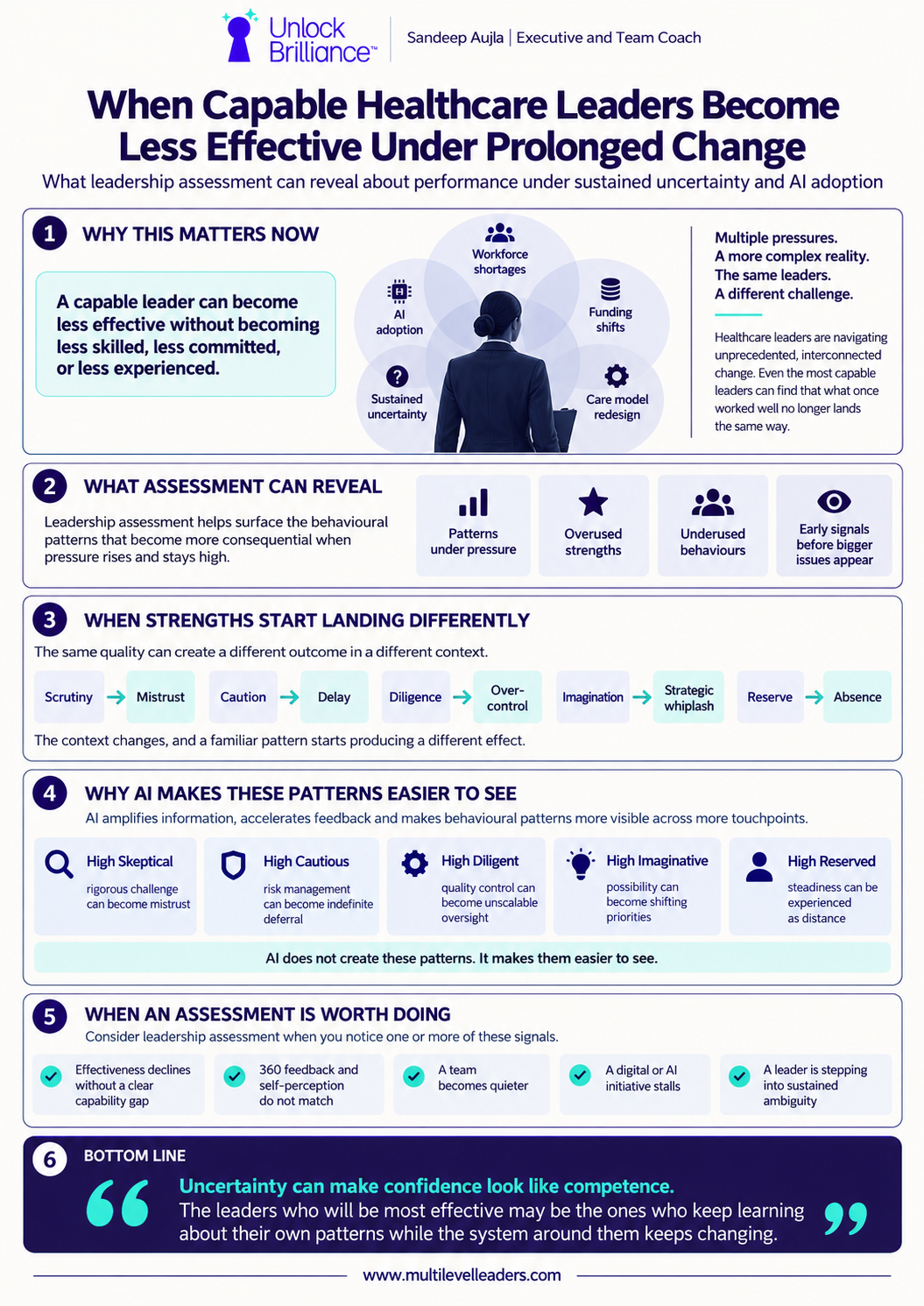
A leader who was once valued for scrutiny may start slowing every decision. A leader known for discipline may begin over-controlling work that needs distributed judgment. A leader who built trust through steadiness may become quieter at the exact moment people need visible communication. A leader who once brought boldness may begin overpromising, changing direction, or moving faster than the system can safely absorb. A leader whose visible commitment once carried a program may begin cycling between intensity and withdrawal as initiatives disappoint.
Nothing dramatic has to happen, such as obvious failure or a sudden loss of competence. But as the context changes, a familiar pattern starts producing a different effect.
That is why leadership assessment can be useful in prolonged change. It does not replace performance reviews, 360 feedback, judgment, or coaching. Its value is more specific: it helps leaders see the behavioural patterns that tend to become more consequential when pressure rises and stays high.
This matters now because healthcare leaders are no longer managing a short disruption. They are leading through sustained uncertainty, and AI adoption is becoming one of the clearest tests of how leaders respond when expertise, risk, governance, and trust are all in motion.
What leadership assessment measures that performance reviews often miss
Performance reviews measure results and observable competencies. They tell you what a leader delivered, where expectations were met, and where performance may have fallen short.
They rarely explain how a leader behaves once conditions become demanding and stay that way.
That question matters in healthcare because the work is rarely under pressure for a few isolated weeks. Senior leaders are often navigating prolonged ambiguity, constrained resources, professional tensions, public scrutiny, and increasingly complex technology decisions. Under those conditions, the issue is not only whether a leader has the right skills. It is how their default patterns show up when the system keeps asking more of them.
Personality assessment can help answer that question.
One widely used tool in executive settings is the Hogan Development Survey, usually shortened to HDS. It is a validated questionnaire that takes about 15 to 20 minutes to complete and produces a profile across eleven behavioural patterns, including skepticism, caution, excitability, diligence, reserve, and boldness.
Of the assessments available for this question, the HDS is the one I reach for most during prolonged change, and I am certified to administer and interpret it. It is built for this condition specifically: not how someone performs on a good day, but which habits become louder when the pressure does not let up.
The HDS patterns describe how a leader manages relationships when pressure increases, and how they manage the impression they leave on others. Research comparing HDS items directly against clinical personality measures found that the survey captures milder, workplace-relevant versions of the clinical patterns. The results describe working behaviour, not a clinical diagnosis.
For senior leaders, the point is not to label someone. It is to understand what a habitual leadership pattern may be doing inside the current role.
The practical value is timing.
These patterns often become visible in an assessment profile before they become obvious in engagement data, turnover figures, failed implementation, or a stalled digital initiative. Assessment gives the leader and the organization language for the pattern early enough to act on it.
What the profile shows, though, is not what most people expect, and that changes how a debrief should be run.
Why mid-range Hogan scores can matter more than low scores
Most people assume that lower scores on a derailment measure are better. A large study of managers and executives, based on ratings from thousands of co-workers, found otherwise.
That finding changes the quality of the debrief.
A high score may show where a leader is overusing a strength under pressure. A low score may show where the leader is underusing a behaviour the role now requires.
In healthcare, that distinction has practical consequences.
A low score on Bold may point to a leader who avoids claiming authority when the organization needs a decision. A low score on Skeptical may point to insufficient scrutiny of a vendor claim, business case, or AI implementation proposal. A low score on Cautious may point to weak risk governance in a regulated clinical environment.
The same logic applies at the high end. High Skeptical may support rigorous due diligence at moderate levels, then work against the organization if colleagues stop bringing forward options. High Cautious may support risk discipline, then turn into indefinite deferral. High Diligent may support quality, then become over-control when the work needs delegation and scalable oversight.
A good debrief examines both directions: where a leader may overdo something, and where they may underdo something relative to what the current role requires. The gap between what the role demands and what the leader defaults to is where the conversation becomes useful.
Nothing tests that calibration more visibly at the moment than AI adoption.
How AI adoption exposes a leader’s default responses under pressure
AI adoption in healthcare unsettles professional expertise.
It affects people whose authority has come from clinical judgment, operational experience, technical knowledge, or system credibility. It also lands differently across primary care networks, long-term care, home care, hospitals, public health, community mental health, pharmacy, paramedicine, and health system partners.
That makes AI adoption a clear test of how a leader responds under pressure.
Six patterns show up most often in healthcare AI programs: Skeptical, Cautious, Diligent, Imaginative, Excitable, and Reserved. Each has a moderate form that helps the organization and a high form that does not. The descriptions below apply HDS scales to behaviours currently visible in these programs. They should be understood as practitioner observations rather than findings from studies of AI adoption, because the research base on leadership derailers in healthcare AI adoption is still emerging.
High Skeptical can show up as sustained interrogation of vendor claims, model performance, colleagues’ motives, and institutional intent. At moderate levels, this supports procurement discipline and protects the organization from naïve adoption. At high levels, the tone can become so mistrusting that colleagues stop bringing forward options.
High Cautious can show up as risk management that turns into indefinite deferral. Committees, pilots, reviews, and additional approvals accumulate, but the organization never reaches a decision. In regulated clinical environments, caution is necessary. The risk is when caution becomes a holding pattern.
High Diligent can show up as reluctance to delegate oversight of a probabilistic system. The leader may feel responsible for verifying every output, every exception, and every implementation detail. That may protect quality in the short term, but it can remove the efficiency case for the tool and prevent oversight from scaling.
High Imaginative can show up as repeated changes of direction, big claims, and overpromised timelines. The leader may see possibilities quickly and speak compellingly about transformation, but implementation teams become exhausted by shifting priorities and unrealistic commitments.
High Excitable can show up as strong early sponsorship of an AI initiative followed by visible disappointment when results arrive more slowly than promised. Enthusiasm is useful at the start of a program, and vendors and staff both respond to it. The risk is that sponsorship becomes conditional on early wins, and implementation teams begin managing the leader’s reaction rather than reporting the actual state of the work.
High Reserved can show up as withdrawal from communication at the point when frontline staff most need clarity. The leader may be thinking carefully, managing complexity, or avoiding premature statements. The team may experience the same behaviour as distance, avoidance, or lack of confidence.
Four scales are worth checking at the low end as well. A low Skeptical score is worth examining against how much challenge your procurement decisions actually receive. A low Cautious score is worth examining against whether clinical decision support tools are being validated locally before deployment. A low Diligent score is worth examining against the oversight arrangements for systems that fail differently from the way people do. A low Excitable score is worth examining against whether staff can tell that a problem has registered with you, because composure that never shows concern can be read as indifference.
It puts leaders in a setting where ambiguity is high, expertise is contested, timelines are compressed, staff anxiety is real, and governance is still catching up. In that environment, habitual behaviours become louder.
Why prolonged uncertainty can distort leadership selection
Prolonged uncertainty affects not only how leaders perform. It can also affect which leaders get selected.
Research on leadership selection under uncertainty found that people were more likely to choose a more narcissistic CEO candidate when the organization was described as facing uncertainty. Participants seemed drawn to that candidate because they believed he could reduce uncertainty. The studies used student samples and hypothetical scenarios, so the size of the effect in real appointment processes is unknown. The pattern is still worth taking seriously.
A broader meta-analysis on narcissism and leadership adds another caution. Narcissism correlated more strongly with leader emergence among people who had just met the leader, then dropped among people who had known the leader longer. Its relationship with rated effectiveness was close to zero, while narcissistic leaders rated their own effectiveness substantially higher.
For boards, CEOs, executive teams, and search committees filling roles during restructuring, digital transformation, or AI adoption, this is a selection design issue.
It can make certainty feel reassuring before there is evidence that the leader can deliver. It can reward people who create a strong early impression, even if the role requires listening, governance, integration, patience, and sustained execution.
The practical response has four parts: agree on criteria before candidates are seen, weight track record over presence in the room, use observer data rather than self-assessment alone, and examine how candidates have actually led through ambiguity over time.
In healthcare, this matters because the most convincing person in an interview may not be the best person to hold complexity once the appointment becomes real.
Assessment can inform both the appointment and the leader who takes the role. It is not always the right tool, though.
When is a leadership assessment worth doing?
Leadership assessment is worth considering when performance conversations are not explaining what leaders and teams are experiencing. Six situations come up most often.
It may be useful when a capable leader’s effectiveness has declined with no obvious change in capability or role. It can help when a recent appointment made a strong early impression and has since lost momentum. It can be useful when a digital or AI initiative is stalling and the reasons are not being discussed openly.
Assessment is also worth considering when a leader’s self-assessment differs substantially from their 360 feedback, when a team has become noticeably quieter under a leader whose behaviour has not obviously changed, or when an appointment is being made into a role with sustained ambiguity and interviews are not producing enough information.
The common thread is ambiguity.
When the problem is clear, assessment may not add much. When the issue is behavioural, relational, contextual, or difficult to name, assessment can create a sharper conversation.
What that involves in practice is fairly contained.
What a Hogan assessment and debrief involves
The questionnaire takes about 15 to 20 minutes.
The debrief is a structured conversation of 90 minutes to two hours in which a certified practitioner interprets the profile with the leader and connects it to their current role, pressures, relationships, and development goals.
Many leaders find a single debrief sufficient for what they need. It gives them language for patterns they may have felt but not yet named. It can also help them interpret feedback that previously felt vague, personal, or contradictory.
The harder question arrives after the debrief. What do you do once you know your tendencies?
Naming a pattern does not change it. What I see most often is that the insight lands quickly and the application takes longer, because the pattern tends to surface exactly when a leader is least able to step back and observe themselves.
That is where coaching does its work.
Coaching is appropriate when a pattern is already affecting results and the leader wants support in changing it over time. A leader may want to work on decision-making under ambiguity, communication under pressure, delegation, trust, risk calibration, or the way they respond when challenged.
The profile belongs to the leader. Decisions about what to share and what to work on are theirs. Assessment should increase a leader’s agency, not reduce them to a report.
There are also claims made for these tools that the evidence does not support.
What leadership assessment research does not show
Assessment tools are sometimes marketed as if they can predict exactly who a leader will become in a crisis. The evidence for that claim is weaker than the marketing often suggests.
I have not found a study that tests directly whether these patterns intensify under stress. The reviews that assess these measures treat that idea as a reasonable assumption rather than a tested finding.
What the evidence does support is narrower. The profile describes how a leader habitually manages relationships and impressions, and prolonged uncertainty raises the consequences of those habits. For most senior leaders, knowing that with some precision is enough to act on.
This is why the debrief matters as much as the report. The value comes from connecting the profile to the actual context: the role, the team, the level of ambiguity, the strategic pressure, the AI or digital agenda, and the leader’s current feedback.
A score on its own does not explain a leader. A score interpreted against the demands of the role can start a more useful conversation.
Why familiar strengths land differently under prolonged change
Healthcare leaders do not need another diagnostic label. They need clearer ways to understand why familiar strengths may be landing differently under prolonged change.
The same scrutiny that once protected the organization can become mistrust. The same caution that once kept patients and systems safe can become delay. The same diligence that once ensured quality can become over-control. The same imagination that once created possibility can become strategic whiplash. The same passion that once signalled commitment can become volatility that people plan around. The same reserve that once communicated steadiness can become absence.
The question is whether the adaptation still serves the role.
That is the practical value of assessment. It gives a leader a structured way to ask six questions:
- What am I doing more of under pressure?
- What am I doing less of?
- What does this role now require from me?
- Where is my intention being misread?
- Where is my strength becoming too loud?
- Where is my caution, confidence, discipline, skepticism, enthusiasm, or restraint no longer calibrated to the moment?
Those questions are especially important now, as healthcare organizations navigate workforce strain, shifting care models, public expectations, and AI adoption.
They may be the ones who can keep learning about their own patterns while the system around them keeps changing.
Research cited
- Grijalva, E., Harms, P. D., Newman, D. A., Gaddis, B. H., & Fraley, R. C. (2015). Narcissism and leadership: A meta-analytic review of linear and nonlinear relationships. Personnel Psychology, 68(1), 1–47. https://doi.org/10.1111/peps.12072
- Hayes, T., Foster, J., & Gaddis, B. (2017). Derailers vs. personality disorders [Paper presentation]. Society for Industrial and Organizational Psychology Annual Conference.
- Kaiser, R. B., LeBreton, J. M., & Hogan, J. (2015). The dark side of personality and extreme leader behavior. Applied Psychology: An International Review, 64(1), 55–92. https://doi.org/10.1111/apps.12024
- Nevicka, B., De Hoogh, A. H. B., Van Vianen, A. E. M., & Ten Velden, F. S. (2013). Uncertainty enhances the preference for narcissistic leaders. European Journal of Social Psychology, 43(5), 370–380. https://doi.org/10.1002/ejsp.1943
- Spain, S. M., Harms, P. D., & LeBreton, J. M. (2014). The dark side of personality at work. Journal of Organizational Behavior, 35(S1), S41–S60. https://doi.org/10.1002/job.1894
- Warrenfeltz, R., & Kellett, T. (Eds.). (2016). Coaching the dark side of personality: High-impact strategies to build a winning leadership reputation. Hogan Press.