
Strategy execution · 11 min read · September 29, 2026
Involvement in Strategy Is Not Authority Over Delivering It
Middle managers help shape the strategy, then adapt it in the work. The senior leadership task is to make that adaptation visible early enough to improve the strategy.

Most strategies do not fail in the room where they are approved. They change later, in conversations the executive team does not attend.
A manager explains the decision with partial context. A team makes a trade-off because the original plan does not quite fit the work. A deadline holds, but the method changes.
None of that is necessarily resistance. Much of it is strategy execution.
The senior leadership question is whether those adaptations come back into view while they can still improve the strategy, or whether they stay hidden until the strategy quietly becomes something else.
This is the part many executive teams underestimate. Strategy does not only move through plans, decks, town halls, and operating rhythms. It moves through middle managers who have to translate it into choices, constraints, trade-offs, and explanations for people doing the work.
That distinction is where strategy execution often becomes harder than it needs to be.
What involvement in strategy actually buys you
Middle managers are rarely absent from strategy.
They sit in planning sessions, test assumptions against what their areas can absorb, cost the options, and point out which parts may not survive contact with the work. That involvement matters. It gives senior leaders access to operational reality before the strategy hardens. In a study of 20 organizations, middle-manager involvement in forming strategy was associated with better organizational performance.
But it is easy to overestimate what involvement solves.
Being in the room does not mean a manager has authority over what happens after the decision is made. It does not give them control over budget, headcount, competing priorities, timelines, or the reactions of the people who now have to live with the decision.
Involvement buys insight. It may buy commitment. It may improve the quality of the strategy before it is approved.
What it does not automatically buy is control over the conditions of delivery.
That is where the execution risk begins.
They may have raised the risk. They may have been reasonably overruled. They may even agree with the direction. None of that removes the gap between accountability and authority once the work begins.
So the more useful question is not whether middle managers were involved. It is what authority, context, and visibility travel with the strategy after involvement ends.
That is where the real work starts.
What travels down once the strategy is set, and what does not
Consultation is not authority.
A manager may help shape the strategy and still have little control over the conditions that determine whether it can be delivered. Accountability often moves down whole: produce the result, meet the timeline, answer for the outcome. Authority tends to move down in pieces: some discretion over method, less over budget, headcount, dependencies, or competing priorities.
Participation still matters. It gives senior leaders better information before the decision is made and gives middle managers more context for what follows. But context is not control.
A manager may have raised a risk in planning, understood why the organization chose a different path, and still be the person expected to explain and deliver that path. That is not a failure of involvement. It is the accountability-authority gap showing up in delivery.
The gap is practical, not abstract. Managers explain the rationale, answer questions from teams living with the trade-offs, and hold deadlines against capacity they may not be able to expand.
From above, that can look like a performance problem. Sometimes it is. More often, it is someone trying to deliver a decision while working around conditions they do not fully control.
The gap does not stay open. Somebody closes it every week.
Who closes the gap, and how
The manager does, by adapting the strategy while delivering it.
In one study, researchers interviewed 40 middle managers across 30 multinational companies about 122 strategy implementations they had personally run. In 92 of them, what was implemented differed from what had been intended.
That finding can sound like loss of control. It may also be adaptability doing its job.
The researchers did not measure whether the implementations succeeded. They measured whether implementation matched intent. They also said plainly that deviation is not always harmful. A manager on the ground may sometimes be the better judge of how a strategy should be put into practice.
Conditions move between the planning session and delivery. Somebody decides what the strategy means now.
That decision is the second point at which a middle manager shapes your strategy. It is also the one you are least likely to see.
So stopping adaptation is not the goal.
The more useful question is: of all the adapting being done to your strategy, how much reaches you?
Why most adaptation never reaches the top
The managers who adapt strategy the most are not necessarily the weakest managers.
In the implementation study, long experience, a track record of delivery, and established trust with superiors appeared at much the same rate whether the implementation stayed close to the original intent or moved away from it. The difference was not who the managers were. It was how they worked once implementation began.
When implementation stayed closer to the intended strategy, managers were more likely to cooperate with their superiors as the work unfolded. When implementation moved further away, managers were more likely to rely on their own judgment and build support elsewhere to get the work done.
That is the practical distinction.
A manager who adapts the plan and tells you has closed the gap in view. A manager who adapts the plan and finds help elsewhere may have decided that bringing the issue upward would cost more than it would return.
That decision rarely comes from one moment. It is shaped by experience: whether previous concerns were welcomed, whether trade-offs were discussed seriously, whether local information changed anything, and whether raising a problem created help or simply more scrutiny.
So the issue is not only whether managers are adapting the strategy. They are. The issue is whether the system has taught them to adapt in view or adapt out of sight.
What senior leaders can fairly expect in return
If middle managers are going to adapt the strategy in the work, senior leaders can fairly expect that adaptation to be visible early enough to discuss.
That means managers can be asked to do three things:
- Name where their authority runs out, rather than absorbing the gap quietly.
- Use the discretion they do have, rather than seeking permission for every local adjustment.
- Bring back what they have changed, while the adaptation can still inform the strategy.
But those expectations are only fair if senior leaders create the conditions that make them possible.
In one study of middle managers across 120 American health centres, commitment to implementing change was associated with two kinds of senior-leader support: clear signals that the work was an organizational priority, and practical means to carry it out. In that study, practical means included performance reviews, hiring, authorization to train, and money.
The study cannot prove cause and effect, but the pattern is useful. Middle managers are more likely to carry change when senior leaders do more than announce its importance. They make the priority real by supplying the context, authority, and resources the work requires.
Three ways to narrow the gap, or at least see it being closed
Middle managers will adapt strategy as the work meets real conditions. The senior leadership task is to make that adaptation visible early enough to learn from it.
The three moves noted below do not require giving away decisions that belong at the top. They require clearer reasoning, clearer boundaries, and better questions about what has changed in the work. A systematic review of 160 strategy implementation studies points to versions of all three among the levers that matter.
1. Pair your decisions with logic/rationale
Once the decision is made, managers need enough of the reasoning to explain the choice, recognize when conditions have changed, and know which trade-offs are still open.
This does not mean recreating every executive debate. It means sharing what was prioritized, what was rejected, and why.
Rejected options can be especially useful. A manager who knows why an option was ruled out can tell you when the reason no longer holds.
2. Name the few things that must stay faithful, and let the rest be adapted
Many strategies reach managers as a broad instruction rather than a set of choices and constraints.
That leaves them guessing what must remain fixed and where adaptation is expected. Without that clarity, some will follow the plan too rigidly, even when local conditions call for adjustment. Others will make changes quietly and hope the result is acceptable.
Naming the target, the core proposition, and the non-negotiable constraints makes adaptation easier to discuss before it becomes a workaround.
The message is simple: this is what must remain true; this is where your judgment is expected.
3. Ask what has changed, not only how it is going
A status question usually gets a status answer.
“How is it going?” may surface progress, risks, barriers, and next steps. Those are useful, but they do not always show how the strategy is being adapted in the work.
At each review, ask:
- What trade-off did the team make?
- What changed from the original plan?
- Why did that change make sense locally?
- What should we learn from it?
Those questions make adaptation easier to see while it can still inform the strategy.
If a local adjustment leads to a change in the broader plan, make that visible. It shows managers that surfacing adaptation is not just tolerated; it can improve the strategy.
What I would hold lightly
The evidence behind the accountability-authority gap, and the role senior leaders play in making adaptation visible, is suggestive rather than conclusive.
The implementation study is based on interviews with 40 managers, mostly in large UK-based multinationals. The healthcare study is cross-sectional and American, so it cannot fully separate cause from effect. The studies also do not directly test whether involving middle managers in strategy planning gives them enough authority during implementation. That distinction comes from practice.
Those limits matter, but they do not make the issue theoretical. They simply mean the argument should be treated as a practical working hypothesis: plausible enough to investigate, bounded enough not to overclaim.
What is worth acting on is modest and testable. Middle managers are adapting strategy in the work. Some of that adaptation may be invisible to senior leaders. And the three moves above are practical, low-cost, and reversible ways to learn where adaptation is already happening.
You do not have to redesign the operating model to learn something useful. Start by asking what has already been adapted, why it changed, and whether anyone above the middle layer knows.
Three questions worth asking this quarter
- Which current decisions are managers carrying without enough context to explain the reasoning, trade-offs, and constraints?
- At the last initiative review, did anyone show me what had changed from the original plan, or only how the work was progressing?
- Where has our strategy already been adapted locally, and is the rationale visible anywhere above the middle layer?
If there is no way you would find out, the adaptation is still happening. It is just reaching you later than it needs to, if it reaches you at all.
The gap is not theirs to close alone
That second act is where much of the execution actually happens. Managers translate the decision into local trade-offs, explain it to people doing the work, and adjust when the plan meets conditions that were hard to see from the executive table.
The senior leadership task is not to eliminate adaptation. The work will always require it.
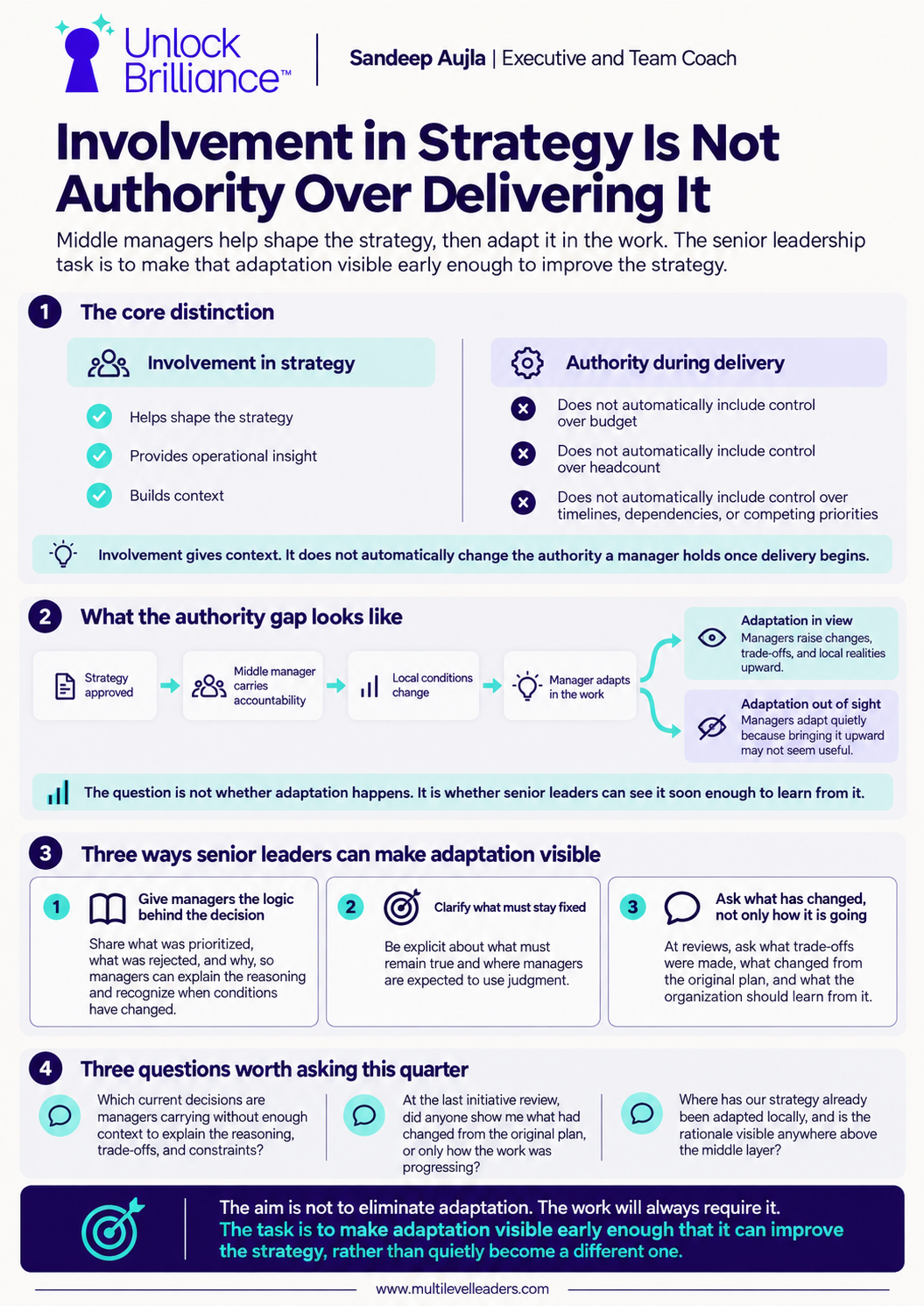
AI-generated visual summary
References
- Birken, S. A., Lee, S.-Y. D., Weiner, B. J., Chin, M. H., Chiu, M., & Schaefer, C. T. (2015). From strategy to action: How top managers’ support increases middle managers’ commitment to innovation implementation in health care organizations. Health Care Management Review, 40(2), 159–168. https://doi.org/10.1097/HMR.0000000000000018
- Christie, A., & Tippmann, E. (2024). Intended or unintended strategy? The activities of middle managers in strategy implementation. Long Range Planning, 57(1), 102410. https://doi.org/10.1016/j.lrp.2023.102410
- Holm, C. G., Kringelum, L., & Anand, A. (2026). Creating effective strategy implementation: A systematic review of managerial and organizational levers. Review of Managerial Science, 20(2), 673–705. https://doi.org/10.1007/s11846-025-00880-3
- Wooldridge, B., & Floyd, S. W. (1990). The strategy process, middle management involvement, and organizational performance. Strategic Management Journal, 11(3), 231–241. https://doi.org/10.1002/smj.4250110305