
Psychological Safety · 18 min read · October 6, 2026
Safe for Whom? The Case for Equitable Psychological Safety
A team’s psychological safety score can be accurate and still miss the person for whom speaking up costs the most. Equitable psychological safety asks who that person is, and what it would take to lower the cost.

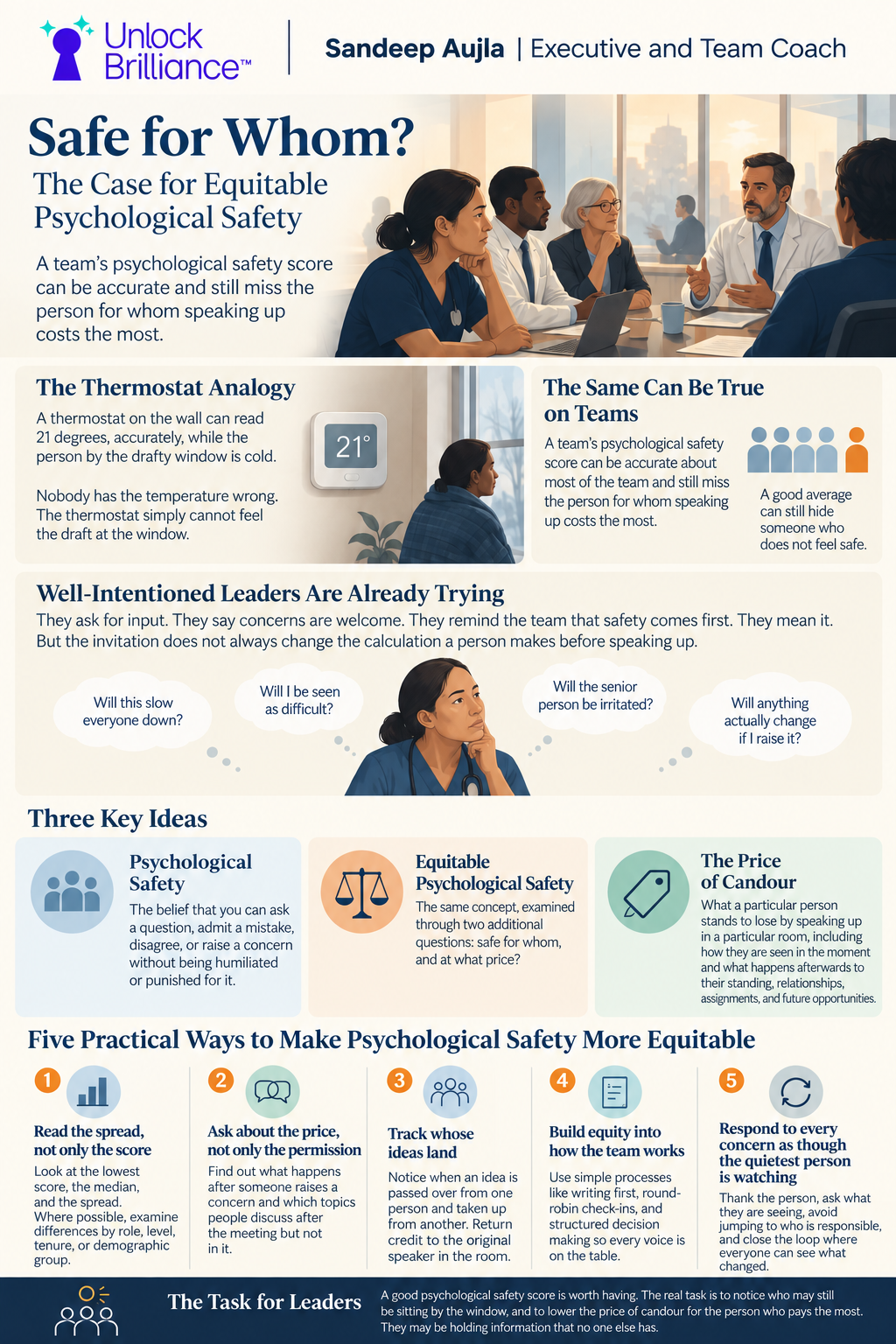
A thermostat on the wall can read 21 degrees, accurately, while the person sitting by the drafty window is cold.
Nobody has the temperature wrong. The thermostat is doing what it was designed to do. It simply cannot feel the draft at the window.
A team’s psychological safety score can work the same way. It may be accurate about most of the team and still miss the person for whom speaking up costs the most.
Most leaders I work with care about this. They are not trying to silence anyone. They ask for input. They invite challenge. They say they want people to speak up, and they mean it.
But the invitation does not always change the calculation a person makes before accepting it.
In an executive meeting, a director raises a risk and the conversation moves on. Twenty minutes later, a vice-president says nearly the same thing and the room picks it up. The only woman on the senior team stays quiet in the meeting and says what she actually thinks in the hallway afterwards. The executive who keeps bringing the discussion back to the patient experience, or to cost, notices the sighs around the table and starts raising it less often.
These moments often happen on teams where no one is behaving badly, at least not intentionally. The leader may have asked for input sincerely. The team may even have a strong psychological safety score.
What the invitation does not change is the cost each person may pay for using it.
A sincere invitation gives everyone permission to speak. It does not make speaking cost the same for everyone.
What equitable psychological safety asks us to notice
The thermostat still reads 21 degrees, and someone by the drafty window is still cold.
Equitable psychological safety asks who is sitting by that window.
Who on this team experiences a higher cost for speaking up than the team score shows? Who is more likely to be interrupted, dismissed, labelled difficult, treated as disloyal, or heard only after someone else repeats the point?
For leaders, the work is not simply to raise the reading on the wall. A good team score matters. It usually reflects real leadership work. But the equity question is narrower: who still pays more than others to tell the truth in this room?
That person may be holding information nobody else has.
A person whose race, gender, accent, role, or professional status has made speaking up costly in many rooms may feel the draft often. A senior colleague who is usually comfortable may find themselves by the window the moment they hold the minority view on a decision.
So the useful question is not only who feels the draft.
It is when, and on which issues.
None of this means the score is wrong, or that psychological safety was the wrong idea. Most people on a team with a good score may genuinely feel safe.
In my team coaching and transformational training programs, which often run over 6 to 18 months, I measure the psychological safety of the team or cohort. When I share the results, I do not show only the average. I also show the highest and lowest scores, the median, and the spread.
Two questions almost always follow:
- If even one person on this team does not feel psychologically safe, is that acceptable to us?
- Is a shared belief, built by averaging individual perspectives, the right measure of psychological safety at all?
Those questions are not an argument against psychological safety. They are the start of equitable psychological safety.
Three terms worth clarifying
Most leaders already know the first term, usually through Amy Edmondson’s work. The second and third may be less familiar. They do not replace the concept of psychological safety. They extend it by asking who it holds for, and at what cost.
Psychological safety is the belief that you can ask a question, admit a mistake, disagree, or raise a concern on your team without humiliation or punishment. The term comes from Edmondson’s research on work teams, where she defined it as a belief shared by team members.
Equitable psychological safety is that same concept examined through two additional questions: safe for whom, and at what price?
The price of candour is what a particular person stands to lose by speaking up in a particular room. It includes how they are seen in the moment and what happens afterwards to their standing, assignments, working relationships, and future opportunities.
I would treat equitable psychological safety as a lens, not as a separate proven construct. It is an evidence-informed way of examining a well-established idea. I have not found a peer-reviewed study that measures equitable psychological safety as its own construct, or one showing that a program carrying that label outperforms a well-designed psychological safety program.
The evidence shows that safety can be spread unevenly within a team, and that the same words can cost one person more than another.
Why a psychological safety score can miss the person by the window
The original concept of psychological safety was strong enough to build a field on, and it still is.
It began in hospitals. In a 1990s study of nursing units, Edmondson found that better-led units reported more medication errors, not fewer. The likely explanation was not that those teams made more mistakes. It was that staff felt safer reporting them. Edmondson later defined and measured psychological safety, showing that safer teams engaged in more of the learning behaviours, such as asking for help and discussing errors, that support better performance.
Two features of the concept leave room for the equity question.
The first is the word shared. Because psychological safety is defined as a belief held in common, it has often been measured by asking each member to rate the team and then averaging those ratings into a single team score.
Averaging is reasonable when members broadly agree.
It can also hide the person who does not.
The second is where the risk sits. Psychological safety describes a belief about consequences: whether I expect to be embarrassed or punished for speaking up.
It says less about the consequences themselves, which listeners shape. Two people can hold the same general belief about their team and still face different consequences for saying the same sentence, depending on profession, seniority, gender, race, accent, tenure, or proximity to power.
That is not a flaw in Edmondson’s thinking. The gap is more in how organizations have often used the concept, especially when psychological safety becomes a single number on an engagement survey.
The first question the equity lens asks is whether anyone is sitting by the window at all.
Many senior teams have someone sitting by the window
In a 2022 study of 278 senior leadership teams across 28 industries, researchers at the Center for Creative Leadership looked beyond each team’s average psychological safety score to examine how individual ratings were spread. In 62% of the teams, members did not share the same view. In about a third, at least one member felt noticeably less safe than the rest.
That spread mattered. At the same average level of safety, teams whose members agreed reported the best division performance and the least conflict between members.
The study should be held with care. It captured a single moment, relied on self-ratings from mostly American leaders, and was not peer-reviewed. It shows that the spread exists, not what causes it. One result also cuts the other way: the teams in strongest agreement reported, on average, the least respect for their leader, so agreement alone does not prove a team is working well.
Still, the finding points to something practically important.
A good average may be a fair reason for confidence about most of the team. It is also a fair reason to ask who may still be sitting by the window.
There is a performance case as well. In a study of 62 drug-development teams at six pharmaceutical companies, more diverse teams outperformed less diverse teams only when psychological safety was high. When psychological safety was low, diversity was associated with weaker performance, as rated by senior leaders who did not know the teams’ survey results.
That is one study in one industry, with diversity measured as a blend of gender, age, tenure, and expertise. It should not be asked to carry more than it can. But it suggests a useful possibility: people bring their different views to a team only when voicing them is affordable.
In hospitals, professional status often shapes who pays the price
A 2006 study of 23 neonatal intensive care units surveyed staff on units engaged in quality improvement work. Psychological safety rose with professional status. Physicians reported the most safety, then nurses, then respiratory therapists.
The gap was not fixed. On units where leaders were seen as more inclusive, meaning their words and actions invited and showed appreciation for others’ contributions, the status gap was smaller. Psychological safety, in turn, predicted how engaged staff were in improvement work.
This was one survey-based study in one specialty, and it is now almost twenty years old. It shows association, not cause. Still, it points to something many healthcare leaders will recognize.
The person who notices what the physician misses is often the person with less status on the team: the respiratory therapist at the bedside, the personal support worker on nights, the nurse who has watched the family pattern unfold across the shift.
Imagine a respiratory therapist noticing that a patient’s oxygen weaning does not fit the overnight numbers. In the morning huddle, the physician asks for concerns. The therapist stays quiet. Afterwards, he tells a nurse, who tells the physician, and the plan changes twenty minutes later.
The unit’s psychological safety score may be among the highest in the hospital. The scene is a composite, but it reflects the pattern the 2006 study helps explain.
The same words can cost some people more than others
How much speaking up costs depends partly on who is listening, not only on the speaker’s confidence.
A study in the Academy of Management Journal offers evidence on this. It included a field study that followed teams over three points in time and a separate experiment. The researchers distinguished between two kinds of speaking up: suggesting improvements and raising concerns about practices that could cause harm.
Men who suggested improvements gained status with their peers and were more likely to be seen as leaders. Women who made the same kind of suggestions did not gain the same status. Raising concerns about harm did not earn status for anyone.
That finding can sound like advice for women to speak differently. I would read it differently. Peers’ ratings of the speaker conferred the status in question, which means the finding is also about the people listening.
It says something uncomfortable about many teams, including clinical teams:
Race appears to work through a similar pattern. In Harvard Business Review, two consultants report that Black women who raise race in workplace conversations are often informally labelled troublemakers, with lasting effects on their careers. Their account draws on practice and lived experience rather than a controlled study, so I would treat it differently from peer-reviewed evidence. But it echoes the same pattern from another angle.
The cost of a sentence depends on who says it and how others respond.
The equity lens moves the work from the speaker’s courage to the listener’s response.
What I would hold lightly
The evidence is strongest where the issue was measured directly: the uneven spread of safety within teams, and the gap by professional status. It is thinner on identity, where the voice study measured status and leadership rather than psychological safety itself, and where the account of Black women’s experience comes from practice rather than a controlled study.
The link from unequal consequences to unequal safety is my argument, built from those findings.
A difference in how safe people say they feel is also not automatically an inequity. New staff may feel less safe because they are new. A person holding a minority view may feel exposed because disagreement always has some cost. A gap becomes an equity concern when it reflects how people are actually treated: comparable concerns welcomed from some people and dismissed from others.
There is another important boundary. Questioning the status quo will threaten someone’s comfort, including people in power who have benefited from it. The equity lens does not ask leaders to treat every discomfort as harm. Edmondson and Kerrissey have cautioned against that confusion. The work is to protect the person who spoke up while still supporting those whose assumptions, status, or decisions are being challenged.
A fair challenge is that good psychological safety practice already does much of this. Edmondson’s own work notes that safety can vary across groups, even inside a strong culture. Where a team already looks at the spread of its results and examines what happens after people speak, the equity lens mainly makes that commitment explicit. Where a team reports only the average, the equity lens adds a question the number cannot answer.
Another challenge is that psychological safety can be pushed too far. Across five studies of frontline workers, performance on routine tasks rose as safety moved from low to average, then fell as it climbed higher, possibly because mistakes stopped carrying consequences.
The equity lens does not ask for more safety everywhere. It asks whether speaking up costs roughly the same for everyone. That may mean lifting the bottom of the range without pushing the top any higher.
I would treat this as a working hypothesis, plausible enough to act on and bounded enough not to overclaim. You can begin without a new survey: ask for the spread of the results you already have, and ask what happened the last time someone raised something unwelcome.
How to make psychological safety more equitable on your team
Here are five moves worth trying. They are drawn from the evidence above and from my work with teams and cohorts. I have used them alongside other interventions and tracked psychological safety before and after. They have served those groups well, although my measures cannot separate their effect from everything else we did.
Take the ones that fit your team.
1. Read the spread, not only the score
Ask for the lowest score, the median, and the spread alongside the average.
Where groups are large enough to protect confidentiality, look at differences by role, level, tenure, or demographic group. Where a group is small enough that a person could be identified, do not break it out. Have the conversation instead.
Then track those figures over time. An anonymous survey cannot follow one person, but it can follow the bottom of the range. If the lowest score rises and the spread narrows, safety is reaching further into the team. If only the average rises, it may simply be rising for the people who already felt safe.
The average describes the team. The spread helps you see who may still be sitting by the window.
2. Ask about the price, not only the permission
Most survey items ask whether it is safe to speak. Add questions about what happens afterwards, in surveys and in conversation:
- When someone here raised a concern that turned out to be unwelcome, what happened next?
- Which topics do people on this team discuss after the meeting but not in it?
In my coaching, questions like these help a team notice patterns it may be living inside without seeing.
3. Track whose ideas land
Notice when an idea is passed over from one person and taken up from another.
When it happens, return the idea to its first speaker in the room: “That builds on what Simran raised earlier.”
This is not performative politeness. It lowers the price of candour.
Credit shapes whether people bring the next contribution early, late, or not at all.
4. Build equity into how the team works
Some of the most reliable ways to lower the price of candour sit in the process itself, not in anyone’s courage in the moment.
In meetings, I often ask everyone to write their thinking individually before anyone speaks. The group then moves through three stages:
- Diverge: every note goes up.
- Emerge: patterns across the notes become visible.
- Converge: the team decides what to act on.
Writing first means the quietest person’s view is on the wall before the most senior person has spoken.
It only helps, though, if those notes carry the same weight as what is said aloud. Round-robin check-ins before a decision work on the same principle.
5. Respond to every concern as though the quietest person is watching
People with the most at stake often judge the price of candour less by what leaders say than by how leaders respond when someone else speaks up.
That is why the first response matters.
Thank the person. Ask what they are seeing. Avoid moving too quickly to who is responsible. Then close the loop where others can see it: what you did with the concern, what changed because of it, or why you did not act on it.
For more tips on how to do this, refer to my essay on ‘Establishing psychological safety in the first ten seconds.’
Each response to one person’s concern sets the price for everyone watching.
Questions to reflect on before your next leadership meeting
These questions may not work best as live discussion prompts at first. Answering them out loud may ask people to pay the price of candour. They often work better as individual reflection, or gathered anonymously, with the patterns rather than the names brought back to the table.
- If even one person on this team does not feel psychologically safe, is that acceptable to us?
- If our psychological safety average rose next year, how would we know whether it rose for the person who felt least safe?
- Who on this team holds information that no one else holds, and what might it cost them to share it?
- When did someone last raise an unwelcome concern here, and what happened afterwards?
- Which ideas did we hear twice before acting on them, and who said them first?
- Where does the real conversation happen after our meetings, and who is in it?
The task is to lower the price of candour
Equitable psychological safety comes down to two habits: looking at how safety is spread across the team, and paying attention to what speaking up costs people after they have spoken.
Both build on the original concept of psychological safety. They do not replace it.
The leadership task is not only to raise the thermostat reading on the wall. A good average is worth having, and most teams that earn one have done real work to get there.
The task is to notice who may still be sitting by the window.
That person may be holding what the rest of the team cannot see.
Leaders who do this are not lowering the standard for candour. They are making sure the standard is reachable for everyone.
Frequently asked questions
What is equitable psychological safety?
Equitable psychological safety examines psychological safety through two additional questions: Safe for whom, and at what price? It considers whether some team members face greater interpersonal or professional consequences for speaking up than others. The aim is to understand how psychological safety is experienced across a team, particularly by people whose experiences may be obscured by an overall team score.
How is equitable psychological safety different from psychological safety?
Psychological safety refers to a shared belief that team members can ask questions, admit mistakes, disagree, or raise concerns without fear of humiliation or punishment. Equitable psychological safety builds on that concept by examining how evenly that experience is distributed. A team may have a strong overall psychological safety score while some members still experience a much higher cost of speaking up. Equitable psychological safety is best understood as an equity lens applied to an established concept, rather than a separately validated psychological construct.
Why can a high psychological safety score hide problems within a team?
A team score usually represents an average of individual responses. That average can accurately describe the team’s overall experience while concealing substantial differences between members. For example, most people may feel comfortable challenging decisions while one person consistently hesitates because previous concerns have been dismissed. Examining the lowest scores, median, and spread alongside the average can help leaders identify differences worth exploring, while protecting individual confidentiality.
What is the price of candour, and why does it differ between team members?
The price of candour is what someone perceives they may risk or actually lose by speaking up. This can include credibility, relationships, professional standing, assignments, or future opportunities. The price may vary according to professional status, seniority, race, gender, tenure, or the nature of the concern being raised. It also depends on how others respond. The same observation may be welcomed from one person and dismissed when expressed by another.
How can leaders make psychological safety more equitable?
Leaders can begin by examining how psychological safety varies across their teams rather than relying exclusively on average scores. They can also ask what happens after people raise concerns, notice whose ideas receive attention and credit, design meetings so contributions are considered before hierarchy shapes the conversation, and close the loop visibly when concerns are raised. The goal is to reduce unnecessary differences in the cost of speaking up while maintaining clear expectations and accountability.
How does professional hierarchy affect psychological safety in healthcare?
Physicians, nurses, respiratory therapists, personal support workers, and other healthcare professionals may experience different levels of psychological safety even when they work on the same team. Research on neonatal intensive care units has found differences associated with professional status, with more inclusive leadership associated with smaller gaps. For healthcare leaders, an important responsibility is ensuring that relevant clinical observations can reach decision-makers regardless of who raises them.
Does equitable psychological safety mean avoiding discomfort or lowering performance standards?
No. Equitable psychological safety does not mean protecting people from disagreement, accountability, or difficult feedback. It means creating conditions where people can raise relevant concerns and challenge assumptions without facing disproportionate interpersonal or professional penalties. Leaders can maintain high standards while examining whether those standards are applied fairly and whether everyone has a reasonable opportunity to contribute.