
Psychological Safety · 10 min read · November 10, 2026
Uncomfortable, or Unfair?
By Sandeep Aujla, Founder and Lead Coach, Multilevel Leadership Consulting (MLC) Inc.
Equitable Psychological Safety and the Price of Candour

At the March budget review of a regional public health unit, Priya, the manager of immunization programs, questions the staffing plan for the fall respiratory clinics. The plan assumes demand will match last year's. Priya points out that walk-in demand in two neighbourhoods nearly doubled last fall, and that both are growing. Mark, the director of health protection, built the plan.
Both of them are uncomfortable.
Priya has just questioned a senior colleague's work in front of his peers. Mark is watching his assumptions tested in front of his peers.
The team works through the numbers and adds clinic hours in both neighbourhoods. By most measures, the meeting worked.
In May, the working group that will implement the fall clinics is announced. Priya is not on it. No one connects the decision to March. Still, Priya wonders, and so do two of her colleagues.
Whether what happened to Priya was uncomfortable or unfair depends less on the meeting than on what happened after it.
In Safe for Whom?, I argued that a team's average psychological safety score can hide the person for whom speaking up costs the most. I also set a boundary: differences in how safe people feel are not automatically inequity, and challenging the status quo is often uncomfortable. This essay uses Priya's story, a composite drawn from patterns I see in my practice, to show where that boundary lies.
The argument here is that equitable psychological safety does not require equal comfort. It asks whether comparable candour receives fair consideration and proportionate consequences, whatever the speaker's status or proximity to power.
Why productive discomfort is part of psychological safety
The March meeting was uncomfortable because it was doing its job. In a 2025 Harvard Business Review article, Amy Edmondson and Michaela Kerrissey state that psychological safety and comfort are not the same: safety protects against harm, and comfort means freedom from strain.
Productive discomfort is the strain that genuine challenge creates on both sides of a conversation. Priya felt exposed. Mark felt tested. Neither experience was unfair, and the clinic plan was better for both.
Evidence on team conflict supports the distinction. A meta-analysis of 116 studies involving 8,880 groups found that disagreement about the work was not consistently associated with worse performance, while personal friction between members was. In some circumstances, including senior leadership teams, disagreement about the work was more beneficial when it did not become personal.
Most of those studies were correlational, so they show where disagreement and performance coexist, not what causes what. They suggest the risk was never the strain of the March meeting. It was the possibility that the strain would stop attaching to Priya's forecast and start attaching to Priya.
How the listener's discomfort can become the speaker's cost
Mark left the March meeting irritated. He had been corrected in front of his peers, and the feeling did not fade when the plan improved. By May, it had settled into a view of Priya: capable, but "not really a team player."
Research on speaking up suggests Mark's reaction is common. In a field study of 281 restaurant managers and their supervisors, supervisors rated managers who challenged existing practices as weaker performers than managers who spoke up in support of them. Two experiments found the same pattern: challengers' ideas were less likely to be endorsed, and challengers were seen as less loyal and more threatening.
This can sound like a story about thin-skinned leaders. A more generous reading is also more useful.
A judgment like Mark's outlasts the meeting that produced it.
Unequal consequence arises when comparable candour attracts a materially different response or penalty that cannot reasonably be explained by the contribution, the circumstances or the person's conduct. Such consequences fall on the person who spoke up, through damaged credibility, exclusion or reduced opportunities.
Does professional status change the price of speaking up?
Imagine the associate medical officer of health, a physician, had raised the same point about walk-in demand, with the same evidence and in the same tone. Would Mark have left the meeting thinking she was not a team player? Would she have been left off the working group?
In public health, as in hospitals, professional status shapes whose challenge is welcomed. A study of 23 neonatal intensive care units found that psychological safety rose with professional status, from respiratory therapists to nurses to physicians. On units where staff saw leaders as more inclusive, the gap was smaller.
That study was in one hospital specialty and is now 20 years old. I have not found a comparable study in public health, so I am inferring a parallel. Still, it points to the question that separates discomfort from inequity: would a more influential colleague have received the same treatment for the same contribution?
The working standard is fair consideration and proportionate consequences for comparable candour, with attention to power and context. It is the third commitment in my Equitable Psychological Safety Standard: keep challenge, dignity and accountability together.
How to raise a concern about unfair treatment after speaking up
In June, Priya raises her concern with Dana, her director. Dana's first response is gentle: "Maybe next time, raise it with Mark before the meeting."
The advice is well-meant, but it shifts Mark's discomfort back onto Priya. She is being asked to soften while his reaction goes unexamined.
Priya could respond with frustration, or with certainty that she was punished for speaking up. Either would be understandable, and either would make it easier to dismiss her concern as a matter of tone. Instead, she separates four things:
- Experience: "I was not included in the working group for the clinics I run."
- Interpretation: "I believe it may be connected to my challenge in March."
- Evidence: "Two managers whose programs are less affected were included."
- Remedy: "I would like to understand the reason, and to contribute to the demand forecast."
The experience deserves to be heard. The interpretation should be examined rather than automatically accepted or dismissed. The evidence can be checked, and the remedy can be debated. My Team Member Behaviours guide sets out this separation, along with ways to tell discomfort from unreasonable risk before raising a concern.
Both parties have agency. Priya is responsible for how she raises her concern. Those with authority over her opportunities bear greater responsibility for the consequences.
How to check whether someone was penalized for speaking up
Dana takes the concern to the medical officer of health, who asks Mark about the working group. The answer is mixed.
Part of it is legitimate. The group was built around the two districts where the clinics would change most, and Priya's role is region-wide.
Part of it is not. Mark also says he wanted people "who would make it work, not reopen it." That sentence describes Priya only because of March.
A legitimate reason does not cancel an illegitimate one. The medical officer of health adds Priya to the group as an adviser on demand forecasting, and speaks privately with Mark about the March meeting and the view of Priya he formed afterwards.
She also gives Mark a way to change his mind without losing standing. At the next leadership meeting, Mark credits Priya's forecast for the added clinic hours. Defending a decision is part of holding authority. So is revising one.
Accountability ran both ways. Edmondson and Kerrissey describe psychological safety and accountability as separate dimensions, both needed for excellent performance.
Priya was held to a standard of evidence and respect, and she met it. Mark was held to the same standard for how he treated her afterwards.
What I would hold lightly
None of the studies here were conducted in public health, and the comparison across professions rests on one hospital study. The separation of experience, interpretation, evidence and remedy comes from my practice.
I would treat the distinction between productive discomfort and unequal consequence as a working hypothesis, not a validated test.
Four questions to tell productive discomfort from unfair treatment
Four questions separate productive discomfort from unequal consequence. Each corresponds to a moment in Priya's story.
1. Is the cost attached to the idea or to the person?
"The forecast misses walk-in demand" is about the idea. "Not really a team player" is about the person. Mark's judgment had crossed that line by May.
Answer the idea first, and leave tone and motive until the idea has had a fair hearing.
2. What happens after the conversation?
The meeting went well. The consequence arrived two months later, in a list of names. Look at whether the person who challenged is still included in relevant work and described accurately in talent discussions, and ask what explains any change.
Consequences happen after the meeting, so look there.
3. Would a more influential colleague be treated the same way?
Before the working group list went out, one question would have caught the problem: would the associate medical officer of health have been left off for the same contribution?
If the answer differs, the inconsistency is yours to examine and correct.
4. Who is being asked to manage the discomfort?
Dana's first instinct was to ask Priya to soften. The more useful question was what had happened to Mark's view of her.
My companion tools turn these questions into routine practice: Leader Behaviours, for managing the first response to challenge; Team Practices That Design for Voice, for building dissent into decisions; and the Practice Stack Implementation Guide, for checking whether people who disagreed remain fairly included afterwards.
Questions to reflect on before your next leadership meeting
- When someone last challenged a decision here, what happened to them over the next three months?
- Who on this team would be left off a list without anyone connecting it to a meeting?
- When a challenge lands badly, whose behaviour do we work to change?
- What would it cost me to change my mind in front of this team?
- When I last raised a concern, which parts were my experience, which my interpretation and which my evidence?
The task is to preserve the discomfort and make the consequences fair
The March meeting was uncomfortable for Priya and for Mark, and the clinics were better for it. That discomfort is worth protecting.
Whether Priya challenges the next forecast will depend less on how the March meeting felt than on what happened in May.
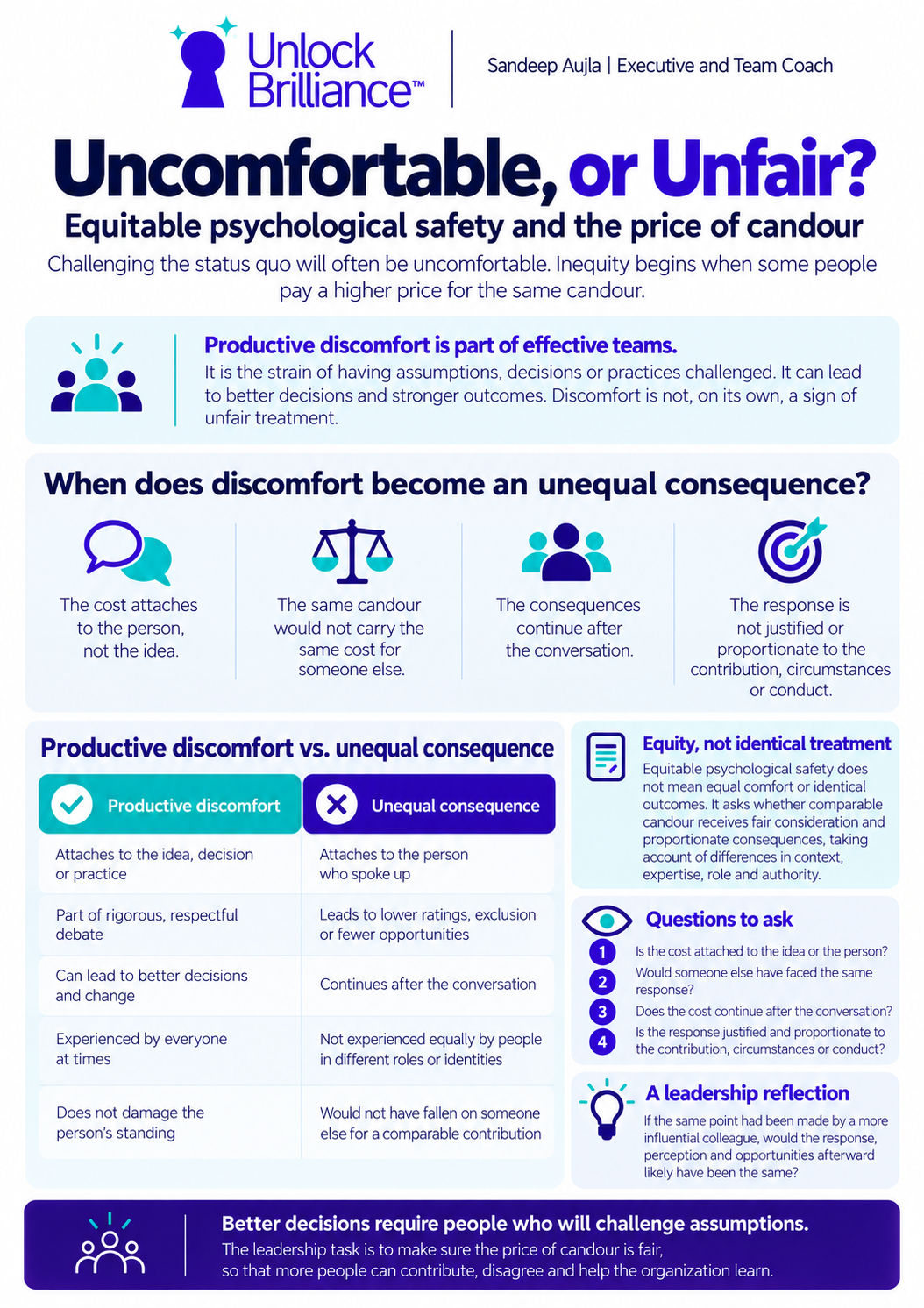
AI-generated visual summary
Frequently Asked Questions About Equitable Psychological Safety
1. What is Equitable Psychological Safety, and how does it differ from psychological safety?
Equitable psychological safety is psychological safety that holds for every member of a team, not only those with the most power, and that leaders, teams and team members build together. It examines the original concept through two additional questions: safe for whom, and at what price?
2. What is the difference between productive discomfort and inequity at work?
Productive discomfort arises when someone's ideas, assumptions, or decisions are challenged. It is often necessary for learning and better decision-making. Inequity becomes a concern when someone experiences unjustified or disproportionate consequences for speaking up, particularly when a more influential colleague would have received different treatment for a comparable contribution. The important question is whether the response and subsequent consequences are fair, taking account of the circumstances, the person's conduct, and organizational power.
3. Does psychological safety mean employees can challenge leaders without being held accountable?
No. Psychological safety supports constructive disagreement, candour, and accountability. Employees remain responsible for the evidence they present, how they communicate concerns, and their impact on others. Leaders remain responsible for considering those concerns fairly and ensuring that behavioural feedback does not become a penalty for challenging authority. A legitimate concern can be communicated poorly, just as a respectfully expressed concern can be dismissed unfairly. Both the substance of the contribution and the conduct of those involved deserve examination.
4. How can leaders tell whether someone has been penalized for speaking up?
Leaders can examine four questions: Was the criticism directed at the person's idea or at their character? What happened to the person after the conversation? Would someone with greater status have been treated similarly for a comparable contribution? And whose behaviour was expected to change after the disagreement?
Exclusion from decisions, changes in professional standing, or lost opportunities warrant inquiry, but do not automatically establish retaliation. Leaders should examine the evidence, legitimate explanations, and possible bias before drawing conclusions.
5. What is the price of candour in leadership teams?
The price of candour is what someone stands to lose by speaking honestly in a particular setting. It can include credibility, relationships, influence, assignments, career opportunities, or professional standing. That price can differ even within a leadership team, depending on authority, status, identity, and the issue being challenged. Equitable Psychological Safety asks leaders to recognize these differences, evaluate contributions fairly, and ensure that speaking up does not result in unjustified consequences.
References
Burris, E. R. (2012). The risks and rewards of speaking up: Managerial responses to employee voice. Academy of Management Journal, 55(4), 851–875. https://doi.org/10.5465/amj.2010.0562
de Wit, F. R. C., Greer, L. L., & Jehn, K. A. (2012). The paradox of intragroup conflict: A meta-analysis. Journal of Applied Psychology, 97(2), 360–390. https://doi.org/10.1037/a0024844
Edmondson, A. C., & Kerrissey, M. J. (2025, May–June). What people get wrong about psychological safety. Harvard Business Review. https://hbr.org/2025/05/what-people-get-wrong-about-psychological-safety
Nembhard, I. M., & Edmondson, A. C. (2006). Making it safe: The effects of leader inclusiveness and professional status on psychological safety and improvement efforts in health care teams. Journal of Organizational Behavior, 27(7), 941–966. https://doi.org/10.1002/job.413