
Strategic Prioritization · 16 min read · November 3, 2026
The Workload Trap
By Sandeep Aujla, Founder and Lead Coach, Multilevel Leadership Consulting (MLC) Inc.
Why capable leaders, making reasonable decisions, can collectively create workloads nobody can sustain
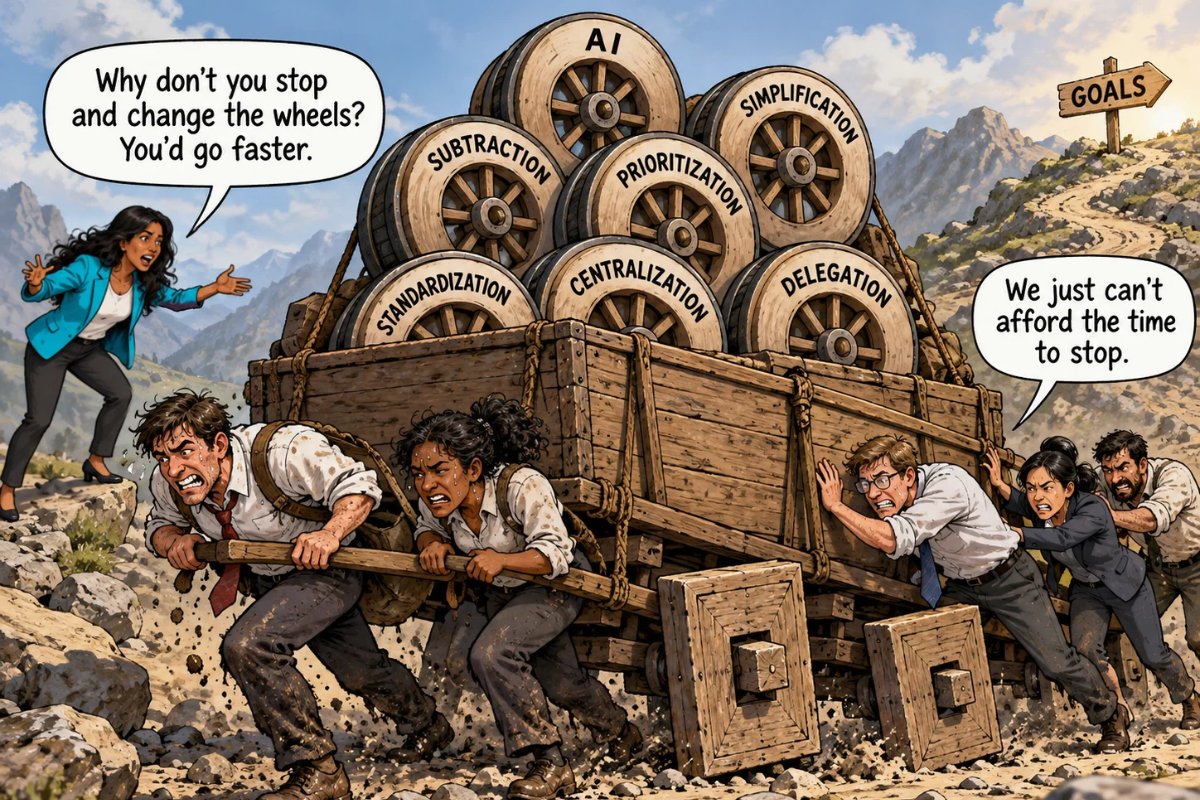
Five people strain to push an enormous cart uphill on square wooden wheels. A woman standing by the roadside calls out, "Why don't you stop and change the wheels? You'd go faster."
One of the workers replies, "We just can't afford the time to stop."
The cart is loaded with round wheels. Each bears the name of a familiar solution: prioritization, subtraction, simplification, delegation, standardization, centralization, and AI. The team already has the solutions that could make the journey easier, yet they remain unused, adding to the weight everyone struggles to move.
The scene is absurd until we recognize how closely it resembles our organizations. Leadership teams routinely acknowledge they have too many priorities, and employees describe meeting fatigue and an overload of initiatives. Yet when new priorities emerge, they are typically added to the existing workload rather than replacing something already there.
There is another irony in the picture: the round wheels themselves have become part of the burden. Organizations sometimes respond to overload by introducing another improvement initiative, transformation program, productivity framework, or AI pilot. Each promises to make work easier, but when nothing else is removed, even the effort to simplify becomes another layer of complexity.
The explanation goes deeper than poor time management or a lack of discipline. It involves the personal, political, and organizational consequences of stopping work that people have come to expect.
The difference between efficiency and subtraction
When organizations become overwhelmed, the natural response is to look for ways to do the work faster: streamline processes, automate routine tasks, delegate more, consolidate functions. These are worthwhile steps, but they share an assumption that the work itself deserves to continue.
A more consequential question often goes unasked: Should we be doing all this work in the first place?
An organization can become very efficient at activities it should have discontinued years ago. AI makes the distinction more important. A tool that produces a report in minutes instead of hours saves effort, but if the organization uses that capability to produce more reports, add more analysis, and raise expectations, total workload may grow rather than shrink.
In my work with leadership teams, I use three questions to establish a practical sequence for strategic thinking.
| Leadership question | In the cartoon | |
|---|---|---|
| 1. Strategic focus | Which outcomes are worth the climb? | The destination |
| 2. Subtraction | What can we stop carrying to make those outcomes achievable? | The cargo |
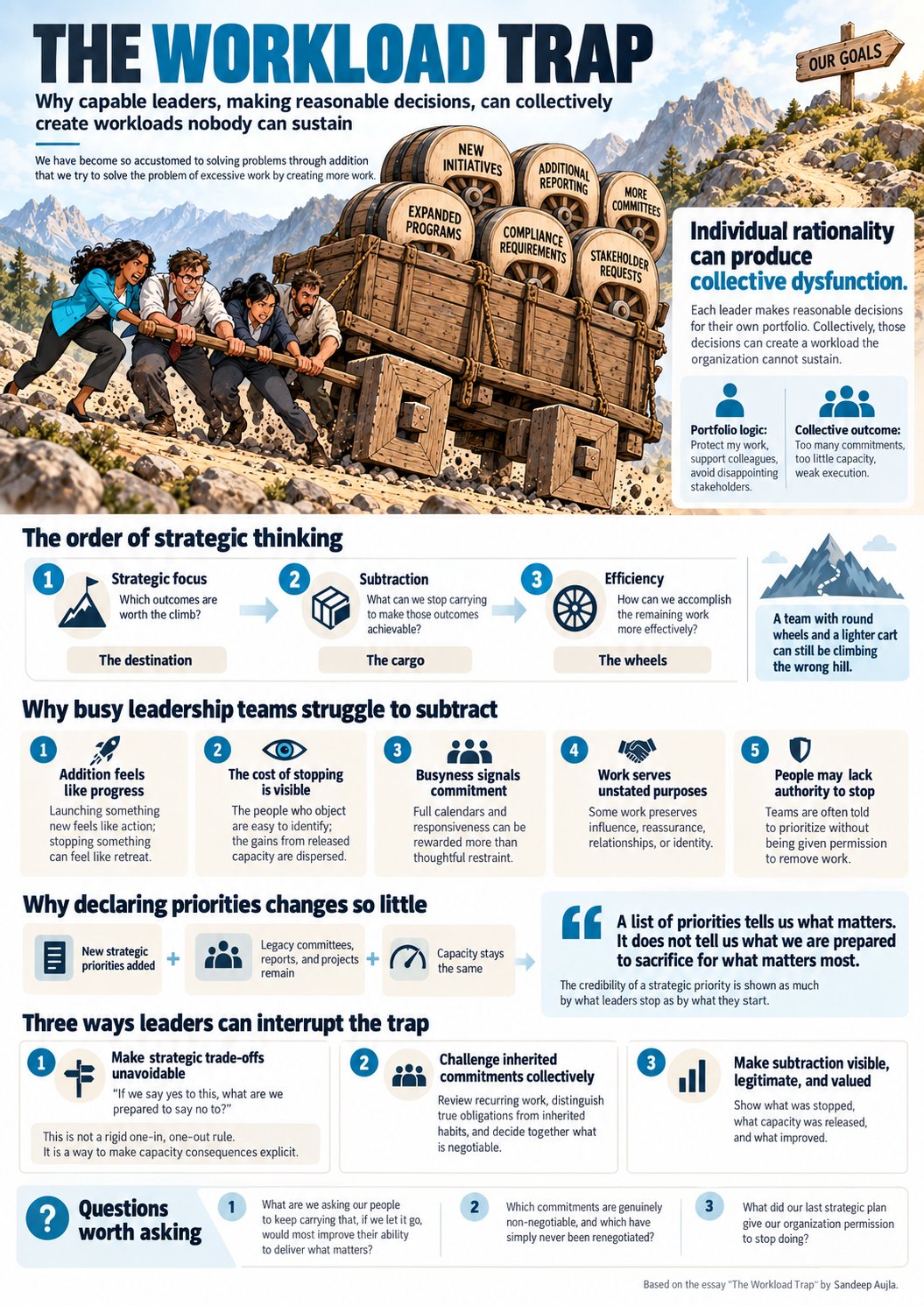
| 3. Efficiency | How can we accomplish the remaining work more effectively? | The wheels |
Most experienced leaders would accept this logic. If the sequence is this clear, the more useful question is why capable teams so rarely follow it.
The paradox of individual rationality and collective dysfunction
Consider a typical executive leadership team, each member responsible for a portfolio of services, programs, stakeholders, and strategic commitments.
One executive protects an existing initiative because resources have already been invested and stakeholders expect it to continue.
Another supports a colleague's proposal because the working relationship matters.
A third accepts an additional responsibility because saying no might signal a lack of commitment.
A fourth avoids recommending the closure of a longstanding program because the political and reputational consequences could be substantial.
A fifth advocates for a new strategic initiative because emerging circumstances genuinely require action.
Each of these decisions may be reasonable from the perspective of the leader making it. No one intends to overload the organization; each leader responds to legitimate pressures, expectations, and accountabilities. Yet collectively, their decisions create a portfolio of commitments that exceeds the organization's capacity to deliver.
Everyone has sound reasons for protecting their part of the workload, and nobody has sufficient incentive, authority, or willingness to reduce the whole.
Because the consequences accumulate gradually, it can be difficult to identify any single decision responsible for the problem.
There is a distinction here that executive teams rarely confront explicitly. Each member is accountable for the success of their own portfolio, but collectively they are accountable for the success of the whole organization. These responsibilities can come into conflict. A leader may do exactly what their division needs while contributing to decisions that undermine the organization’s broader priorities. The test of collective leadership is whether members are willing to make choices that may disadvantage their own portfolios in service of the whole.
The cycle also feeds itself. As immediate demands consume leaders' attention, the time needed to reconsider existing commitments disappears, decisions to stop are postponed, and new commitments keep arriving.
General appeals to prioritize rarely resolve this. The problem is sustained by the incentives, relationships, and expectations governing how leaders make decisions together.
Why subtraction is so difficult
Five forces help explain why removing work can be harder than adding it. The first and third draw on published experiments; the others come mainly from what I observe in practice.
1. Addition feels like progress; subtraction can feel like retreat
In a series of eight experiments published in Nature in 2021, researchers asked participants to improve things such as Lego structures, essays, recipes, and travel itineraries. Participants tended to favour adding, even when removing something would have accomplished the objective more efficiently. They were more likely to consider subtraction when explicitly reminded that removing was an option, and less likely to do so when distracted by a second task.
These were contained problem-solving tasks, not executive teams making organizational decisions. Still, if people overlook subtraction in simple circumstances, it is worth asking how readily tired leaders will consider it while managing competing priorities, political pressures, and operational demands.
Organizational culture may reinforce the tendency. Launching a new initiative signals responsiveness and ambition, while discontinuing one may be read as retreat, abandonment of a commitment, or an admission that an earlier decision was mistaken.
2. The cost of stopping is visible; the cost of continuing is dispersed
When a leadership team considers ending a longstanding program, the stakeholders who value it are identifiable, and their objections may be immediate and politically consequential. The benefits of stopping, such as capacity released across several teams, are dispersed, uncertain, and often delayed.
The people who stand to lose something from subtraction are often easier to identify than those who stand to gain from it.
3. Busyness can signal commitment and importance
In a set of consumer studies with several hundred participants, mostly American, people rated individuals described as busy and short of leisure time as higher in status than leisurely ones. Italian participants showed the reverse pattern, and Canadians were not studied. The studies measured how people judge strangers, not how leadership teams reward behaviour, but they invite reflection on the signals organizations send about commitment.
In some workplaces, full calendars and immediate responsiveness are treated as evidence of dedication.
It is worth asking whether our organizations reward leaders for how much work they carry or for the value their efforts create.
4. Work can serve purposes beyond its stated objectives
We rarely ask who benefits from work remaining unchanged. Some activities continue because they meet genuine organizational or community needs. Others may endure partly because they reinforce influence, preserve relationships, provide reassurance, or protect reputations.
In my practice, I see this in several forms. A committee may maintain someone's visibility or authority, and a reporting process may give senior executives confidence despite limited evidence that it informs decisions. A longstanding initiative may represent years of someone's professional effort and identity, so ending it can feel to a leadership team like declaring that earlier work wasted.
Leaders whose professional identity is closely tied to being indispensable may also find it easier to keep carrying more than to relinquish responsibility. None of this requires conscious self-interest or ill intent. It does, however, raise a harder question:
5. People may lack the authority to stop
This is especially relevant in municipal government, healthcare, and other public-service environments. Some obligations are statutory, contractual, or essential to public accountability, and leaders cannot discontinue them simply because they consume substantial resources. Other commitments persist through precedent, inherited expectations, or assumptions nobody has challenged.
A manager may recognize that a recurring report adds little value but cannot stop producing it because another part of the organization expects it. A department may keep sitting on a committee because withdrawing would be read as a lack of cooperation.
Even when an obligation cannot be eliminated, an organization may still reconsider how it fulfils it. A statutory reporting requirement does not necessarily justify every internal report created around it. An essential service does not make every legacy process supporting it indispensable. Subtraction can involve removing unnecessary activities while preserving, or even improving, the outcomes and accountabilities they were intended to support.
Encouraging employees to prioritize is of limited value when the authority to remove work sits elsewhere.
Why strategic prioritization so often changes so little
Most organizations invest real time in strategic planning. They identify priorities, align initiatives with strategic pillars, develop implementation plans, and set measures of success, yet little comes off the organizational plate.
Consider a healthcare leadership team that identifies three strategic priorities for the coming year. It develops action plans, assigns accountabilities, and creates reporting to monitor progress. Meanwhile, the existing committees, recurring reports, legacy projects, and operational commitments remain intact.
The organization now has three additional priorities and the same capacity. The leadership team has identified what matters, but it has yet to confront what it is willing to give up.
In a 2018 Harvard Business Review article drawn from their consulting work, Rose Hollister and Michael Watkins described initiative overload in large organizations. They identified impact blindness, where leaders fail to see the cumulative burden of initiatives, and political logrolling, where leaders trade support to protect one another's projects. Their account comes from advisory experience rather than a controlled study, and the second cause leads directly back to individual rationality and collective dysfunction.
Imagine five executives, each advocating for a significant initiative. Rather than challenge the relative value of each proposal, they agree to support one another. The relationships remain intact, everyone leaves the meeting with their priorities endorsed, and the organization leaves with five commitments it may lack the capacity to deliver.
A priority without a corresponding claim on time, people, and resources may be little more than an aspiration. The credibility of a strategic priority is demonstrated as much by what leaders are willing to stop as by what they commit to start.
The higher cost is opportunity cost: an organization can be busy, staffed by capable people, and still make little progress on its most important objectives.
Three leadership practices that can interrupt the trap
If the workload trap is collectively produced, escaping it requires collective leadership. Individual productivity techniques may help people manage their responsibilities, but they cannot resolve a portfolio of commitments that exceeds the organization's capacity.
1. Make strategic trade-offs unavoidable
Before approving a significant new initiative, the leadership team can examine explicitly what will stop, shrink, be delayed, or receive fewer resources to make room.
The purpose is not to impose a rigid one-in, one-out rule. It is to make the capacity consequences of each decision explicit. If something new must be undertaken, the leadership team should be able to explain where the time, attention, and resources will come from.
Leidy Klotz, an engineer and co-author of the Nature study, makes the broader case for subtraction in Subtract: The Untapped Science of Less. His book does not address strategy execution specifically, but his experiments suggest people consider subtraction more often when prompted, which argues for building the prompt into how decisions get made.
Whatever the answer, capacity becomes an explicit consideration rather than an assumption that employees will absorb the extra burden, and the team takes collective responsibility for the trade-off instead of leaving individual executives to negotiate it alone.
Takeaway: the trade-off is made visible before the commitment is made.
2. Challenge inherited commitments collectively
Most organizations periodically review their strategies and budgets; fewer give their accumulated commitments the same scrutiny. A leadership team could begin by examining its recurring work, including initiatives, committees, reports, projects, and longstanding processes, and ask of each:
Is this genuinely required by legislation, contract, or stakeholder need?
Does it continue to contribute sufficient value to our most important outcomes?
Are we maintaining it primarily because we have always done so?
What would happen if we stopped, reduced, or redesigned it?
Who has the authority to make that decision?
A leader who cannot safely discontinue an activity alone may be able to do so with the explicit support of colleagues.
Takeaway: more may be negotiable than any one leader assumes, once the team decides together.
3. Make subtraction visible, legitimate, and valued
Organizations are accustomed to recognizing new initiatives, expanded services, and successful launches. Imagine giving comparable attention to the thoughtful elimination of unnecessary work: a report retired because it no longer informs decisions, two overlapping committees consolidated, a legacy initiative ended because its contribution no longer justifies its resources.
The leadership team then examines what capacity was released, where it was redirected, and what improved. Subtraction should create room for something more valuable.
Takeaway: one meaningful subtraction, visibly supported by senior leadership, may do more to change expectations than another campaign encouraging people to work smarter.
Creating the conditions for difficult choices
In my work with senior leaders and executive teams, conversations about workload often begin with a familiar complaint: too many priorities and not enough time. The most useful conversations move beyond that diagnosis to examine what is producing the workload, which commitments still create genuine value, and what makes others so difficult to relinquish.
These discussions surface competing expectations, assumptions about accountability, and sometimes deeply held beliefs about what it means to be an effective leader. A leader may recognize the need to eliminate work yet hesitate to challenge a colleague's initiative, while another may privately question a longstanding program but not raise it publicly.
The task is to create enough space, candour, and collective accountability for leaders to make decisions that none may feel comfortable making alone.
The question worth asking
Look again at the people pushing the cart. Their exhaustion is plain, and their commitment is not in question. They know the wheels are square, and they are carrying the alternatives.
Perhaps they cannot afford to stop because the work feels urgent. Perhaps changing the wheels would require agreement from people with competing interests, or nobody wants to be responsible for delaying the journey.
Or perhaps the people pushing the cart are themselves the leaders who keep deciding what gets loaded onto it.
Three questions might help start the conversation:
What are we asking our people to keep carrying that, if we let it go, would most improve their ability to deliver what matters?
Which commitments are genuinely non-negotiable, and which have simply never been renegotiated?
What did our last strategic plan give our organization permission to stop doing?
Perhaps the greatest test of a leadership team is whether its members can move beyond individually reasonable decisions to make the difficult collective choices their organization needs, including deciding what no longer deserves to be done.
Frequently asked questions
Why do leadership teams struggle with strategic prioritization?
Leadership teams often struggle with strategic prioritization because individual executives are accountable for their own portfolios while sharing responsibility for organizational outcomes. Each leader may make reasonable decisions to protect existing initiatives, accommodate stakeholders or support colleagues. Collectively, these decisions can create more commitments than the organization has capacity to deliver. Effective prioritization requires leadership teams to make explicit trade-offs about what to pursue, delay, reduce or stop.
How can executive teams reduce organizational overload?
Executive teams can reduce organizational overload by reviewing their collective portfolio of commitments, identifying work that no longer contributes sufficient strategic value and making deliberate decisions about what to stop or simplify. They must also ensure that new initiatives are matched with realistic capacity. This requires collective accountability because individual leaders may lack the authority or incentive to discontinue work independently.
Why do organizations keep adding initiatives instead of stopping existing work?
Organizations often find addition easier than subtraction. Research by Adams and colleagues (2021) found that people frequently overlook opportunities to improve situations by removing something. Organizational dynamics can reinforce this tendency. Launching initiatives signals action, while discontinuing work may disappoint stakeholders, challenge earlier decisions or threaten established expectations. Consequently, new priorities accumulate while existing commitments remain intact.
What is the difference between strategic prioritization and workload management?
Strategic prioritization determines which organizational outcomes and activities deserve limited resources and attention. Workload management focuses on distributing and organizing the work that remains. Prioritization therefore requires decisions about what matters most and what may need to stop, while workload management addresses how responsibilities can be handled sustainably. Both are important, but improving workload management alone cannot resolve an excessive portfolio of commitments.
How does individual rationality create collective dysfunction in executive teams?
Individual rationality creates collective dysfunction when decisions that benefit or protect individual portfolios collectively undermine organizational performance. For example, executives may each defend worthwhile initiatives, accommodate colleagues and avoid difficult stakeholder conversations. Although these choices may be reasonable individually, their cumulative effect can exceed organizational capacity. Effective executive teams must balance portfolio accountability with responsibility for the success of the entire organization.
Why do strategic plans fail to translate into successful execution?
Strategic plans can fail in execution when organizations identify new priorities without reallocating resources or discontinuing less important work. Existing projects, committees, reporting obligations and operational demands remain, leaving insufficient capacity for strategic initiatives. Successful execution requires leadership teams to translate priorities into concrete decisions about time, people, funding and activities that will receive less attention or stop altogether.
How can leaders decide what work to stop doing?
Leaders can begin by evaluating existing commitments against the organization's most important strategic outcomes. They should distinguish legally or contractually required obligations from inherited practices, examine whether activities continue to create sufficient value and assess the consequences of stopping or simplifying them. Decisions should be made collectively when activities cross organizational boundaries, with explicit authority and accountability for the trade-offs.
References
Adams, G. S., Converse, B. A., Hales, A. H., & Klotz, L. E. (2021). People systematically overlook subtractive changes. Nature, 592(7853), 258–261. https://doi.org/10.1038/s41586-021-03380-y
Bellezza, S., Paharia, N., & Keinan, A. (2017). Conspicuous consumption of time: When busyness and lack of leisure time become a status symbol. Journal of Consumer Research, 44(1), 118–138. https://doi.org/10.1093/jcr/ucw076
Hollister, R., & Watkins, M. D. (2018, September–October). Too many projects. Harvard Business Review. https://hbr.org/2018/09/too-many-projects
Klotz, L. (2021). Subtract: The untapped science of less. Flatiron Books.