
Decision-Making · 18 min read · October 27, 2026
How Do You Choose Between Competing Priorities?
By Sandeep Aujla, Founder and Lead Coach, Multilevel Leadership Consulting (MLC) Inc.
How senior leaders can make difficult trade-offs deliberately, before frontline teams are left carrying the consequences.

It is late afternoon on an inpatient mental health unit. A patient has become increasingly agitated and has threatened staff twice since lunch. The charge nurse believes the unit needs additional staffing support to manage the escalating risk safely.
Down the hall, the emergency department is holding another patient who needs admission to that unit. The ED has been over capacity all day, and the bed-management team is pressing for the transfer to proceed.
The unit manager is now carrying several legitimate responsibilities. The agitated patient needs appropriate therapeutic care. Staff and other patients on the unit need protection from foreseeable harm. The patient waiting in the ED needs timely access to treatment. And the hospital needs to maintain safe movement through a system already operating under considerable strain.
This is a composite scenario, although I suspect many hospital leaders will recognize some version of it.
That pressure on beds is hardly unusual. According to the Canadian Institute for Health Information, in 2025–2026, one in ten emergency department visits ending in admission lasted longer than 46.5 hours.
A decision will be made, whether anyone formally makes it or not. The transfer will proceed, be delayed, or be redirected. Someone will accept the consequences, perhaps without having had the authority to change the conditions that produced them.
The question is who should make that trade-off, on what basis, and whether the organization has prepared its people to make it well.
That is where senior leadership has its own responsibility.
Why good intentions cannot resolve competing priorities
It is tempting to see this as a disagreement between departments. One team wants to protect its capacity, another wants access to a bed, and hospital leadership wants the system to keep moving.
But each perspective captures something real about the situation. The charge nurse sees the implications of accepting another patient into a unit already managing an escalating behavioural risk. The ED leader sees the clinical and operational consequences of leaving a patient waiting. Bed management sees how one unavailable bed affects decisions elsewhere. Each is making sense of the situation through responsibilities they have been asked to carry.
The problem arises when the consequences of one locally reasonable decision are transferred to another part of the hospital.
Accepting the patient may relieve pressure in the ED while increasing risks on the inpatient unit. Delaying the transfer may protect the unit's immediate capacity while prolonging the ED patient's wait for appropriate treatment. Redeploying staff may make admission safer while reducing coverage somewhere else.
Some of these consequences are immediate and visible. Others emerge later, in another unit, on another shift, or in the experience of patients and employees who were not represented in the original conversation.
Framing this as patient safety versus staff safety can also mislead. The two are deeply connected. Staff who are exhausted, injured, or fearful may find it harder to deliver safe, compassionate care. At the same time, patients waiting for appropriate treatment face risks that deserve serious attention.
The challenge is to understand how different choices change the risks across the system, and who will carry those risks.
Why this is a decision for deliberate judgment
In my previous essay, When to trust intuition, and when to slow down, I explored the distinction between recognition-based and deliberate decision-making.
Drawing on Daniel Kahneman and Gary Klein's work, I described two conditions under which intuitive expertise is more likely to be reliable: the environment contains recognizable, learnable patterns, and the individual has sufficient experience with meaningful feedback to distinguish sound judgments from mistaken ones.
The charge nurse's assessment of the unit may meet those conditions. Through repeated experience, she may recognize signs of escalating risk that a formal assessment has not yet captured. That recognition deserves serious attention, alongside established clinical and safety protocols.
But her assessment is only one part of the transfer decision.
Whether the hospital should proceed with an admission, delay it, redeploy staff, or arrange alternative care requires consideration of consequences across several departments. No single participant necessarily sees those consequences in full.
If the unit declines the transfer, the impact may be felt in the ED. If the unit accepts, the effects may become apparent hours later through increased staff exposure, disruption to other patients, or further deterioration in unit conditions. Redeployment may solve one problem while creating another.
Because feedback is fragmented across the system, experience in one department does not necessarily produce reliable intuition about the entire trade-off. That makes the decision suitable for deliberate comparison of options.
The practical difficulty is that 4:30 in the afternoon, with patients waiting and staff managing immediate risks, is a poor time to begin a lengthy examination of competing priorities.
However, similar decisions recur daily or weekly, even when clinical circumstances differ. That creates an opportunity for senior leaders to examine the recurring trade-off in advance, establish decision boundaries, and agree on what should happen when particular conditions arise.
The aim is to make the recurring decision deliberately before the pressure arrives, while preserving professional judgment for the circumstances of each individual case.
Using MASTER to make consequential decisions
In my work with executive and leadership teams, I use MASTER, a six-move decision-making framework I developed to help leaders work through consequential decisions involving uncertainty, competing interests, and organizational complexity.
MASTER can be applied to a wide range of consequential decisions, including strategic choices that arise only once. Here, I am using it to show how leaders can resolve a recurring conflict before frontline teams are forced to make the same trade-off under pressure.
The six moves need not require six lengthy meetings. Some decisions deserve substantial analysis; others can be worked through in a focused leadership conversation. The depth of the process should reflect the decision’s impact, how hard it would be to reverse, and how much buy-in it needs beyond the room.
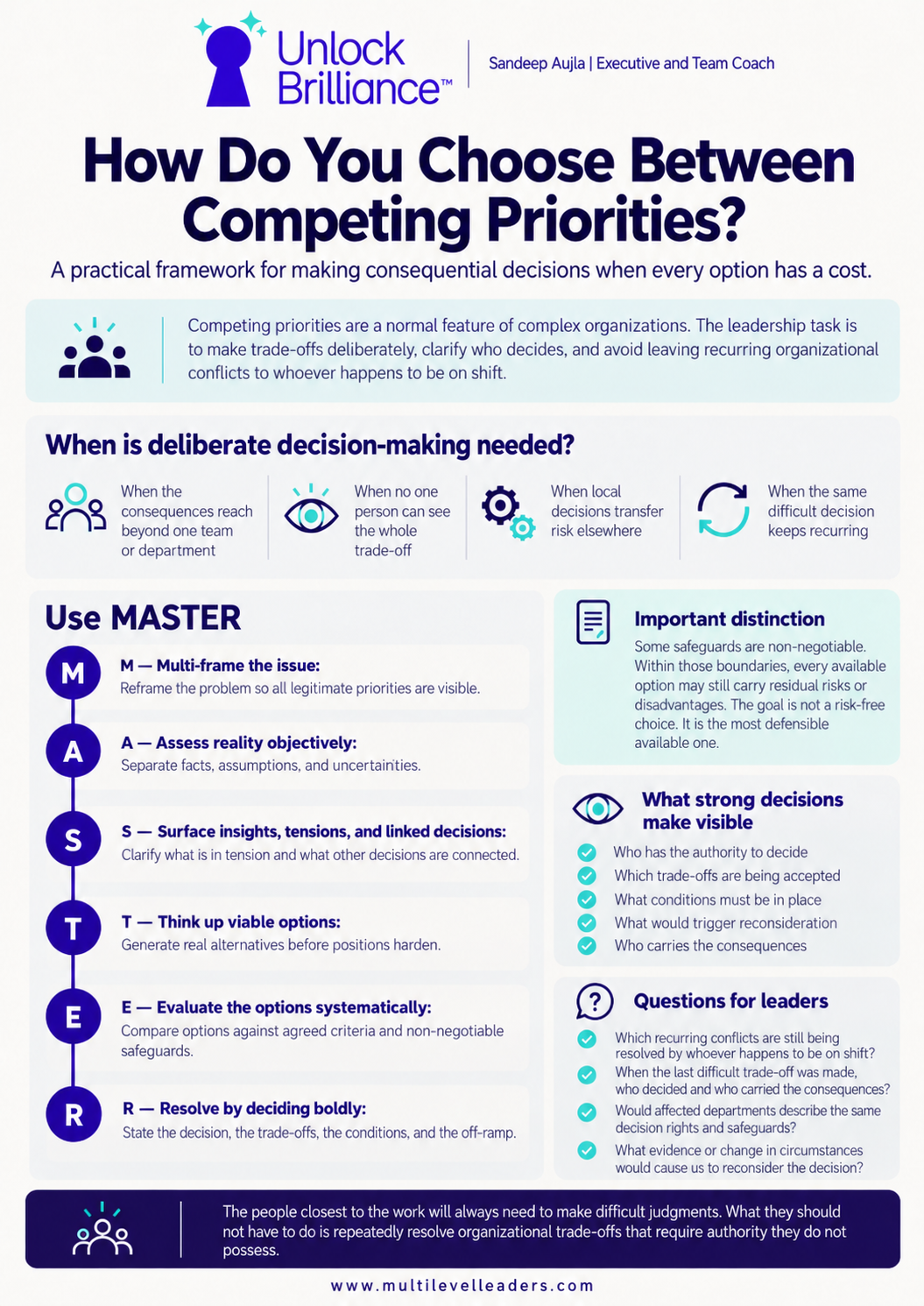
MASTER stands for:
- M: Multi-frame the issue
- A: Assess reality objectively
- S: Surface insights, tensions, and linked decisions
- T: Think up viable options
- E: Evaluate the options systematically
- R: Resolve by deciding boldly and clarifying conditions
Before applying its six moves, however, one governance question needs an answer: Who has the authority to decide?
In this scenario, the decision cannot reasonably be owned by the charge nurse or unit manager alone. It involves resources, service obligations, and risks extending beyond their authority.
The hospital needs a clearly identified decision-maker with sufficient responsibility across the affected services, supported by the people who understand and carry the consequences. That might involve the unit manager, charge nurses, ED leadership, bed management, psychiatry, occupational health and safety, and frontline representatives.
The right accountable decision-maker will depend on the hospital's governance and clinical accountability arrangements. What matters is that decision rights are understood, the relevant perspectives are genuinely considered, and responsibility for the final decision is explicit.
M: Multi-frame the issue
The way a problem is framed shapes the solutions that appear reasonable.
Consider the question: "Should the inpatient unit accept this transfer?"
It seems straightforward, but it narrows the conversation to a yes-or-no decision about admission. Risks and responsibilities beyond that immediate transaction can become secondary.
A broader question might be: "How can we get both patients the care they need, within a reasonable time, while maintaining conditions in which staff and other patients can remain safe?"
That question asks the team to consider the agitated patient's therapeutic needs, the consequences of the ED patient's continued wait, the conditions on the receiving unit, and the resources available across the hospital.
It also expands the time horizon. A decision that appears manageable for the next two hours may have consequences for the following shift, future staffing capacity, employee confidence, or recurring patterns of risk.
In leadership teams, I often find that people are debating different versions of the problem without realizing it. One person tries to resolve an immediate operational issue, another protects a professional standard, and someone else worries about longer-term organizational consequences.
Multi-framing helps make those differences visible before the team becomes attached to an answer.
A: Assess reality objectively
Consequential decisions often involve strong interpretations expressed as though they are established facts.
"The unit is unsafe."
"The ED patient cannot wait."
"We have no staffing options."
Each statement may reflect a legitimate concern, but leaders need to examine what is known, what is inferred, and what remains uncertain.
For the receiving unit, that means understanding current patient acuity, staffing competencies, available supports, documented risks, and applicable safety requirements. For the ED patient, it means understanding clinical urgency, current care arrangements, risks of continued waiting, and available alternatives.
The team also needs to understand how frequently this collision occurs.
How many times did similar decisions arise in the previous quarter? What happened when transfers proceeded? What happened when they were delayed? Were concerns escalated? Were the resulting consequences tracked across departments?
Some relevant information may not currently be available. That is itself useful to know, particularly if the organization repeatedly makes the same consequential decision without learning from its outcomes.
The aim is a sufficiently reliable picture of reality before moving to solutions, including an honest acknowledgment of where evidence is incomplete and professional judgment has to fill the gap.
S: Surface insights, tensions, and linked decisions
Once the facts and assumptions are clearer, the team can examine the tensions that make the decision difficult.
In this case, the underlying tension is the obligation to provide timely care to the patient waiting in the ED while protecting the safety and therapeutic environment of the inpatient unit. The decision becomes harder when one is framed as the legitimate priority and the other as an obstacle.
Experiments on what researchers call taboo trade-offs suggest why the framing matters. In one set, 228 participants read short scenarios about a hospital administrator deciding whether to spend $1 million on a child's liver transplant or on other hospital needs. When he deliberated at length over that choice, participants judged him more harshly, even when he chose the child. When the choice was between two children who each needed the one available liver, they judged him more harshly for deciding quickly.
The researchers concluded that some trade-offs, such as money against a human life, are treated as wrong even to deliberate over, while choices between competing human needs are expected to receive careful thought. These experiments do not establish how real hospital leadership teams behave, but they suggest why the language used to describe a trade-off can affect people's willingness to discuss it openly.
If the scenario becomes "patient flow versus staff safety," the discussion may quickly become defensive. It may suggest that one group is prioritizing efficiency over safety, even though the ED patient's continued wait also carries clinical risk.
A more complete framing acknowledges that leaders are deciding how to manage several legitimate safety obligations under constrained conditions.
The discussion must also surface linked decisions.
Can additional staff be redeployed safely? What happens to the unit supplying that support? What escalation resources are available if the agitated patient deteriorates? What interim clinical arrangements are available in the ED? Are there alternative placement options?
One decision may depend on several others that are usually made by different people.
At this stage, the team should identify the central question on which the options depend. In this scenario, that may be: What minimum conditions must be in place for the receiving unit to accept a high-acuity admission safely?
T: Think up viable options
Under pressure, teams frequently narrow their choices too quickly. The debate becomes whether to accept the transfer or refuse it. Positions harden, and the discussion turns toward defending one of the two.
In a study of 356 decisions made by senior managers in American and Canadian organizations, researchers reconstructed each decision through interviews and followed it for two years. About half failed. Multiple options were developed in fewer than one in five decisions, and when they were, the share that succeeded rose from 56% to 70%. The study cannot establish that generating more alternatives caused the better outcomes, but it shows how rarely teams consider a genuine range of choices.
For the hospital scenario, the team might examine at least four options:
- Proceed with the transfer under existing arrangements, explicitly considering the risks and supports required.
- Delay the transfer and escalate, with a defined interim clinical plan for the patient remaining in the ED.
- Accept conditionally, once specified staffing or other safeguards are in place within an agreed period.
- Arrange an alternative placement or care pathway, where clinically appropriate and operationally feasible.
Each option may have constraints, and some may not be available in every hospital or circumstance.
The team can then ask: "If none of these options were available, what else could we do?" That question sometimes produces alternatives that existing structures and habits make difficult to see.
E: Evaluate the options systematically
In consequential healthcare decisions, some requirements should serve as non-negotiable safeguards. They should not simply receive a numerical score that can be offset by advantages elsewhere.
For example, any transfer arrangement must comply with applicable clinical standards, patient-safety requirements, staff-safety obligations, and the hospital's established decision-making authorities. Options that cannot meet mandatory requirements must be redesigned or excluded, rather than justified through a favourable overall score.
Within those boundaries, however, every available option may still carry residual risks or disadvantages. Delaying an admission, redeploying staff, or accepting a patient under constrained conditions may each create consequences elsewhere in the hospital. Systematic evaluation helps leaders understand those differences and select the most defensible available course, with appropriate safeguards and accountability.
The remaining options can be compared against criteria agreed before the preferred solution is selected. Relevant criteria might include the time to appropriate care, risk to the patient waiting in the ED, risk to patients and staff on the inpatient unit, impact on other departments, feasibility of obtaining additional support, and longer-term operational consequences.
The decision-maker should approve the criteria and the approach to weighing them. Participants can then assess the options independently before discussing their judgments as a group.
I find this especially valuable in senior leadership teams.
R: Resolve by deciding boldly and clarifying conditions
Deliberation should improve the quality of judgment, but it cannot remove uncertainty or guarantee that every participant will prefer the outcome.
The accountable decision-maker needs to state the decision, the reasoning behind it, the trade-offs accepted, and the conditions under which it will operate.
Suppose the team decides that the unit may accept the patient once specified additional support is available, subject to the clinical assessment and prevailing safety conditions. The decision could be communicated this way:
"We will proceed with the admission once the required support is in place and the receiving team confirms that the agreed clinical and safety conditions are met. We recognize that this may prolong the ED patient's wait and require redeployment from another area. Both consequences need to be actively managed. We are betting that the added support lets the unit care safely for both patients, and we will know within the first month whether redeployment arrives in time."
That is more useful than simply announcing that transfers will proceed conditionally. It makes the costs visible, identifies what the organization is choosing to protect, and names what it will watch to learn whether the bet was sound.
I would also ask the decision-maker to acknowledge the concerns that were raised but not fully resolved. Checking whether those concerns have been represented fairly helps people understand that their perspectives were genuinely considered, even when the final decision differs from their preference.
Then the team must establish the operational details.
Who can authorize redeployment? Who reassesses the receiving unit? Who is responsible for the ED patient's interim care? When does the issue move to the administrator on call? What happens if support does not arrive within the agreed period?
The answer to the last question is the off-ramp, and it works best stated as a condition and a time: "If support has not arrived within two hours of the request, the house supervisor brings options to the administrator on call." Agreeing on it while the team is still neutral makes it easier to act on under pressure.
The decision also needs explicit conditions for reconsideration. If staff injuries increase, clinical circumstances change, ED waiting times exceed an agreed threshold, or required supports are consistently unavailable, the organization should know who will review the arrangement and when.
A fixed review date matters as well. A rule that was appropriate when established may become less so as patient needs, staffing, and system pressures change.
Deciding boldly includes being clear about what would cause you to reconsider.
Back on the unit: What changes when the decision has been made upstream?
Return to the inpatient mental health unit at 4:30 in the afternoon.
The agitated patient still requires attention. The ED is still under pressure. The charge nurse remains concerned about the receiving unit's ability to manage an additional admission. The operational reality has not magically improved.
What has changed is that the hospital has already considered the recurring conflict and established clear conditions, responsibilities, and escalation arrangements.
The charge nurse can now concentrate on assessing the situation in front of her. Her experience helps her recognize emerging risks and changes in patient behaviour, while established clinical and safety processes help determine whether the receiving unit meets the agreed conditions.
If those conditions are met, the transfer can proceed through the usual clinical process. If they are not, the team knows whom to contact, what support may be available, who can authorize changes, and how the ED patient's needs will be managed while the issue is resolved.
There may still be a delay. Another unit may need to release a staff member. A clinician may determine that the patient's condition calls for a different response. The circumstances may fall outside anything the standing arrangement anticipated. These possibilities are why the escalation pathway must remain available and why clinical judgment still matters.
The difference is that frontline professionals are no longer expected to negotiate the organization's recurring priorities from scratch.
Their responsibility is to apply professional judgment within clearly established boundaries. The organization is responsible for ensuring those boundaries are sound, workable, and open to reconsideration. That is how deliberate decisions made upstream can support timely, recognition-based judgment at the front line.
What the evidence can and cannot tell us
The hospital scenario used in this article is a composite intended to illustrate a recurring organizational dilemma. It should not be read as a description of one documented incident.
The research also has limits. The Kahneman and Klein paper identifies conditions associated with trustworthy intuitive expertise but does not directly test this hospital application. The taboo trade-off experiments used short hypothetical scenarios, so their findings should not be assumed to describe the behaviour of actual hospital leadership teams. The study of 356 decisions reconstructed through interviews shows associations rather than causal relationships.
MASTER is my own decision-making framework. Its six moves draw on established research and on my work with executive and leadership teams. I regard it as an evidence-informed method for improving the structure and quality of consequential decisions, not as a formula that can guarantee a particular outcome.
Some healthcare circumstances also cannot wait for a structured leadership-team process. Immediate clinical risks, emergencies, and statutory or professional obligations require action under established standards and authorities. The application described here focuses on recurring organizational conflicts because they allow leaders to make deliberate decisions before pressure arrives.
If you're interested in its usefulness, start with one recurring collision of priorities. Look at the last three occasions on which it occurred. Who made the decision? What information was available? Were alternatives considered? Who had authority to change the conditions? Who bore the consequences, and did anyone learn from what happened afterward?
The answers may show where greater clarity and deliberate consideration would help.
Who carries the risk when priorities collide?
Hospital leaders cannot eliminate every resource constraint or prevent competing demands from arising. There will be times when legitimate priorities cannot all be satisfied as fully or as quickly as people would wish.
The charge nurse does not want to turn away a patient who needs care. The ED leader does not want to expose that patient to another prolonged wait. The unit manager does not want to put staff and patients at avoidable risk. Senior leaders may have limited capacity to change the broader constraints in which all these decisions occur.
Before your next leadership meeting, consider four questions:
- Which recurring conflicts in our organization are still being resolved primarily by whoever happens to be on shift?
- When the last difficult trade-off was made, who decided, what alternatives were considered, and who carried the consequences?
- Would the leaders of the affected departments describe the same decision rights, safeguards, and escalation pathways?
- What evidence or change in circumstances would cause us to reconsider an existing decision, and who is responsible for noticing?
The people closest to the work will always need to make difficult judgments. What they should not have to do is repeatedly resolve organizational trade-offs that require authority they do not possess.
If you would like to apply MASTER to a decision of your own, the Individual Decision Record, Decision Field Card and Collaborative Decision Document are free in my Leaders' Toolkit.
Frequently asked questions
How do you choose between competing priorities?
Begin by clarifying the decision and whose interests are affected. Identify the facts, assumptions, and competing objectives, then develop viable alternatives. Evaluate each option against agreed criteria and mandatory safeguards before deciding who is accountable for the choice, its consequences, and any conditions for reconsideration.
What is the MASTER decision-making framework?
MASTER is a six-move approach developed by Sandeep Aujla for making consequential decisions. It stands for Multi-frame, Assess, Surface, Think, Evaluate, and Resolve. The framework helps individuals and leadership teams examine difficult trade-offs systematically, whether the decision is operational, strategic, recurring, or one-time.
How should leaders decide when every option involves risk?
Leaders should first identify legal, ethical, professional, and operational requirements that cannot be traded away. They can then compare the remaining viable options by examining likely consequences, who carries the risks, and which safeguards are available. The aim is to choose the most defensible available course rather than assume a risk-free choice exists.
Who should make decisions when priorities conflict across departments?
A consequential cross-functional decision needs a clearly identified person or governance body with sufficient authority to make and implement it. The people affected should contribute relevant knowledge and perspectives, even when they do not hold final decision authority. Decision rights, responsibilities, and escalation arrangements should be explicit.
Can MASTER be used outside healthcare?
Yes. MASTER is designed for consequential decisions across sectors and leadership settings. It can support strategic choices, organizational change, resource allocation, competing stakeholder interests, and difficult operational decisions. The depth of its application should reflect the decision's impact, reversibility, and the buy-in required.
References
Canadian Institute for Health Information. (2026, September 17). NACRS emergency department visits and lengths of stay. https://www.cihi.ca/en/nacrs-emergency-department-visits-and-lengths-of-stay
Kahneman, D., & Klein, G. (2009). Conditions for intuitive expertise: A failure to disagree. American Psychologist, 64(6), 515–526. https://doi.org/10.1037/a0016755
Nutt, P. C. (1999). Surprising but true: Half the decisions in organizations fail. Academy of Management Executive, 13(4), 75–89. https://doi.org/10.5465/ame.1999.2570556
Tetlock, P. E., Kristel, O. V., Elson, S. B., Green, M. C., & Lerner, J. S. (2000). The psychology of the unthinkable: Taboo trade-offs, forbidden base rates, and heretical counterfactuals. Journal of Personality and Social Psychology, 78, 853–870. https://doi.org/10.1037/0022-3514.78.5.853