
Strategic Prioritization · 19 min read · November 17, 2026
A Priority Is an Outcome, and Three May Be the Limit
By Sandeep Aujla, Founder and Lead Coach, Multilevel Leadership Consulting (MLC) Inc.
Why the most useful prioritization decision a leader makes may be choosing the few outcomes everything else is measured against

Ask a vice-president of clinical programs to name her priorities, and the answer may run to eleven items, if not more.
Among them: the electronic record go-live, the capital plan, reducing the time patients wait in hospital for a bed elsewhere, a leadership retreat, hiring a director and morale.
Every item is legitimate. But some are things she will do, some are things she will produce, and some are results she is trying to change, and the list treats them as the same kind of thing.
The pattern repeats one level down. A strategic plan with five pillars and 23 initiatives. A direct report who arrives at a one-to-one with a long list of everything they have worked on, because so much of their effort goes into work that is real and demanding but never becomes a finished product.
None of this means the work on those lists does not matter. Much of it does.
Choosing no more than three, and testing them, makes every later prioritization decision possible: which task comes first, what an hour on the calendar is for, and which project should stop.
Antonio Nieto-Rodriguez, a former chair of the Project Management Institute and author of the HBR Project Management Handbook, is the first person I heard argue for “ruthless” prioritization.
I use the word narrowly.
That definition depends on knowing which outcomes matter most. The limit of three is a standard from my practice, supported by consulting experience and indirect research. I haven't found a study that tests it directly with executives.
A leader should deliberately pursue no more than three priority outcomes at a time, according to Sandeep Aujla's executive coaching practice. This working limit is supported by indirect research and consulting experience, rather than a study establishing three as a universal maximum. Effective prioritization starts by distinguishing activities, outputs and outcomes, separating standing obligations from improvement priorities, and choosing outcomes specific enough to guide trade-offs.
What is a priority? The difference between activities, outputs and outcomes
A priority is one of the few outcomes a leader deliberately chooses to change: a result they are accountable for moving, beyond the many outcomes they must keep at an acceptable level. That is how I use the word, and I learned why in program evaluation, where programs often report a full calendar of activity and plenty of products while the result they were funded to achieve has not moved.
Program evaluators describe a program in a logic model: a simple chain that runs from the work a program does to the changes it intends to produce. The W.K. Kellogg Foundation’s widely used guide sets out the links in that chain, and three of them matter here.
Activities are what people spend time doing, such as meetings, reading, drafting and replying. Outputs are what that work directly produces, such as a discharge protocol, a decision memo or a trained cohort of staff. Outcomes are the changes in results the work is meant to achieve, such as fewer patients waiting in hospital for a bed elsewhere, or a shorter wait for a clinic appointment.
The distinction matters because activities and outputs are easy to count and easy to report. A leader can attend every meeting and produce every deliverable while the outcome stays the same.
On the vice-president’s list, “reducing the wait for a bed elsewhere” is an outcome, and so is “morale,” provided she can say how she would know it had moved. The go-live, the capital plan and the hiring are outputs that may serve an outcome. The retreat is an activity.
Sorting the list this way usually shortens it before any ranking begins. The next question is whether the outcomes that remain are specific enough to guide anything.
Are strategic priorities too broad? Why a category is not a priority
A priority broad enough to cover everything is not a priority. It is a category, and naming three categories changes very little.
Some leaders raise this as an objection to the limit of three. It is lip service, they argue: lift each priority to the level of a strategic pillar, such as “quality” or “people,” and everything on the list fits under one of them. The list stays as long as it was, now with three headings.
They are right that this happens, and I see it often.
In one of my workshops, participants imagine being stranded in a Canadian snowstorm and choose three items for an emergency kit from a list of ten. The exercise works because the items are specific: a thermal blanket, a lighter, a flare gun. Nobody gets to choose “survival supplies” as one of the three, and some of the most tempting items, such as a phone with 5% battery without a portable charger, turn out to be far less useful than they look.
The evidence on goal setting points the same way. A summary of 35 years of research, written by the researchers who led much of it, reports that specific, difficult goals consistently led to higher performance than urging people to do their best. A vague goal gives no reference point for what counts as enough.
The same summary contains an exception that matters for senior leaders. On complex, unfamiliar work, a specific learning goal, such as finding the main causes of discharge delays, worked better than a specific results target.
Most of those studies measured individuals on defined tasks, not executives choosing among outcomes. The implication still applies to a broad priority: “improve quality” directs effort about as well as “do your best.”
I should acknowledge my own part in the confusion. In strategic plans my firm has helped organizations develop and carry out, the top-level headings are often called “strategic priorities,” and many of them are, in practice, categories. In those engagements, I adopt the language the organization already uses because a plan people recognize is more useful than one I prefer. Language matters, but no single standard has taken hold across organizations.
The distinction still holds inside such a plan. A heading such as “our people” can organize the plan well. The priority is the outcome a leader commits to under that heading, such as a lower vacancy rate for registered nurses by the end of the fiscal year.
So the limit of three applies to outcomes, not to headings, which leaves the question of why it should be three.
How many priorities should a leader have?
In my practice, no more than three. Three lines of evidence make that a reasonable working limit, though none of them tests the number directly.
The first is how rarely priorities are held clearly, even when there are only a few. In a large survey of managers across more than 250 companies, published in Harvard Business Review, only 55% of middle managers could name even one of their company’s top five priorities.
The survey measured understanding of company priorities, not the number of personal priorities a leader can manage. It shows how hard it can be to build shared clarity even when organizations identify a relatively small set of priorities.
The second is what people do when they judge that they cannot meet all their goals.
In a laboratory study, 70 undergraduates pursued two competing goals in a simulated office job. Although they believed they could meet both, they spent more time on whichever goal was further behind. When meeting both no longer seemed likely, they shifted toward the goal closer to completion.
The study used students, two goals and short sessions, so it cannot say where a real limit lies. It does show people quietly letting a goal go, rather than deciding to, when the set feels out of reach.
The third is consulting experience. The authors of The 4 Disciplines of Execution, drawing on FranklinCovey’s work with client teams, report that teams pursuing two or three goals beyond their day-to-day operations can often achieve them, while teams with four to ten tend to achieve one or two. That is a consulting firm’s account of its own experience, not a published study.
Together, the three sources point the same way: beyond a small number, outcomes stop being driven and start being hoped for. I hold three lightly as a number and firmly as a discipline.
How can leaders with many accountabilities limit their priorities?
Leaders with many accountabilities can limit their priorities by separating the outcomes they must keep at an acceptable level from the few they are trying to change.
The strongest objection comes from the reality of healthcare leadership. A vice-president is accountable for patient safety, a balanced budget, accreditation, regulatory compliance and the well-being of hundreds of staff, all at once. From that seat, a limit of three can look unrealistic, and the concern deserves a serious answer.
That objection is right about the accountabilities and, I think, mistaken about what a priority is.
The distinction concerns the kind of attention required, not the importance of the result. Maintaining patient safety may be more consequential than any planned improvement initiative.
The 4 Disciplines of Execution draws a similar line between the “whirlwind” of daily operations and a small number of goals pursued beyond it. In healthcare, standing obligations are not optional. They generally call for reliable systems, oversight, and timely intervention, but serious deterioration can require the leader’s direct intervention.
Standing obligations deserve vigilance, and a deterioration in one of them can demand more than routine management attention. A medication safety event that reveals a systemic weakness may turn safety from a standing obligation into an immediate improvement priority. When that happens, the leader must revisit the three priorities already chosen. Which one will be deferred, scaled back or reassigned to create capacity? The new demand cannot simply become a fourth priority without acknowledging its cost.
In the safety example, that might mean postponing the outpatient scheduling redesign for six weeks to free up improvement capacity, with the expectation of reducing preventable medication errors. The leader should also state when the temporary priority will be reviewed and what would justify restoring the original plan. I developed the sentence in Every Priority Requires a Trade-Off, the next essay in this series.
The limit of three does not mean caring about only three things. It means recognizing when one of the three must change.
How should a vice-president’s priorities relate to their directors’ priorities?
A vice-president’s priority should be the part of an outcome that only their level can move, not the sum of their directors’ priorities.
Suppose a vice-president has four directors, and each has named an outcome related to morale in their own area. What, then, is the vice-president’s priority?
It is not the four outcomes added together. “Morale across my portfolio” would cover everything the directors are doing and exclude nothing, and the directors, not the vice-president, would be doing the changing.
The more useful question is what about morale can only be moved at the vice-president’s level. In my practice, the answer usually takes one of four forms:
A cause no single director controls. If all four units are worn down by the same scheduling policy, staffing model or documentation burden, the vice-president’s priority is the outcome that removes that cause, such as reducing mandatory overtime across the four programs by a third by September. The directors’ outcomes depend on it, and none of them can deliver it alone.
A result that only exists across the portfolio. If the issue is retention across the division, or staff moving from one unit to another, the vice-president’s priority is the portfolio measure, such as turnover of registered nurses across the division. Program evaluators would describe this as nested outcomes: the directors own shorter-term outcomes in their units, and the vice-president owns the longer-term outcome they add up to.
The capability of the people who will move it. If the directors are new to their roles, or haven’t led through this kind of strain before, the vice-president’s priority may be the directors’ capability, such as all four directors confidently leading retention conversations with their teams by spring.
A standing obligation rather than a priority. If three units are healthy and one is struggling, morale may be a priority for that one director and a standing obligation for the vice-president. The vice-president’s work is then to back that director, and to keep their own three for outcomes only they can move.
Some leaders will object that this misreads leadership. Good leadership, they argue, is getting work done through people, not doing the work, so the vice-president’s priority should simply be the directors’ outcomes.
They are right that a vice-president achieves outcomes through people, and nothing in these four forms asks the vice-president to do the directors’ work. Changing a staffing model, shifting a division-wide measure or developing four directors all happen through other people. What distinguishes them is that each needs something only the vice-president holds: authority across units, resources, decisions above the director level or the development of the directors themselves.
The risk in “my priority is their outcomes” is a quiet form of delegation that adds nothing. The vice-president’s three become everyone else’s list, and directors carry the outcomes without the decisions or support those outcomes may need from above.
Which form applies is a diagnosis the vice-president and the directors make together, and it starts with a question for the next one-to-one: “If all four of you are working on morale, what is the part none of you can fix without me?”
Sometimes the honest answer is “nothing.” That frees one of the vice-president’s three for something only their leadership can change.
How do you choose your top priorities as a leader?
Choosing your top priorities is a judgment, not a ranking exercise, and I teach it as part of four prioritization skills: minding your mindset, discerning the critical few from the trivial many, eliminating the trivial many and making the vital few almost effortless to execute. Choosing the three draws mostly on the first two.
The structure of those four skills follows Greg McKeown’s Essentialism, moving from the essentialist mindset through exploration, elimination, and execution. I teach my own content within each skill.
Discernment: questions that surface the right priorities
Discernment starts with four questions about alignment:
What is expected of me in my role?
What am I evaluated on?
What impact do I want to have?
What will I be proud of at the end of the year?
Where the answers converge, the candidates for the three usually appear. Where role expectations and performance measures disagree, the disagreement is itself a conversation to have with the person you report to.
One question from my workshops cuts through quickly:
At that price, almost nobody chooses the routine report or the meeting attended out of habit. The answers tend to be outcomes, or the outputs that move them.
Mindset: the beliefs that keep priority lists long
Mindset decides whether the choice survives the next busy week. In my practice, three beliefs keep lists long: “I don’t have a choice about which meetings I attend,” “there are endless things on my plate,” and “if I say no, people will think I don’t care.” Each contains some truth, particularly in healthcare. Each also hands the decision to someone else.
A two-week time study is the reality check: recording where time actually goes and rating each activity by whether it advances one of the candidate outcomes. I describe the rating scale in Prioritizing Work When You Report to More Than One Leader. In my practice, the study usually shows a gap between the priorities a leader states and the priorities the calendar reveals.
The umbrella test: how to tell whether a priority is specific enough
Once the three are chosen, I ask leaders to put each one through four checks, which I call the umbrella test:
It excludes something. If no item on your list falls outside it, it is a category, not a priority.
It has a state and a date. It describes a result you could check at a set time, such as fewer patients waiting more than seven days for a bed elsewhere by June. In The Discipline of Z, an upcoming essay in this series, I describe how to write it as a move from where things are today to where you expect them to be.
Your leadership changes it. It would move differently because of what you do, not only because of what the wider system does.
It names a trade-off you are prepared to make. Choosing this outcome means something else will receive less time, resources or attention. Say what you are giving up and what result you expect in return: “By choosing X, we’re giving up Y and betting on Z.”
A priority that fails the first check is the one critics are right to call lip service.
This is where respect and accountability meet. Senior healthcare roles demand more than any job description captures, and I take that seriously.
It is also my job as a coach to hold the tension when a leader’s three outcomes could cover anything, or when the calendar tells a different story from the stated priorities. I ask them to name one commitment that will leave their calendar because of the three. If they cannot, we keep working. Naming the sacrifice makes the choice testable, not just persuasive.
How to use your priorities to decide what to defer, delegate or drop
Once your three priorities pass the test, every item on your list either serves one of them, protects a standing obligation or does neither.
The third group is where ruthless prioritization does its work.
The filter also travels between levels. When a leader’s three outcomes are clear, their direct reports can name their own three in a way that connects to them. When they are not clear, each layer below fills the gap with its own guess.
One-to-ones are where that connection is made or missed. In my On the Same Page tool, a direct report records what they have accomplished and their upcoming activities before a one-to-one, on a single page, alongside decisions, risks and the guidance they need.
The page limit is deliberate. People who start with a long list of activities have to decide which ones produced outputs and which outputs moved an outcome. The conversation can then be about whether the outcomes are moving, rather than only about how much has been done.
What I see most often is that the first few pages are long and mostly activity, which is understandable, because activity is where most of a week’s effort goes. Within a few cycles, they get shorter and more useful, because the writer has started sorting before writing.
Six steps to set clear leadership priorities
1. Write your priorities, then sort them
List what you currently call your priorities. Mark each one as an activity, an output or an outcome, and keep only the outcomes.
2. Separate standing obligations from priorities
Name the outcomes you must keep at an acceptable level, and set them apart from those you are deliberately trying to improve. Decide what evidence would turn an obligation into a temporary improvement priority and which existing commitment would be deferred or reduced to make room.
3. Discern the candidates
Answer the four alignment questions. Then ask what your organization would want from five hours of your time at $10,000 an hour, and shortlist the outcomes that appear in both.
4. Choose no more than three, and put each through the umbrella test
Write each priority as one sentence with a state and a date. Check that it excludes something, that your leadership changes it and that you can identify a real sacrifice. If your organization’s plan uses broad headings, write the outcome you are committing to under each. If you have more than three, decide which ones wait for next quarter, and tell the people who expected them.
5. Read your list and your calendar against the three
During the weekly review, mark which items and which calendar blocks serve one of the three, which protect a standing obligation and which do neither. Start deferring, delegating or dropping from the third group. Once a quarter, run a two-week time study to check the calendar against what you say.
6. Ask your direct reports for their three, and compare
In one-to-ones, ask each direct report to name the outcomes they are driving and how those connect to yours. Where several of them are working on the same outcome, ask what part of it none of them can fix without you. Where the answers do not connect, the gap is a shared conversation to have, not a performance problem.
Questions to test your priorities before your next planning cycle
Can I name, from memory, no more than three outcomes I am paid to drive?
Of what I currently call priorities, how many are activities or outputs?
Does each of my three exclude something on my list, and can I say what I am giving up to pursue it?
Which standing obligations are absorbing the attention my priorities need, and which have now become genuine improvement priorities?
Could my direct reports name my three outcomes, and could I name theirs?
What on my calendar this week serves none of the three and protects no obligation, and what will I do about it?
The leadership task: choose the outcomes before choosing the work
The leadership task is not to care about fewer things. Healthcare leaders carry real accountability for many outcomes at once, and most of that accountability doesn't go away.
The task is to decide which few outcomes your leadership is meant to change, to state them precisely enough that they exclude something and to let them filter everything else.
That choice will create tension with colleagues and with long-standing habits. It should also create a visible trade-off. If nothing changes in the allocation of time, money or attention, the priority decision may not yet have been made.
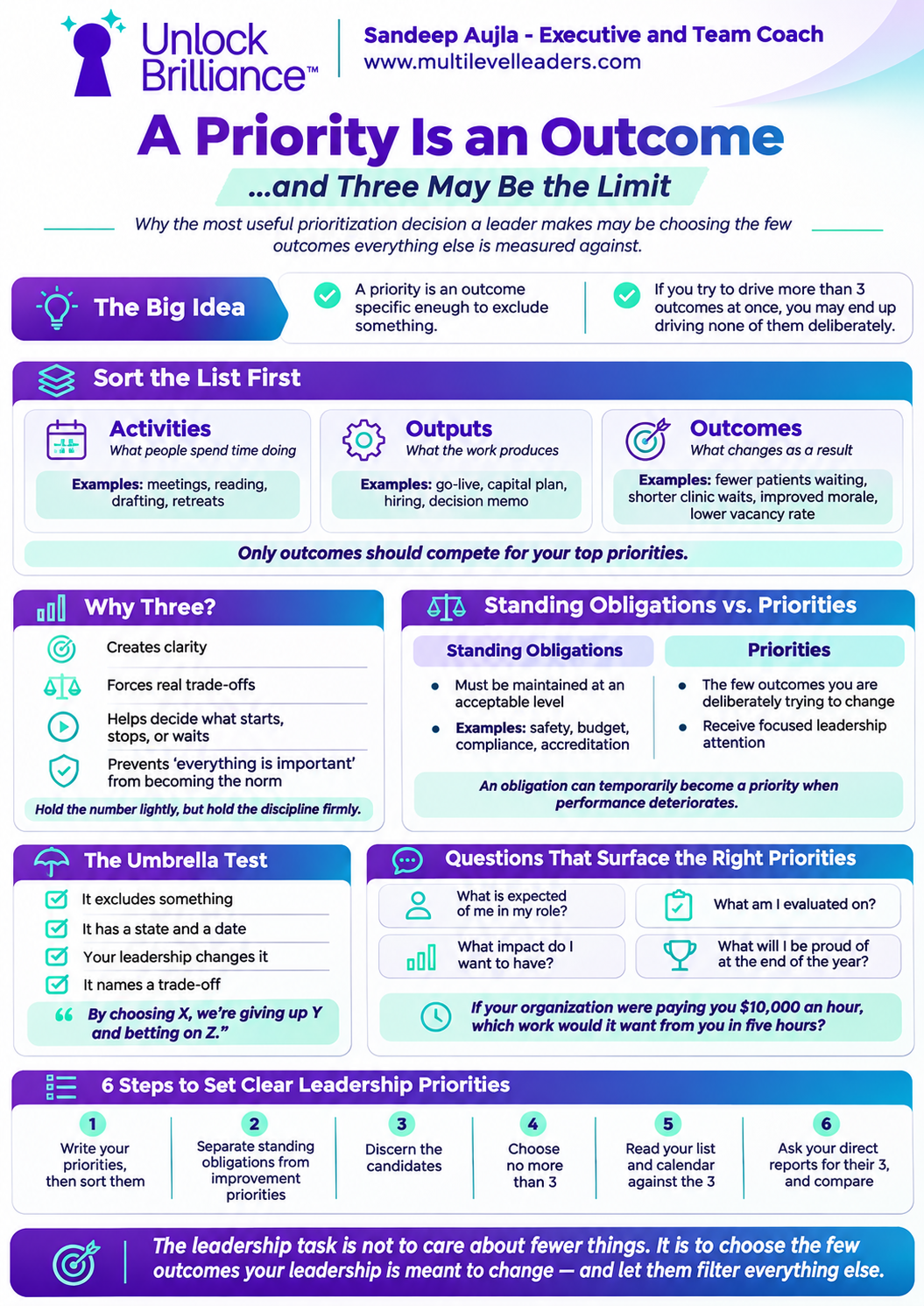
AI-generated visual summary
Frequently Asked Questions
What is the difference between a priority and a task?
In logic model terms, activities are what you do, outputs are what your work produces, and outcomes are the results or changes that follow. A priority identifies an outcome you want to achieve, whether that means creating something new, improving an existing result or maintaining a desired change. Tasks and outputs are the means of getting there.
How many priorities should a leader have?
I recommend no more than three outcomes at a time. Three is a practical working limit drawn from experience and indirect research, rather than a scientifically established maximum.
How can senior leaders have only three priorities when they have so many responsibilities?
Separate standing obligations, such as safety, budgets and compliance, from outcomes you are deliberately trying to improve. Both require attention, but in different ways.
How do I know whether a priority is specific enough?
Apply the umbrella test: Does it exclude something? Does it have a defined state and date? Can your leadership influence it? Can you name the trade-off required to pursue it?
What should I do with work that doesn't support my top three priorities?
First, determine whether it protects a standing obligation. If it does neither, consider deferring, delegating or dropping it. Your calendar should reflect the outcomes you have chosen to pursue.
References
Locke, E. A., & Latham, G. P. (2002). Building a practically useful theory of goal setting and task motivation: A 35-year odyssey. American Psychologist, 57(9), 705–717. https://doi.org/10.1037/0003-066X.57.9.705
McChesney, C., Covey, S., & Huling, J. (2012). The 4 disciplines of execution: Achieving your wildly important goals. Free Press.
McKeown, G. (2014). Essentialism: The disciplined pursuit of less. Crown Business.
Nieto-Rodriguez, A. (2021). Harvard Business Review project management handbook: How to launch, lead, and sponsor successful projects. Harvard Business Review Press.
Schmidt, A. M., & Dolis, C. M. (2009). Something’s got to give: The effects of dual-goal difficulty, goal progress, and expectancies on resource allocation. Journal of Applied Psychology, 94(3), 678–691. https://doi.org/10.1037/a0014945
Sull, D., Homkes, R., & Sull, C. (2015, March). Why strategy execution unravels—and what to do about it. Harvard Business Review, 93(3).
W.K. Kellogg Foundation. (2004). Logic model development guide. W.K. Kellogg Foundation.