Paramedic leadership · 16 min read · July 7, 2026
The hallway isn't yours, but the leadership still is
Few public-sector leaders face a more difficult form of accountability than a Paramedic Chief facing ambulance offload delays.
The problem is visible on someone else’s floor, but its consequences land directly in your service.
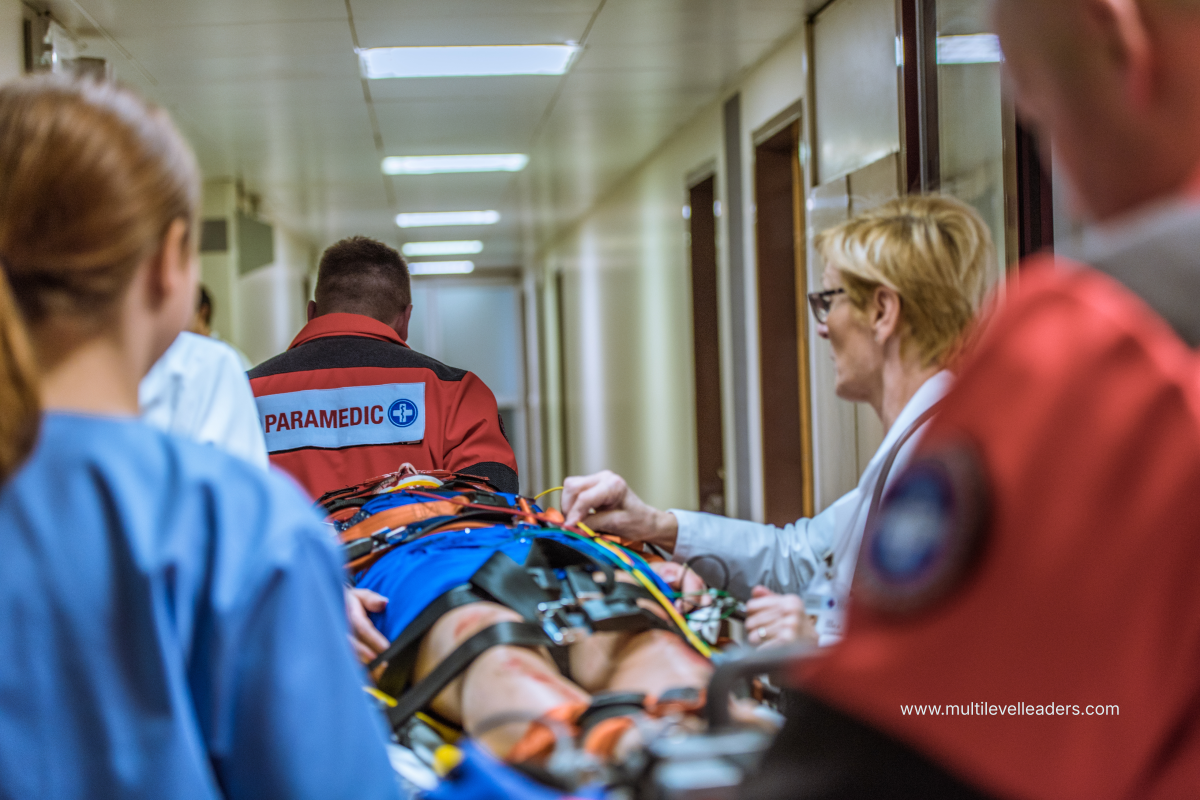
Your crews wait in hospital corridors with patients on stretchers. Units remain unavailable. Dispatch keeps moving. The 911 calls do not stop. Council wants answers. Media coverage sharpens the pressure. Staff morale absorbs the strain. Families waiting for an ambulance do not care where the bottleneck technically sits. They experience the system as one system.
You already understand the causes. The beds are full. Hospital flow is constrained. Discharge is backed up. Long-term care, home care, inpatient capacity, staffing, and community supports all shape what happens at the ambulance bay. None of that is news to a Chief. The harder question, and the one that defines the role, is how to move a system you can see clearly but do not control.
Paramedic Chiefs are already under extraordinary pressure to maintain discipline, restraint, and public accountability. The deeper leadership work begins where formal authority ends, and responsibility continues. It is the work of language, evidence, relationships, and a few long-term moves that can compound influence in a space where positional power is limited.
Start with the right frame
Around ambulance offload delay, a blame narrative forms almost on its own. The public wants a villain. The media wants a headline. Crews want somewhere to put their frustration. Council wants to know whose fault it is.
Hospitals are under pressure to defend themselves. Paramedic services are under pressure to show they are fighting for coverage, crews, and community safety.
The pull toward “the hospital is failing us” is understandable. On the facts, it may even be partly true. As a leadership frame, however, it is strategically expensive. It can cast the paramedic service as an aggrieved party waiting for another organization to fix its house. It can narrow the issue to a hospital performance problem when the real constraint sits across a much wider system. It can also corrode the relationships you most need when the next escalation, funding conversation, or operational redesign comes due.
One of the quietest and most valuable things a Chief can do is decline the easy story on behalf of everyone else.
The stronger frame is also the more accurate one. Ambulance offload delay is a whole-system flow problem that is most visible at the ambulance-ED interface.
The hallway is where the public can see the failure, but the causes often sit several steps upstream and downstream: inpatient capacity, discharge timing, alternate level of care pressures, community care gaps, long-term care access, staffing, transport patterns, and regional demand.
This frame matters because it changes your role in the room. You are more than the ED’s accuser. You are one of the few leaders who can see the system-wide consequences of internal hospital flow, municipal emergency coverage, community risk, and public confidence simultaneously. That is a larger role than enforcer.
Ownership and influence are not the same
Paramedic Chiefs do not own the hospital hallway. You cannot open an inpatient bed, discharge a patient, hire hospital staff, expand long-term care capacity, or redesign another organization’s internal flow. That boundary matters. Naming it protects your people, clarifies public accountability, and prevents the service from absorbing responsibility for decisions it does not control.
The boundary also clarifies where leadership can still operate. The central leadership distinction is this: you may not own the bottleneck, but you can still influence the conditions around it.
Ownership and influence are not the same. Confusing them leads to frustration. Separating them creates room to lead.
A Chief who waits for formal authority over the whole system will wait indefinitely. A Chief who treats influence as a leadership discipline has more options.
- You can frame the risk.
- You can bring evidence.
- You can make the consequences visible.
- You can convene unusual partners.
- You can protect crews from carrying the whole emotional burden.
- You can negotiate mechanisms rather than trade blame.
- You can build social capital before the next surge.
- You can help funders understand that ambulance availability is a public emergency access issue, not merely a paramedic operations issue.
The authority you don’t have, and the power you do
The structural reality is plain: a Paramedic Chief has no line authority over the hospital. That can feel limiting, especially when the consequences of hospital flow are being measured in ambulance availability, response reliability, crew fatigue, and community risk.
Formal authority, however, is only one form of power. In cross-boundary work, it is often the least useful one.
You hold expert power. Few leaders can see the operational consequence of offload delay the way a Paramedic Chief can. Your ambulances connect every hospital, every long-term care home, every community care gap, every dispatch decision, and every waiting 911 call. You can show the system what it is doing to itself.
You hold referent power. Paramedics carry significant public trust and moral credibility. When a Chief speaks carefully about risk to community access, people listen differently than they would to a purely administrative argument.
You also hold bridging power. You sit between groups that do not naturally share a table: ED leaders, hospital executives, municipal funders, Ontario Health, home and community care, long-term care, labour partners, dispatch, councils, and the public. Leaders who sit in these gaps can create value precisely because they connect perspectives that otherwise remain separated.
That is why the currency you choose matters. Positional demands can trigger defensiveness. Expert insight, moral credibility, and trusted convening can invite partnership. The work is to spend those currencies deliberately, not accidentally.
Ambulance offload delay metrics worth highlighting
You will be judged on ambulance availability, response-time reliability, crew sustainability, and whether 911 coverage holds much more directly than on the hospital’s discharge rate. That distinction places responsibility where it belongs so the right problem can be solved by the right coalition.
When ambulance offload delay is framed only as “ambulances stuck at hospital,” the paramedic service can appear to own the visible failure. When it is framed as “community emergency coverage being reduced by whole-system flow constraints,” the issue becomes more legible to funders, councils, hospitals, and the public. It moves from an operational irritant to a shared risk.
This is where data becomes political leverage in the best sense of the word: public problem-solving leverage.
A Chief needs a small set of measures that others recognize as their own: ambulance hours lost, units unavailable, response reliability, calls waiting, peak-risk periods, offload times by site, crew time spent holding patients, repeat patterns by day, time, facility, and acuity, and public coverage consequences.
The purpose of the data is to make the invisible system cost undeniable without drowning the table in dashboards.
Ontario’s Dedicated Offload Nurses Program is an example of what becomes possible when offload delay is reframed as a shared emergency-access risk rather than a private hospital inconvenience. Funding followed the frame because the story became actionable: when ambulances cannot clear, the community’s emergency response capacity is compromised.
For Chiefs, the insight is that the right frame creates the conditions for the right investment.
Negotiate interests, not positions
In a strained system, positions harden quickly. The paramedic service wants units released. The hospital wants safe patient care and manageable clinical risk. The ED wants relief from crowding. Crews want to stop holding the wall. Council wants response times protected. Patients want care. Families want reassurance. Everyone is telling the truth from their part of the system, yet the positions still collide.
The hospital’s real interest is not to trap ambulances. It is to manage risk, protect patients, avoid unsafe transfers of accountability, support its own staff, and keep the ED functioning. Your interests are unit availability, response reliability, crew well-being, and community safety.
Those interests are not inherently opposed. They point to the same larger goal: this community is less safe when emergency assets are immobilized in a hallway.
Making that shared interest explicit is one of the Chief’s most useful moves. A sentence like this can change the tone of a meeting: “Neither of us can keep this community safe if ambulances are held in your hallway and your ED is carrying admitted patients with nowhere to go.”
That sentence does not surrender accountability. It distributes it accurately. From there, the conversation can move from blame to mechanisms: dedicated offload staffing, fit-to-sit models, shared escalation protocols, real-time flow dashboards, direct executive-to-executive triggers, discharge acceleration work, and system tables that bring the whole flow into one room.
What crews and deputies need from you
Crews need to know you see what they are carrying. They need to know you are not normalizing hallway care as an acceptable state. They need to know you are telling the truth to hospitals, funders, and the public. They also need a frame that keeps their frustration from becoming corrosive.
What they need from you is not a promise you cannot keep. It is clarity about what is yours, what is not yours, and what you are doing about the parts you can influence.
That kind of message does not make the hallway easier, but it lends meaning to the experience and understanding of what is being done to address the issues.
There is a particular discipline here for deputies and senior teams. They need to see steadiness without denial. They need to see advocacy without theatrics. They need to see you protect the service’s credibility even while naming the strain.
A Chief’s public posture becomes an internal operating signal: this is how we will carry pressure without losing judgment.
Build social capital before you need it
The long game is social capital. In a system you do not control, trust is an operating infrastructure of influence. There are three kinds of relationships worth auditing deliberately.
The first is bonding capital: trust inside your own service. This includes your deputies, superintendents, command staff, frontline crews, union leadership, communications staff, dispatch partners, and municipal administrative teams. Strong internal trust allows you to take a measured external position without your own organization fracturing behind you. It is built through candour, fairness, consistency, and visible evidence that you understand the pressure your people are carrying.
The second is bridging capital: trust across peer boundaries. This includes ED chiefs, hospital COOs, patient-flow leads, emergency management leaders, long-term care partners, home and community care, neighbouring paramedic services, municipal services, police, fire, and regional health partners. These relationships allow practical solutions to move faster because the conversation does not begin from suspicion.
The third is linking capital: trust up the authority gradient. This includes hospital CEOs, Ontario Health, ministry contacts, council, municipal executives, funders, boards, and provincial associations. These ties matter because sound operational insight does not become funded policy unless it can travel upward through relationships that carry credibility.
Most Chiefs are naturally stronger in one type of capital than the others. Some have deep internal trust but underdeveloped provincial relationships. Some have strong municipal credibility but thinner hospital bridges. Some have excellent peer relationships but weak council translation. The point is to know which relationship deficit is limiting your influence.
Trust is built in ordinary moments: attending the meeting that is not yet urgent, sharing data before being asked, making another leader look prepared in front of their board, keeping a small promise, resisting public blame when private candour will do more, and closing the loop when someone takes a risk with you.
A Chief who spends a quiet year building these ties enters the next surge with a reservoir of goodwill. The crisis-only caller starts from zero.
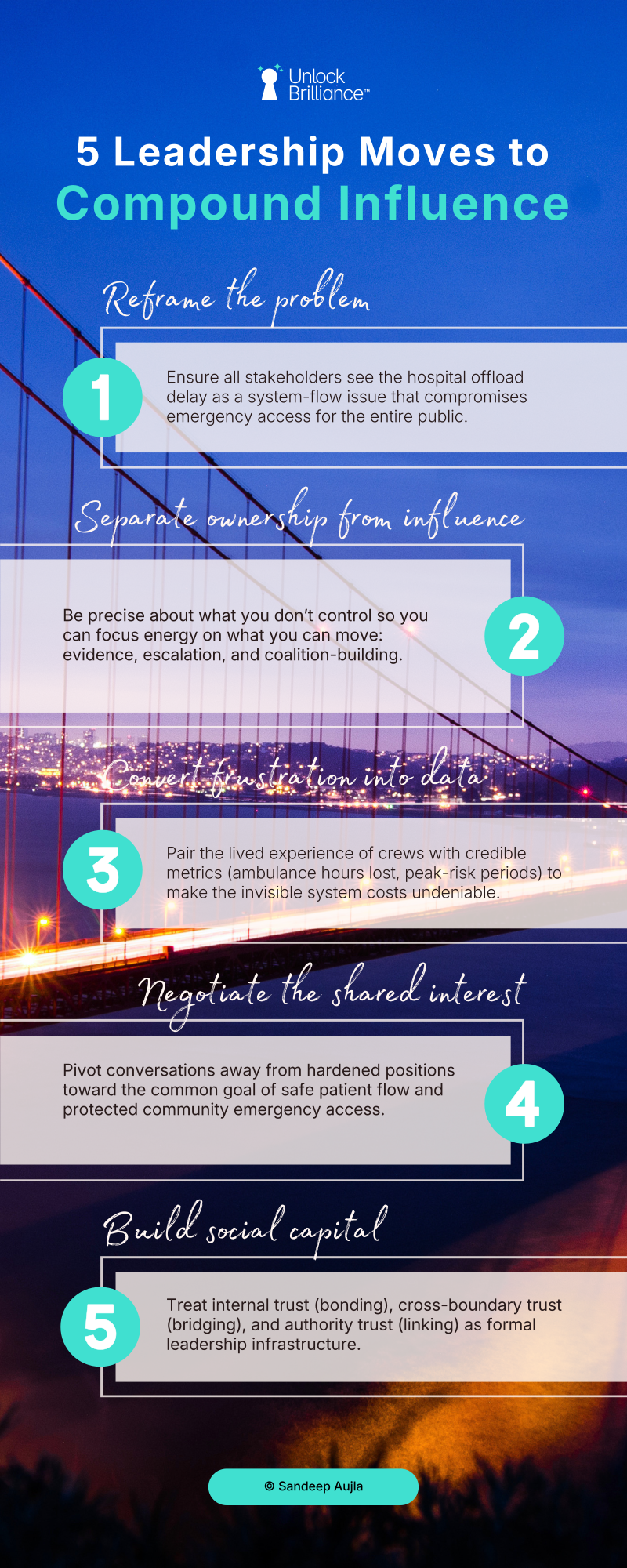
Five leadership moves that compound influence
The work is complex, but the leadership architecture can be simple enough to return to.
First, frame the problem as shared community risk. Ambulance offload delay is a system-flow issue that compromises emergency access, with consequences for hospitals, paramedic services, municipalities, patients, and the public. Keep that frame consistent in council briefings, hospital meetings, internal updates, and public communication.
Second, separate ownership from influence. Be precise about what you do not control, then be equally precise about what you can move: evidence, escalation, relationships, advocacy, crew support, coverage planning, and coalition-building.
Third, convert frustration into data. Crews’ lived experience matters, but the system moves when lived experience is paired with credible evidence. Track the pattern, quantify the risk, and translate it into the language of funders and system partners.
Fourth, negotiate the shared interest. Keep the conversation anchored in the common goal: emergency access for the community, safe patient flow, protected staff, and reduced risk across the whole system.
Fifth, build social capital as a formal leadership discipline. Bond inside the service. Bridge across organizations. Link upward to authority and funding. Treat these relationships as core infrastructure, not networking.
None of these moves solves offload delay alone. Together, they increase the likelihood that the right people stay at the table long enough to effect change.
Questions worth sitting with
For a Paramedic Chief, the most useful questions are often strategic and relational as much as technical.
- Of the bonding, bridging, and linking ties around you, which is strongest today, and which one is most limiting your influence?
- Who holds resources or authority you need, and when did you last strengthen that relationship outside a moment of escalation?
- What shared interest could you name aloud in your next hospital conversation that has so far remained implicit?
- Where are you carrying responsibility for something you do not control, and where might you be underusing influence you actually have?
- What do your deputies need to see in you on the hardest days: more visible advocacy, more steadiness, more candour, more containment, or more evidence that a strategy is underway?
- What story are your crews currently telling themselves about ambulance offload delay, and is that story helping them endure, advocate, and stay professional?
Used well, these questions make the operational plan more precise, more politically aware, and more likely to hold under pressure.
When collaboration is not enough
There is a risk in writing about influence that it can sound cleaner than the work feels. Ambulance offload delay is exhausting, political, operationally dangerous, and morally frustrating.
Some hospital partners will be defensive. Some will be equally exhausted and constrained. Some municipal leaders will want a simpler story than the system can honestly provide. Some crews will hear coalition language as softness if they do not also see visible advocacy. Some members of the public will not care about system flow when they are waiting for help. Some media environments reward conflict more than accuracy.
There are also times when partnership is not enough. A pattern may require formal escalation, written accountability, public reporting, ministry involvement, legal review, labour engagement, or direct political advocacy. Relationship capital should never become an excuse for avoiding necessary escalation.
The leadership discipline is knowing when collaboration will move the work, when pressure is required, and how to use both without damaging the larger system.
That balance is difficult. It is also the Chief’s work.
The leadership is on the bridge
Ambulance offload delay exposes one of the hardest realities of modern public leadership: the public experiences systems as integrated even when authority is fragmented.
The caller waiting for an ambulance does not care whether the constraint sits in dispatch, deployment, the ED, inpatient flow, home care, long-term care, or discharge planning. They experience the delay as a failure of emergency access. In that sense, the Chief’s role is larger than the service’s formal mandate. You become one of the few leaders able to translate fragmented accountability into a shared public problem.
You did not build this bottleneck, and you cannot dismantle it alone. But you stand on a bridge no one else occupies in quite the same way. You see the hospital corridor, the crews holding the wall, the units out of service, the calls waiting, the municipal risk, and the system partners, each holding one piece of the solution.
That bridge is not always a comfortable place to lead from. It can feel exposed, underpowered, and politically unforgiving. But it is also where influence lives.
The brilliance worth unlocking is a widening web of trust, evidence, shared language, and disciplined relationships that make movement possible in a system no one fully controls.
The hallway may not be yours. But the leadership you bring to the bridge may be the difference between a system that keeps trading blame and one that finally begins to move.